

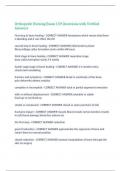
Orthopedic Nursing Exam 159 Questions with Verified Answers,100% CORRECT
Orthopedic Nursing Exam 159 Questions with Verified Answers First step in bone healing - CORRECT ANSWER hematoma which means that there is bleeding and it can effect the HH second step in bone healing - CORRECT ANSWER inflammatory phase fibrocartilage callus formation starts within 48 hours third stage in bone healing - CORRECT ANSWER reparative stage bony callus formation starts 3-4 weeks fourth stage stage of bone healing - CORRECT ANSWER 2-4 months extra structured remodeling fracture and symptoms - CORRECT ANSWER break in continuity of the bone pain deformity edema crepitus complete vs incomplete - CORRECT ANSWER total vs partial segment transection with vs without displacement - CORRECT ANSWER unstable vs stable lined up vs not lined up simple vs compound - CORRECT ANSWER closed vs open puncture of skin fractures impact - CORRECT ANSWER muscle blood vessels nerves tendons results in soft tissue damage blood loss edema etc the first step - CORRECT ANSWER reduction goal of reduction - CORRECT ANSWER approximate the segments of bone and return them to normal position closed reduction - CORRECT ANSWER manual manipulation of bone through the skin no surgery open reduction - CORRECT ANSWER surgical manipulation of bone second step - CORRECT ANSWER immobilization goal of immobilization - CORRECT ANSWER fixation of the reduced segments internal fixation - CORRECT ANSWER pins plates rod advantage faster ambulation disadvantage surgery required external fixation - CORRECT ANSWER casts splints external fixation devices advantage may not require surgery disadvantage casts may slow ambulation moment ion limb external fixation device requires surgery high risk of infection Principles of cast care - CORRECT ANSWER neurovascular checks elevate skins edges pad neurovascular checks - CORRECT ANSWER 5 Ps pulses pain pallor parastysia paralysis below where the cast is hands feet fingers toes capillary refill temperature elevate - CORRECT ANSWER reduce edema in the cast skin edges pad - CORRECT ANSWER handle with palms cool air to relieve itching no sharp objects traction - CORRECT ANSWER pulling to imobilize and align segments General nursing interventions for traction - CORRECT ANSWER maintain the pulling force and direction of traction maintain body alignment weights hang freely and do not touch floor nothing is obstructing rope no knot in pully do not wedge the patients feet or place against foot board because it will take away the tension when in traction - CORRECT ANSWER perform neuromuscular assessments frequently 5ps assess for common complications of immobility pressure ulcer DVTs PEs respirations bowel obstruction teach about purpose of traction skin traction - CORRECT ANSWER short term immobilize alignment muscle spasms helps with apply to skin splints straps wrap low weight 5-7lbs example bucks nursing care for skin - CORRECT ANSWER skin assessment protect pressure sites may remove weights if intermittent traction relieve muscle spasms always check orders skeletal traction - CORRECT ANSWER long term immobilizes apply to bone directly weights pins wire tongs more weight 25-35lbs infection risk nursing care for skeletal traction - CORRECT ANSWER never remove weights pin site care per policy frequent assessments report signs of infection Nursing care priorities with fractures - CORRECT ANSWER -hemorrhage -fluid replacement -neurovascular assessment -elevation -immobilization -pain control -monitor for infection complications of fractures - CORRECT ANSWER infection fat embolism compartment syndrome DVT infection osteomyelitis - CORRECT ANSWER ORIF more common symptoms high fever and chills pain and swelling redness warmth and possible drainage increased WBC osteomyelitis nursing care - CORRECT ANSWER strict hand hygiene aseptic practices antibiotic therapy fat embolism syndrome - CORRECT ANSWER release of fat from exposed marrow fat breaks into fatty acids attracts platelets occludes small vessels ischemia increased capillary permeability/rupture fluid shift signs symptoms fat embolism syndrome - CORRECT ANSWER respiratory distress hypoxia tachycardia decreased oxygen saturation tachypnea dyspnea fever possible fluid shift cerebral dysfunction LOC changes confusion restlessness petechiae skin chest supper arm nursing care of FES - CORRECT ANSWER prompt recognition of SS respiratory support set up oxygen pulse ox ABCs corticosteroids to decrease inflammatory response compartment syndrome cause - CORRECT ANSWER poor fitting casts edema hemorrhage edema increases pressure internal or external pressure on the compartment - CORRECT ANSWER entrapped nerves blood vessels muscles below fascia - CORRECT ANSWER hypoxia capillary dilation edema necrosis signs and symptoms of compartment syndrome - CORRECT ANSWER severe unrelenting pain never gets under control 5ps effected negatively notify physician immediately treatment of compartment syndrome - CORRECT ANSWER decompressive fasciotomy antibiotics wet sterile saline dressings pain management debreed necrotic tissue open 7-10 days deep vein thrombosis - CORRECT ANSWER decreased blood flow unilateral swelling and pain DVT cause - CORRECT ANSWER injury to vessel wall altered blod coagulation DVT diagnosis - CORRECT ANSWER doppler study DVT treatment - CORRECT ANSWER Immediately: -Unfractioned heparin -Enoxaparin -Dalteparin -Fondaparinux Then: -Warfarin for 3 months -Compression stockings for 1-2 years -IVC filters (possibly) hip fracture - CORRECT ANSWER proximal 1/3 of femur head neck trochanter intracapsular hip fracture - CORRECT ANSWER within joint intracapsular hip fracture requires - CORRECT ANSWER arthroplasty hip replacement extracapsular hip fracture - CORRECT ANSWER outside of join trochanter region extra capsular hip fracture treatment - CORRECT ANSWER ORIF nursing care hip fracture - CORRECT ANSWER no adduction maintain alignment to prevent dislocation no movement toward beyond midline abductor wedge pillow between legs turn toward unaffected side at least Q4 neurovascular checks 5Ps no flexion 90 raised toilet seat ambulate within 24 hours use walkers - CORRECT ANSWER discharge teaching - CORRECT ANSWER avoid: crossing legs bending at waist to reach sitting in low seats bed rest spinal fractures - CORRECT ANSWER ABCs airway stability cord decompression crutch field tongs spinal traction steroids At or above C8 - CORRECT ANSWER tetrapelegia At or below T1 - CORRECT ANSWER paraplegia C1-3 - CORRECT ANSWER death cardiorespiratory collapse C3-5 - CORRECT ANSWER death from respiratory paralysis spinal shock - CORRECT ANSWER cervical or high thoracic injuries cause massive vasodialation spinal cord response flaccid paralysis below injury parasympathetic take over bradycardia HYPOTENSION immediately after - 4-6 weeks Autonomic dysreflexia - CORRECT ANSWER SCIs at or above T6 Triggered by stimuli that cause abdominal discomfort urinary retention stimuli cant go up spinal cord pressure ulcers fecal impaction mass sympathetic What is orthopaedic surgery - CORRECT ANSWER any type of surgery involving musculoskeletal system Are orthopaedic surgeries high risk - CORRECT ANSWER yes, development of surgical site infection could lead to wound break down and surgical failure What is the role of the orthopaedic nurse - CORRECT ANSWER - assist vet - a lot to go wrong - high pressure for equip to work What can cause fractures - CORRECT ANSWER direct, indirect or disease What can the direction of the fracture line be - CORRECT ANSWER transverse, longitudinal, spiral or oblique What can the extent of the fracture damage - CORRECT ANSWER complete, incomplete, fissure What can the extent of the tissue damage be - CORRECT ANSWER open, closed, compound What can the number of fracture lines be - CORRECT ANSWER simple, comminuted, multiple or segmental What can position of bone fragments be - CORRECT ANSWER non displaced or overriding What is the feature of a spiral fracture - CORRECT ANSWER fracture line spirals around long axis of bone What is the feature of oblique fracture - CORRECT ANSWER fracture is diagonal to long axis of bone What is a feature of transverse fractures - CORRECT ANSWER fracture is at right angles to location of fracture line What is a feature of incomplete fractures - CORRECT ANSWER cortex is broken but periosteum remains intact on one side of bone What is a comminuted fracture - CORRECT ANSWER one fracture site but more than 2 fragments What is a segmental fracture - CORRECT ANSWER more than one fracture line on shaft of long bone What are the 4 stages of fracture healing - CORRECT ANSWER 1. haematoma formation 2. fibrocartilage callus formation 3. bony callus formation 4. bone remodelling What factors affect healing - CORRECT ANSWER - insufficient support - poor nutrition - poor perfusion - infection - pain - immobilisation/weight bearing What does ASIF mean - CORRECT ANSWER Association for the Study of Internal Fixation What is ASIF used for - CORRECT ANSWER internal fixation - instant stability provided - limb can heal and return to normal What is included in the ASIF kit - CORRECT ANSWER 1. drill bit 2. drill sleeve 3. countersink 4. depth gauge 5. tap 6. screw driver What is a glide hole - CORRECT ANSWER drilled using a drill bit that has same external diameter as screw being placed What is a pilot hole - CORRECT ANSWER drilled using a drill bit that has the same diameter as the core of the screw What is the drill sleeve - CORRECT ANSWER prevents drill bit from collecting debris from surround tissues What does the countersink do - CORRECT ANSWER cuts an indent that allows the head of the screw to be flush with surface of the bone What is the depth gauge used for - CORRECT ANSWER measure depth of a drilled hole and to determine length of screw that will be placed What is the tap used for - CORRECT ANSWER used to tap tread in a drilled hole before a screw placed What is the screw driver used for - CORRECT ANSWER place and tighten screws, hexagonal shape at end What are cortical screws - CORRECT ANSWER thread is small and close together What are cancellous screws - CORRECT ANSWER thread wider and further apart What are self tapping screws - CORRECT ANSWER flat sections by screw tip that cut their own thread as being placed What are non self tapping screws - CORRECT ANSWER rounded ends and require the use of a tap to cut thread before placed What is a partial threaded screw - CORRECT ANSWER thread only covers part of the screw shaft. Used to bring bone fragments together What is a fully threaded screw - CORRECT ANSWER thread covers the full length of screw shaft What are different types of plates - CORRECT ANSWER - sherman plate - venables plate - dynamic compression plate What are types of intramedullary pins - CORRECT ANSWER - steinmann pins - arthrodesis wire - kirschner wire - rush pin What are key principles of surgical fractures - CORRECT ANSWER - reduce fracture - align fragments - immobilise fragments - restore soft tissue function Osteoarthritis (OA) - CORRECT ANSWER degenerative joint disease; most common joint disorder. combination of carilage degradation, bone stifening, and inflammation of the synovium causes pain and functional impairment joints feel wrose the more they are used throughout the day. Modifiable Risk Factors of OA - CORRECT ANSWER obesity repeptitive use Non-Modifiable Risk Factors for OA - CORRECT ANSWER increased age female previous joint damage deformity genetic susceptibility Symptoms of OA - CORRECT ANSWER Deep, aching joint pain, occurring especially after exercise or weight-bearing; relieved with rest. Joint pain during cold weather Stiffness when arising in the morning Crepitus of the joint during motion Joint swelling Altered gait Limited range of motion Muscle weakness around arthritic joints. Over time, pain is present even when you are at rest Pain that is worse when you start activities after a period of no activity. Goals of Treatment of OA - CORRECT ANSWER increase the strength of the joints maintain or improve joint movement reduce the disabling effects of the disease relieve pain the treatment depends on which joints are involved Lifestyle Recommendations for OA - CORRECT ANSWER Exercise helps maintain joint and overall movement. Water exercises Applying heat and cold Eating a healthy, balanced diet Getting rest Losing weight if you are overweight Protecting the joints Diagnosis & Treatment of OA - CORRECT ANSWER a physical exam may show: -joint swelling (bones around the joints may feel larger than normal) -limited ROM -tenderness when the joint is pressed -normal movement is often painful. *no blood test are helpful in diagnosing OA *an x-ray of affected joints will show a loss of join space. *in advanced cases, there will be a wearing down of the ends of the bone and bone spurs.. Medications for OA - CORRECT ANSWER OTC pain relievers: Tylenol NSAIDS: asprin, ibuprofen, and naproxen Celebrex (a COX-2 inhibitor) may work as well as other NSAIDs Corticosterioids injected right into the joint- relief lasts only a short time. Supplements: glucosamine and chondroitin sulfate Capsaicin (Zostrix): skin cream may help relieve pain; relief usually begins within 1-2 weeks. Artificial joint fluid can be injected into knee. May relieve pain for 3-6 months. Prognosis: Prevention of OA - CORRECT ANSWER weight loss can reduce the risk of knee OA in overweight women. Osteoporosis - CORRECT ANSWER A condition in which the body's bones become weak and break easily. "porous bone" risks for osteoporosis - CORRECT ANSWER age, gender, genetics, nutrition, and physical activity women are at increase risk due to small bone structure, low levels os testosterone and low estrogen after menopause. symptoms of osteoporosis - CORRECT ANSWER no symptoms in the early stages later symptoms include: -bone pain or tenderness -fractures with little or no trauma; one of the most common causes of hip fracture. -loss of height over time -low back pain due to fracture of the spinal bones -neck pain due to fractures of the cervical bones. -stooped posture Medical Treatment for Osteoporosis - CORRECT ANSWER control pain from the disease slow down or stop bone loss prevent bone fractures with medications that strengthen bone minimize the risk of fall that might cause fractures Medications for Osteoporosis - CORRECT ANSWER Biphosponates: (Fusomax) slows bone loss. Calcitonin: prevents the breakdown of bone; helps pull calcium from the blood and into the bone. Hormone Replacement Therapy: helps calcium absorption (rarely used today) women after menopause. risk of estrogen based breast cancer. Parathyroid Hormone: causes the body to absorb more calcium. only used in severe cases where there is a lot of fractures and other medications are not working. prevention of osteoporosis - CORRECT ANSWER -calcium & viatmin D3 supplements (vitamin D is needed to absorb calcium) -healthy, well balanced diet -avoid drinking excess alcohol -don't smoke -get regular weight bearing exercise Nursing Interventions for patients osteoporosis/back pain - CORRECT ANSWER -pain management -exercise to improve physical mobility -work modifications; body mechanics -stress reduction -dietary plan and encouragement of weight reduction. Joint Replacement Surgeries - CORRECT ANSWER Total Hip Replacement (THR) Total Knee Replacement (TKR) both are ORIF surgeries. Open Reduction Internal Fixation (ORIF) - CORRECT ANSWER correction and alignment of a fracture through surgery and exposure of the fractur then applying either metal screws, nails, plates, wires, or pins. some fractures require the use of multiple types of hardware. Total Joint Replacement (TJR) - CORRECT ANSWER knee or hip. include the replacement of both articular surfaces within a joint or with a metal or synthetic material. Auto Transfuser - CORRECT ANSWER a drain that is used with excessive blood loss. as is drains it pulls fluid out and filters out the RBCs and delivers a tranfusion to the patient. patient is able to get their own blood transfused back into them. mostly in hip replacements, or knee replacement. Post-Op care: Knee Replacement - CORRECT ANSWER Assessment: standard post op in addition to.... -assess pain -assess extremity for edema, pulses, color, cap refill, and temp of toes. -assess surgical site, dressing, and drain -assess for indicators of DVT -assess for infection *be sure to pay special attention to the extremity that was not operated on. Evaluation to reduce edema. Assist with ambulation as soon as ordered by MD Continuous Passive Motion Machine Cryotherapy Continuous Passive Motion (CPM) - CORRECT ANSWER educate patient of the importance. used to increase circulation and ROM of the knee joint. works on the principle of flexion and extension. helps to gradually increase flexibilty. it is removed at short periods of time to encourage patient movement for PT and rest. Cryotherapy - CORRECT ANSWER therapeutic use of cold. encourage the use of ice to minimize pain and swelling in conjuction with CPM. Hip Repair - CORRECT ANSWER can only have toe touching weight bearing post-op. no other precautions. can walk, and use walker. total hip replacement - CORRECT ANSWER two types. anterior approach surgery posterior appraoch surgery Anterior Approach Surgery - CORRECT ANSWER no special precautions post-op, smaller incision toward front of thigh. don't have to cut tendons so there is less complications. Posterior Approach Surgery - CORRECT ANSWER large incision on the side of hip, more invasive *prevent hip flexion of 90 degrees or more at all times do not sit straight up, use a raised toilet seat, sit back at an angle when sitting down. *CANNOT ADDUCT the legs together; abductor pillow will be used *prevent internal rotaton if patient c/o increased pain w/ inward rotation of foot and sortening of leg, NOTFIY MD STAT Hip Fracture: Post-Op Care - CORRECT ANSWER -standard post op care -prevent dislocation (posterior approach) -prevent infection wound & respriatory -prevent DVT -pain control Buck's Traction - CORRECT ANSWER external; applied to skin used in temporary management of fractures of: -femoral neck, femoral shaft in older children -undisplaced fractures of the the acetabulum -after reduction of a hip dislocation can use tape or pre-made boot. do not use more than 10 lbs used temporarily until surgery can be done/short term intervention. Skeletal Traction - CORRECT ANSWER traction apparatus is applied directly to the bone with pins. Purpose of traction: - CORRECT ANSWER reduce muscle spasms; decreases pain reduce, align, and immobilize fractures reduce deformity increase space between opposing forces Principles of Effective Traction - CORRECT ANSWER traction must be continuous to reduce and immobile fractures skeletal traction is NEVER interrupted weights are not removed unless intermitten traction is prescribed ropes must be unobstructed and weights must hang freely knots or the footplate must NOT touch the foot of the bed. (MUST KNOW FOR TEST) Nursing Care of the Patient in Traction - CORRECT ANSWER Properly apply and maintain traction; meticulous nursing care needed. Monitor for complications of skin breakdown, nerve pressure, respiratory problems and circulatory impairment (hazards of immobility) -assess for pain -inspect the skin at least 3 x a day; frequent skin care -palpate skin around traction pins to assess for tenderness q8h; pin care. -assess neurovascular integrity (CMS)- circulation, movement, & sensation. -assess circulation by checking pulses, color, cap refil, and temp of toes. ask pt to move their toes, and theck if they have normale sensation in the toes. -assess for indicators of DVT; SCD's for prevention -assess for indcators of infection -continue ROM on unaffected limbs; monitor for development of contractures r/t lack of activity -trapeze to help with mobility -coping: knowledge. Associated Problems with Fractures - CORRECT ANSWER -pain -loss of function -deformity -shortening of the extremity -crepitus -local swelling and discoloration -diagnosis by x-ray Nursing interventions for Fractures - CORRECT ANSWER -assess injury and soft tissue -calm and reassure the child and parent -assess for pain and point of tenderness, sensation, motion, and pulses. Complete Fracture - CORRECT ANSWER a break that extends through the entire thickness of the bone Incomplete Fracture - CORRECT ANSWER bone is not broken all the way through Simple fracture - CORRECT ANSWER an uncomplicated fracture in which the broken bones to not pierce the skin Compound Fracture - CORRECT ANSWER break in the bone where the bone comes through the skin; open fracture Emergency Management of Fractures - CORRECT ANSWER -Immobilize the body part Splinting: joints distal and proximal to the suspected fracture site must be supported and immobilized -Assess neurovascular status before and after splinting -Open fracture: cover with sterile dressing to prevent contamination -Do not attempt to reduce the fracture Complications of Fractures - CORRECT ANSWER Shock Fat embolism Compartment syndrome Delayed union and nonunion Avascular necrosis Reaction to internal fixaction devices Complex regional pain syndrome (CRPS) Heterotrophic ossification Factors that affect fracture healing - CORRECT ANSWER blood supply, nutrtion, excess movement. Fat Embolism - CORRECT ANSWER bone marrow fat escapes into the bloodstream. S&S: hypoxia, decreased oxygen saturation level, tachypnea, tachycardia, cyanosis, and mental status changes. Compartment Syndrome - CORRECT ANSWER swelling in a muscle, causes extreme pain d/t inability the compatment to expain r/t stiffness of fascia; causes decreased blood flow and results in tissue damage. Avascular Necrosis - CORRECT ANSWER death of bone tissue d/t lack of blood supply Complex Regional Pain Syndrome (CRPS) - CORRECT ANSWER chronic pain of a limb hetertrophic ossification - CORRECT ANSWER bone formation in soft tissue. Medical Management - CORRECT ANSWER Reduction: -closed -open Immobilization: internal or external fixation. open fractures require treatment to prevent infection -tetanus, antibiotics, cleaning and debridement of wound -closure of the primary wound may be delayed to permit edema, wound drainage, further assessment and debridement if needed. External Fixation Device - CORRECT ANSWER used to manage open fractures with soft-tissue damage provide support for complicated or comminuted fractures reassure patient concerned by appearance of device discomfort is usually minimal, and early mobility is possible with these devices. Interventions for Fractures - CORRECT ANSWER elevate to reduce edema monitor for S&S of complications, including infection. provide pin care patient teaching Cast - CORRECT ANSWER external immobilizing device uses: -immobilize a reduced fracture -correct a deformity -apply uniform pressure to soft tissues -provide support to stabilize a joint materials: -firberglass, plaster (rarely used now) Teaching Needs of the Patient with a Cast: Prior to Cast Application - CORRECT ANSWER -explain need for the cast and the process for applying the cast -for plaster casts eplain that it will take 24-72 hours for to dry completely and until then it must be kept off of hard surfaces -explain purpose and goals of the cast -describe expectations during the casting process: ie the heat from hardening plaster (if used) Teaching Needs of the Patient With a Cast - CORRECT ANSWER cast care: keep clean and dry; do not cover with plastic positioning: keep the cast & extremity elevated, use slings if needed -hygiene -activity and mobility -explain exercises -do not scratch or stick anything under the cast: call MD for medication if needed. -cushion rough edges -require follow-up care -cast removal *report the following S&S: -persistent pain or swelling -changes in sensation, movement, skin color, or temp. -signs of infection or pressure areas CMS - CORRECT ANSWER circulation movement stimulation/sensation Assess the 5 P's of Neurovascular Assessment - CORRECT ANSWER pain: should be decreasing -on palpation, and on movement pallor: pale skin or poor cap refill paresthesia: pins and needles sensation pulses: diminished or absent paralysis: should be able to wiggle toes/fingers Assist with Ambulation - CORRECT ANSWER canes: held on strong side of body. cane moves, then weak leg, then strong leg. crutches: weight bearing is no an axillae, it is on the hands should not lean forward. walker: provides greatest support and stability. Relieve pain - CORRECT ANSWER elevate to reduce edema apply ice or cold intermittently, administer analgesics isometric exercise to maintain strength & prevent atrophy heal skin wounds and maintain skin integrity; treat wounds to skin before the cast is applied. Amputation - CORRECT ANSWER the surgical or traumatic removal of a body part. used to relieve symptoms, improve function, or save the persons life. usually as a result of advanced PVD r/t DM, fulminating gas gangrene, crushing injuries, electrical burns, frostbite, congenital deformities, chronic osteomylitis, or malignant tumor. level is determine by ciruclation of the limb and functional usefulness. Assessment of Amputation - CORRECT ANSWER neurovascular status and function of affected extremity or residual limb and the unaffected extremity. -signs and symptoms of infection -nutritional status -concurrent health problems diabetes, smoker? -psychological status of coping Nursing Interventions for Amuptations: Pain - CORRECT ANSWER -administer analgesic or other medications as prescribed -changing postion -putting a light sand bag on residual limb -alternative methods of pain relief- distraction, tens unit, meditation. -NOTE: pain may be an expression of grief and latered body image. Amputations: Promoting wound healing/Pre-prosthetic care - CORRECT ANSWER -handle limb gently -residual limb shaping -proper bandaging: wrap w/ ace from distal to proximal toward the heart to improve venous return and decrease edema. -massage -toughening of the residual limb. Amputations: Complications - CORRECT ANSWER -hemorrhage: r/t surgical severing of major blood vessels -infections -skin breakdown -phantom limb pain: r/t disruption of peripheral nerve endings in the limb. -flexion contracture of the hip: r/t positioning and protective flexion withdrawal pattern associated with pain (encourage turning and position prone.) Resolving Grief and Enhancing Body Image - CORRECT ANSWER encourage communication and expression of feelings create an accepting, supportive atmosphere provide support and listen encourage patient to look at, feel, and care for the resdiual limb help patient set realistic goals help patient resume self-care and independence referral to counselors and support groups Amputations: Rehabilitation - CORRECT ANSWER psychological support prostheses fitting and use physical therapy vocational/occupational training and counseling use a multidisciplinary team approach patient teaching.
Document information
- Uploaded on
- April 1, 2024
- Number of pages
- 23
- Written in
- 2023/2024
- Type
- Exam (elaborations)
- Contains
- Questions & answers


