HDEV Final Exam Questions With 100% Correct Answers
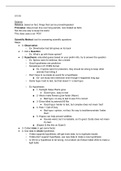
HDEV Final Exam Questions With 100% Correct Answers psychosocial development - Erikson's theory, which emphasizes the importance of social relationships and conscious choice throughout eight stages of development. life crisis an internal conflict that attends each stage of psychosocial development. identity crisis according to Erikson,a period of inner conflict during which one examines one's values and makes decisions about one's life roles. Erikson's 8 stages 1. trust vs mistrust 2. autonomy vs shame and doubt 3. initiative vs guilt 4. industry vs inferiority 5. identity vs role confusion 6. intimacy vs isolation 7. generativity vs stagnation 8. integrity vs despair Erik Erikson's stages of psychosocial development - stage theory of psychosocial development, lifespan consists of eight dilemmas that must be solved correctly in order to solve the next dilemma -each stage builds on tasks of the previous stage, successful mastery leads to a sense of self Erikson's theory focuses on the development of emotional life and psychological traits, he focused on social relationships hence psychosocial development - Erikson places great emphasis on the ego, or the sense of self. - Erikson has stages to include the concerns of adulthood and labeled them after the life crisis that people might encounter during that stage. - Erikson proposed that social relationships and physical maturation give each stage its character. Trust vs. Mistrust - (birth-12 months of age) -infants must learn that adults can be trusted and occurs when adults meet a child’s basic needs for survival. - Infants are dependent upon their caregivers, so caregivers who are responsive and sensitive to their infant’s needs help their baby to develop a sense of trust; their baby will see the world as a safe, predictable place. - Unresponsive caregivers who do not meet their baby’s needs can engender feelings of anxiety, fear, and mistrust; their baby may see the world as unpredictable. - If infants are treated cruelly or their needs are not met appropriately, they will likely grow up with a sense of mistrust for people in the world. Autonomy vs. Shame and Doubt - (ages 1–3 years) - As tots begin to explore their world, they learn that they can control their actions and act on their environment to get results. - toddlers learn to exercise will and to do things independently - This is the “me do it” stage. For example, - we might observe a budding sense of autonomy in a 2-year-old child who wants to choose her clothes and dress herself. Although her outfits might not be appropriate for the situation, her input in such basic decisions has an effect on her sense of independence. - If denied the opportunity to act on her environment, she may begin to doubt her abilities, which could lead to low self-esteem and feelings of shame. Initiative vs. Guilt (age 3-6 years) -Ability to carry out a plan - capable of initiating activities and asserting control over their world through social interactions and play. - preschool children must resolve the task of i_________By learning to plan and achieve goals while interacting with others, preschool children can master this task. Initiative: a sense of ambition and responsibility, occurs when parents allow a child to explore within limits and then support the child’s choice. These children will develop self-confidence and feel a sense of purpose. - Those who are unsuccessful at this stage—with their initiative misfiring or stifled by over-controlling parents—may develop feelings of guilt. industry vs inferiority stage (6 to 12 age) characterized by a focus on efforts to attain competence in meeting the challenges presented by parents, peers, school, and the other complexities of the modern world - Children begin to compare themselves with their peers to see how they measure up. - They either develop a sense of pride and accomplishment in their schoolwork, sports, social activities, and family life, or they feel inferior and inadequate because they feel that they don't measure up. - If children do not learn to get along with others or have negative experiences at home or with peers, an inferiority complex might develop into adolescence and adulthood. identity vs. role confusion (ages 12-18), -Resolved in adolescence -Ability to form a stable identity - stage during which teenagers and young adults search for and become their true selves - During this stage, adolescents attempt to determine whom they are in the present while also imagining possible futures for themselves. - an adolescent's main task is developing a sense of self and attempt to determine whom they are in the present while also imagining possible futures for themselves. - Adolescents struggle with questions such as "Who am I?" and "What do I want to do with my life?" Along the way, most adolescents try on many different selves to see which ones fit; they explore various roles and ideas, set goals, and attempt to discover their "adult" selves. - Adolescents who are successful at this stage have a strong sense of identity and are able to remain true to their beliefs and values in the face of problems and other people's perspectives. - When adolescents are apathetic, do not make a conscious search for identity, or are pressured to conform to their parents' ideas for the future, they may develop a weak sense of self and experience role confusion. They will be unsure of their identity and confused about the future. - Teens who struggle to adopt a positive role will likely struggle to "find" themselves as adults. Intimacy vs. Isolation (20s through early 40s) - individuals form deeply personal relationships, m
École, étude et sujet
- Établissement
- HDEV
- Cours
- HDEV
Infos sur le Document
- Publié le
- 31 mars 2024
- Nombre de pages
- 33
- Écrit en
- 2023/2024
- Type
- Examen
- Contenu
- Questions et réponses
Sujets
-
hdev final exam questions with 100 correct answer