
5THE WATER CYCLE AND WATER INSECURITY
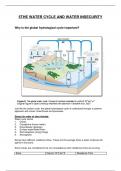
Why is the global hydrological cycle important?
Just like the carbon cycle, the global hydrological cycle is understood through a systems
approach with stores, flows/fluxes and processes.
Stores (in order of size) include:
Water cycle stores
1. Ocean
2. Cryosphere (frozen water)
3. Groundwater (geology)
4. Surface water/lakes/rivers
5. Soil/ biosphere (living things)
6. Atmosphere
Stores have different residence times. These are the average times a water molecule will
spend in that store.
Some stores are considered to be non-renewable as their residence times are so long.
Store Volume 10^3 km^3 Residence Time
, Ocean 3600 years
Ice Caps 15 000 years
Groundwater Up to 10 000 years
Rivers and Lakes 2 weeks to 10 years
Soil moisture 2-50 years
Atmosphere 10 days
Annual fluxes include:
The largest fluxes are evaporation and precipitation, each account for 486 thousand km3 per
year
Vapour transport and water returning to the ocean, each account for 40 thousand km3 per
year.
Water is cycled between stores driven by key processes.
Solar energy: causes water to evaporate and transpire from both sea and land, which then
returns as precipitation.
Gravitational potential energy: the movement of water under the influence of gravity,
therefore transporting it to rivers and eventually the sea.
Stores have different residence times. These are average times a water molecule will
spend in that store. For instance, this is only 10 days for atmospheric water.
Some stores are considered to be non-renewable as their residence times are so long -
these include ice caps and fossil groundwater.
Store Volume 103 km3 Residence time
Soil moisture 122 2-50 weeks
Atmospheric moisture 13 10 days
Groundwater 15300 Up to 10,000 years
River and lakes 178 2 weeks to 10 years
Ice caps 26350 15000 years
Ocean 1335040 3600 years
Global Water Budget:
Oceans lose more water through evaporation than they gain through precipitation, whereas
the opposite is true for landmasses. Surface runoff makes up the difference; this is known as
the global water budget.
Where is Earth’s water?
• Only 2.5% of earth water is fresh water
• Only 1.2% of all fresh water is surface water which serves most of life’s needs
The total amount of water in the world does not change therefore the global hydrological
cycle is a closed system where inputs and outputs are balanced. No inputs occur from the
outside the system and nothing is lost.
,Why is the drainage basin hydrological cycle important?
A Drainage basin is the area of land drained by a river and its tributaries.
Interception – temporary storage of water captured by plants and buildings
Infiltration – the movement of water from the ground surface into the soil
Direct or surface runoff - water "running off" the land surface during an intense storm, or
when the ground is frozen, saturated or impermeable
Saturated overland flow – the upward movement of the water table into the evaporation
zone
Throughflow – the lateral transfer of water downslope through the soil
Percolation – the transfer of water from the soil into the rock beneath
The drainage basin hydrological cycle is an open system because it has inputs and outputs
entering and leaving the system. Therefore, the amount of water in a drainage basin varies
over time.
, Map of precipitation patterns:
Mean annual precipitation 1961 -1990 shows significant global variation. Regions with very
low average mean annual precipitation include the Middle East, Sahel, central Australia and
west USA. However, the regions with above average mean annual precipitation are South-
east Asia, most of South America, Central Africa and Northern Europe.
Rainfall
Different types of precipitation
Orographic (or relief) precipitation
• Warm moist air is forced to rise over high altitude areas.
• The rising air cools and water vapour condenses to form clouds and precipitation.
• On the other side of the mountain air descends and warms forming a rain shadow
(dry area).
Frontal precipitation
• Front – is a boundary between warm, moist air and cold, dense air. (2 air masses)
• At a warm front, warm air is forced to rise over cold air, hence water vapour
condenses forming clouds and precipitation
• Warm front – leading edge of the warm air mass
• At a cold front, cold, dense air pushes underneath warm air causing these processes
to repeat
• Cold front – leading edge of the cold air mass
Convectional precipitation
• Air is forced to rise because it is heated by the earth’s surface and convects (moves
due to heat)
• As the air rises it cools and expands, and water vapour condenses forming clouds
and precipitation. Water vapour therefore condenses to from water droplets, ice
crystals and clouds.
What factors affect the drainage basin hydrological cycle?
Why is the global hydrological cycle important?
Just like the carbon cycle, the global hydrological cycle is understood through a systems
approach with stores, flows/fluxes and processes.
Stores (in order of size) include:
Water cycle stores
1. Ocean
2. Cryosphere (frozen water)
3. Groundwater (geology)
4. Surface water/lakes/rivers
5. Soil/ biosphere (living things)
6. Atmosphere
Stores have different residence times. These are the average times a water molecule will
spend in that store.
Some stores are considered to be non-renewable as their residence times are so long.
Store Volume 10^3 km^3 Residence Time
, Ocean 3600 years
Ice Caps 15 000 years
Groundwater Up to 10 000 years
Rivers and Lakes 2 weeks to 10 years
Soil moisture 2-50 years
Atmosphere 10 days
Annual fluxes include:
The largest fluxes are evaporation and precipitation, each account for 486 thousand km3 per
year
Vapour transport and water returning to the ocean, each account for 40 thousand km3 per
year.
Water is cycled between stores driven by key processes.
Solar energy: causes water to evaporate and transpire from both sea and land, which then
returns as precipitation.
Gravitational potential energy: the movement of water under the influence of gravity,
therefore transporting it to rivers and eventually the sea.
Stores have different residence times. These are average times a water molecule will
spend in that store. For instance, this is only 10 days for atmospheric water.
Some stores are considered to be non-renewable as their residence times are so long -
these include ice caps and fossil groundwater.
Store Volume 103 km3 Residence time
Soil moisture 122 2-50 weeks
Atmospheric moisture 13 10 days
Groundwater 15300 Up to 10,000 years
River and lakes 178 2 weeks to 10 years
Ice caps 26350 15000 years
Ocean 1335040 3600 years
Global Water Budget:
Oceans lose more water through evaporation than they gain through precipitation, whereas
the opposite is true for landmasses. Surface runoff makes up the difference; this is known as
the global water budget.
Where is Earth’s water?
• Only 2.5% of earth water is fresh water
• Only 1.2% of all fresh water is surface water which serves most of life’s needs
The total amount of water in the world does not change therefore the global hydrological
cycle is a closed system where inputs and outputs are balanced. No inputs occur from the
outside the system and nothing is lost.
,Why is the drainage basin hydrological cycle important?
A Drainage basin is the area of land drained by a river and its tributaries.
Interception – temporary storage of water captured by plants and buildings
Infiltration – the movement of water from the ground surface into the soil
Direct or surface runoff - water "running off" the land surface during an intense storm, or
when the ground is frozen, saturated or impermeable
Saturated overland flow – the upward movement of the water table into the evaporation
zone
Throughflow – the lateral transfer of water downslope through the soil
Percolation – the transfer of water from the soil into the rock beneath
The drainage basin hydrological cycle is an open system because it has inputs and outputs
entering and leaving the system. Therefore, the amount of water in a drainage basin varies
over time.
, Map of precipitation patterns:
Mean annual precipitation 1961 -1990 shows significant global variation. Regions with very
low average mean annual precipitation include the Middle East, Sahel, central Australia and
west USA. However, the regions with above average mean annual precipitation are South-
east Asia, most of South America, Central Africa and Northern Europe.
Rainfall
Different types of precipitation
Orographic (or relief) precipitation
• Warm moist air is forced to rise over high altitude areas.
• The rising air cools and water vapour condenses to form clouds and precipitation.
• On the other side of the mountain air descends and warms forming a rain shadow
(dry area).
Frontal precipitation
• Front – is a boundary between warm, moist air and cold, dense air. (2 air masses)
• At a warm front, warm air is forced to rise over cold air, hence water vapour
condenses forming clouds and precipitation
• Warm front – leading edge of the warm air mass
• At a cold front, cold, dense air pushes underneath warm air causing these processes
to repeat
• Cold front – leading edge of the cold air mass
Convectional precipitation
• Air is forced to rise because it is heated by the earth’s surface and convects (moves
due to heat)
• As the air rises it cools and expands, and water vapour condenses forming clouds
and precipitation. Water vapour therefore condenses to from water droplets, ice
crystals and clouds.
What factors affect the drainage basin hydrological cycle?


