
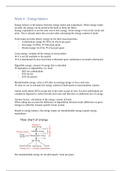
Week 4 – Energy balance
Energy balance is the balance between energy intake and expenditure. When energy intake
exceeds, the energy can be stored in the body as body fat (fuel).
Energy expenditure is not the only way to lose energy. Some energy is lost in the stools and
urine. This is already taken into account when calculating the energy content of foods.
Food intake provides dietary energy by the three macronutrients:
- Carbohydrate (range 30-70%) 4 Kcal per gram
- Fat (range 15-50%) 9 Kcal per gram
- Protein (range 10-25%) 4 Kcal per gram
Gross energy: includes all the energy in food product
It is not all available to the animal
It is determined by how much heat is liberated upon combustion (via bomb calorimeter)
Digestible energy: amount of energy that is absorbed
dependent on digestibility of a food:
- 98% for carbohydrate
- 95% for fat
- 92% for protein
Metabolizable energy: what is left after accounting energy in feces and urine
what we use to calculate the energy content of food based on macronutrient content.
Amino acids (about 20%) can get lost in the urine as part of urea. Fat and carbohydrate are
completely digested to carbon dioxide and water and therefore no additional loss of energy.
Atwater factors: calculation of the energy content of foods.
When taking into account the difference in digestibility between foods (difference in gross
energy) is called the Atwater specific factor system.
People in energy balance, the energy intake (as metabolizable energy) equals energy
expenditure.
The metabolizable energy for alcohol equals 7 kcal per gram.
, USA makes a distinction between soluble and insoluble fiber for calorie calculation. Insoluble
fibers are not fermented and does not contribute to energy 0 kcal/g
Soluble fibers are fully fermented and thus are the same as carbohydrates 4 kcal/g
Most countries, including EU, there is no distinction energy value assigned to fiber is 2
kcal/g
Metabolizable energy is the energy left after losses in feces and urine, so is available for
combustion. A part of this energy is lost as heat, and the remainder is converted to ATP.
This ATP (net energy) can be used for various tasks in body, e.g. muscle contraction and
nerve transmission.
Net energy physical activity, maintenance, growth
Daily energy expenditure:
- Male: 2500 Kcal
- Female: 2000 Kcal
These values can be higher or lower, depending on body size, illness and physical activity.
Maintenance:
Those processes that are essential for survival of an individual. Examples are heart beat, brain
function, respiration etc.
It also includes:
Basal Metabolic Rate (BMR): energy required for basal maintenance in fasted state (60-70%)
Dietary induced thermogenesis: obligatory energy costs of digestion and absorption (about
10% of the caloric value of a meal)
The magnitude of BMR differs per person and depends on lean body mass. Tall people with
lots of muscle, have a high BMR. Short people with little muscle have a low BMR.
Basal Metabolic Rate: energy required for basal maintenance in fasted state
- Energy expenditure in fasted state
- Measured at a comfortable temperature
- Awake but completely at rest
Physical activity most variable component of energy expenditure.
Physical Activity Level (PAL): total energy expenditure divided by the BMR.
Very active people have PAL > 2.0
Extremely inactive have PAL < 1.4
Most are around 1.6-1.7
Physical activity ratio (PAR): the intensity of the exercise, which is expressed as a multiple of
basal metabolic rate.
Energy expenditure estimates of exercises is obtained using a method called: calorimetry.
Indirect calorimetry uses measurement of the rate of oxygen consumption (and sometimes
CO2) to determine the rate of energy expenditure.
The oxygen consumption is determined by:
- Oxygen concentration in the expired air
- Volume of air expired per minute (liters/minute)
Energy balance is the balance between energy intake and expenditure. When energy intake
exceeds, the energy can be stored in the body as body fat (fuel).
Energy expenditure is not the only way to lose energy. Some energy is lost in the stools and
urine. This is already taken into account when calculating the energy content of foods.
Food intake provides dietary energy by the three macronutrients:
- Carbohydrate (range 30-70%) 4 Kcal per gram
- Fat (range 15-50%) 9 Kcal per gram
- Protein (range 10-25%) 4 Kcal per gram
Gross energy: includes all the energy in food product
It is not all available to the animal
It is determined by how much heat is liberated upon combustion (via bomb calorimeter)
Digestible energy: amount of energy that is absorbed
dependent on digestibility of a food:
- 98% for carbohydrate
- 95% for fat
- 92% for protein
Metabolizable energy: what is left after accounting energy in feces and urine
what we use to calculate the energy content of food based on macronutrient content.
Amino acids (about 20%) can get lost in the urine as part of urea. Fat and carbohydrate are
completely digested to carbon dioxide and water and therefore no additional loss of energy.
Atwater factors: calculation of the energy content of foods.
When taking into account the difference in digestibility between foods (difference in gross
energy) is called the Atwater specific factor system.
People in energy balance, the energy intake (as metabolizable energy) equals energy
expenditure.
The metabolizable energy for alcohol equals 7 kcal per gram.
, USA makes a distinction between soluble and insoluble fiber for calorie calculation. Insoluble
fibers are not fermented and does not contribute to energy 0 kcal/g
Soluble fibers are fully fermented and thus are the same as carbohydrates 4 kcal/g
Most countries, including EU, there is no distinction energy value assigned to fiber is 2
kcal/g
Metabolizable energy is the energy left after losses in feces and urine, so is available for
combustion. A part of this energy is lost as heat, and the remainder is converted to ATP.
This ATP (net energy) can be used for various tasks in body, e.g. muscle contraction and
nerve transmission.
Net energy physical activity, maintenance, growth
Daily energy expenditure:
- Male: 2500 Kcal
- Female: 2000 Kcal
These values can be higher or lower, depending on body size, illness and physical activity.
Maintenance:
Those processes that are essential for survival of an individual. Examples are heart beat, brain
function, respiration etc.
It also includes:
Basal Metabolic Rate (BMR): energy required for basal maintenance in fasted state (60-70%)
Dietary induced thermogenesis: obligatory energy costs of digestion and absorption (about
10% of the caloric value of a meal)
The magnitude of BMR differs per person and depends on lean body mass. Tall people with
lots of muscle, have a high BMR. Short people with little muscle have a low BMR.
Basal Metabolic Rate: energy required for basal maintenance in fasted state
- Energy expenditure in fasted state
- Measured at a comfortable temperature
- Awake but completely at rest
Physical activity most variable component of energy expenditure.
Physical Activity Level (PAL): total energy expenditure divided by the BMR.
Very active people have PAL > 2.0
Extremely inactive have PAL < 1.4
Most are around 1.6-1.7
Physical activity ratio (PAR): the intensity of the exercise, which is expressed as a multiple of
basal metabolic rate.
Energy expenditure estimates of exercises is obtained using a method called: calorimetry.
Indirect calorimetry uses measurement of the rate of oxygen consumption (and sometimes
CO2) to determine the rate of energy expenditure.
The oxygen consumption is determined by:
- Oxygen concentration in the expired air
- Volume of air expired per minute (liters/minute)


