STSC Final Review Exam with verified solutions 2024
Standpoint Epistemology "What is true depends on where you are standing" An individual's own perspectives are shaped by their social and political experiences. Developed from feminist theory that women's perspective must be kept in mind. All of the science-making process involved perspectives of men -- female absence from knowledge systems Military Industrial Complex The relationship between the government entities involved in military affairs and the defense industry. Private industry fueling military. This is seen as a threat to science, as in a military industrial complex, the government contracts science institutions to further military research. "Pure" science is clouded by military science. Power of money to influence science OSRD in WWII Comes from Eisenhower farewell speech in 1961 Black Boxing When examining a concept or an event, a failure to look at a certain aspect of the event and instead accepting it as a passive tenet. EX: fire storm - calculating effects of atomic bomb without accounting for the fires. U.S. used cities to determine scope of its Cold War nuclear arsenal, but left out calculation of burn damage EX: examining only the survivors EX: Manhattan Project Hegemonic Power Power given to a dominant nation (hegemon) that influences social, political, and economic conditions of other countries. "Internalized norms" EX: Americans are "ok" with drone strike bc of US hegemonic power Gender norms EX: The US (along w USSR) was a hegemonic power after WWII. The US used its hegemonic power to use military industrialized complex to influence other countries Internalization of existing power norms performed by that power's subjects Teleology A purpose that a particular object is created for. A bomb is created to destroy Philosophical study of nature that describes things based on their apparent purpose Technical Distancing Measuring physical distance from bomb target from warplane "Making decisions from above" Industrialized logic of strategic airfare (WWII) Distance network of culpability from effect on victims For example, line of thought like "I didn't make the bomb or choose to use it - I just flew the plane that dropped it" Drones Fascism An ideology that a totalitarian one-party state (usually under a dictator) is necessary to prepare a nation for armed conflict and to respond effectively to economic difficulties. Tenets: nationalism, disdain for human rights, military-focus, control of mass media, intellectualism seen as a threat, misogyny, racism Examples: Italy and Germany during WWII. Fascism deteriorated when the Allies won during WWII Garrison State A proposed future state where those who specialize in violence are the most powerful members of society. In this case, rise of the power of scientists who are involved in military science. 1941, sociologist Harold Lasswell: specialists in violence are most powerful group in society Consumption Junction Illuminates power relationships between the "consumer" and technology In relation to the atomic bomb, the consumption junction refers to the method of looking at those affected by the atomic bomb (its consumers) Starts analysis with users of technological systems and draws network from there out Sociotechnical System Developed by Gribeauval in the 1700s System that recognizes the relationship between the human and technology Material and human consensus agreement Examples: Guns standardized and simplified Carts were improved to handle rough terrains Horses aligned side by side Technological Momentum Technology is not infinitely malleable. As a technology comes to light, society is able to control the technology. However, as the technological development rapidly expands, there is a certain point where the technology becomes enmeshed into society and no longer is responsive to outside pressures. Some people believe in social determinism, some tech determinism.....tech momentum is a combination of the two Thomas Hughes Systems gain momentum as they are implemented and succeed in their "goal-orientation." Technological momentum refers to the general property of systems that reach and maintain some "lock-in" that produces predictable interaction. Large systems, he suggests, eventually resist change. Technological Choice There is a role for users in the advancement of technology Focus on the consumers of technology Example: gun technology took different forms in different places. Used in Africa as currency to buy slaves, used by Native Americans to ambush (Malone reading) Compartmentalization A defense mechanism that was experienced by scientists as response to the dropping of the atomic bomb to deal with possible guilt "I dropped the bomb but I did not choose the target" Placing blame on others unconscious psychological defense mechanism used to avoid cognitive dissonance, or the mental discomfort and anxiety caused by a person's having conflicting values, cognitions, emotions, beliefs, etc. within Each person should be given only that data about the project that was needed in order for them to do the job that was assigned. The number of people who had any overall knowledge of what was being done was severely restricted The American Century 20th century America as the global superpower (in front of USSR) Characterized by: Economic power Political power Focus on capitalism "Americanization" Military power Strong Navy Started with Spanish-American War and ended with 9/11 Non-state, cyber, and terrorist actors make absolute security impossible Neoliberalism Post WWII renewal of laissez faire-type economic liberalism Response to New Deal and creation of a "welfare state" Tenets include: Market needs to be unregulated Tax / regulation kept to a minimum Inequality is virtuous because it rewards utility and generates wealth at top Republican philosophy Constructed philosophy affects context in which scientists operate Interchangeable Parts Rather than having guns as a piece of "artistic creation", you can have guns that swap out parts and make production more efficient Industrial revolution Standardization of gun manufacturing originated in France The fog of war Making big decisions and not being able to comprehend the consequences Clausewitz, 19th century Prussian strategist High level of confusion and ambiguity are inevitable in warfare. Pre-internet blind dating → just show up and do your best. Surprise requires favorable conditions which are unusual, so deception and intelligence should not be key elements of war strategy Participation in war is the best preparation Gunpowder Empires Statehood transition to modernity, partly driven by saltpeter production How the production of gunpowder linked to other symptoms of empire like mass transportation and taxes Standing armies, taxes, drill practices, colonies and conquest, money and economic stability, capacity to pursue war across the globe Reverse Salient A force that slows down technological momentum In war, something that slows progress at the military front WWI term for backward bulge in troop shape. Glitch that slows down a technological system's innovation, like trenches in WWI. Anything that makes older technology more salient or useful Arendt Thesis "Evil can be extraordinary acts committed by otherwise unremarkable people." Evil stems as a result of atrocious events, rather than being a precursor Stemmed from trial of Eichmann (Nazi war official) Arendt believed that Eichmann was influenced by manipulation of other Nazi soldiers Resulted in poor judgement, lack of morality People are incentivized in predictable ways OSRD during WWII and Cold War social scientists Forman Thesis False consciousness of scientists' knowledge weaponization Faults scientists morally for effects of their research Scientists blinded by self-delusion, so emphasizes negative role of science in world history especially during WWII From 1987 essay on science from Governmentality Make people behave in a certain way to produce social norms (corporeal) Mentioned in lecture about mobilizing science for WWII, so might have to do with degree to which a sort of knowledge can be applied for government use (?) The Battle of Lepanto - 1571 The last major engagement in the Western world to be fought entirely or almost entirely between rowing vessels Holy League (a few Catholic nations) vs. Ottoman Empire Europe's largest naval warfare during 1700s Star Forts Star-shaped military fort that arose as prominence of guns increased 15th century Italy Way to avoid direct fire - not possible to get close to walls w/o threat of crossfire from the fort Marshall Islands Islands in the Pacific that were used by Americans to monitor actions of Japan US also tested 60+ nuclear weapons here "Experimental" territory By far the most contaminated place in the world Ypres Series of battles fought during WWI in Belgium in 1915. Britain v. Germany During Second Battle at Ypres, Germans were first to use gas warfare (chlorine gas) Released gas from cylinders - relying on wind to carry poison. Killed some Germans because of this Resulted in Allied race to develop and use chemical weapons King Phillip's War War between Native Americans and British colonists in late 1600s. (1675-78) First war that Natives had flintlock firearms Natives took European development (gun) and made it their own Guerrilla warfare and Native's better accuracy Rad Lab MIT Radiation Laboratory, formed in 1940 Formed by National Defense Research Committee Employed scientists to work on nuclear physics research Most of microwave radars that were used during WWII developed here
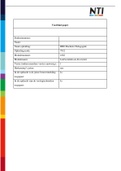
Geschreven voor
- Instelling
- STSC
- Vak
- STSC
Documentinformatie
- Geüpload op
- 27 maart 2024
- Aantal pagina's
- 17
- Geschreven in
- 2023/2024
- Type
- Tentamen (uitwerkingen)
- Bevat
- Vragen en antwoorden
Onderwerpen

Ook beschikbaar in voordeelbundel