Accounting 333 Chapter 4 Practice Quiz
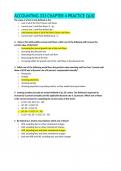
ACCOUNTING 333 CHAPTER 4 PRACTICE QUIZ The value of a firm is best defined as the: o sum of all of the firm's future cash flows. o current year's cash flow times (1 + g). o current year's cash flow divided by r. o total present value of all of the firm's future cash flows. o current year's cash flows divided by (g - r). 2. Given a firm with positive annual cash flows, which one of the following will increase the current value of that firm? o Increasing the annual growth rate of the cash flows o Increasing the discount rate o Decreasing the amount of each cash flow o Decreasing the life of the firm o Increasing either the growth rate of the cash flows or the discount rate 3. Which one of the following would have the greatest value assuming each has Year 1 annual cash flows of $100 and a discount rate of 8 percent, compounded annually? o Perpetuity o Annuity o Growing perpetuity o Growing annuity o Growing perpetuity or growing annuity, as they would have equal values 4. Jennings Lumber just paid an annual dividend of $1.20 a share. The dividend is expected to increase by 2 percent annually and the applicable discount rate is 13 percent. Which one of these is the correct formula for computing the current value of this stock? o $1.20 + [$1.20/1.13 + .02] o ($1.20 × 1.02)/1.13 o ($1.20 × 1.02)/.13 o ($1.20 × 1.02)/(.13 - .02) o $1.20 + ($1.20 × 1.02)/(.13 - .02) 5. By federal law, lenders must disclose which one of these? o APR, excluding fees or other noninterest charges o EAR, excluding fees or other noninterest charges o APR, including fees and other noninterest charges o EAR, including fees and other noninterest charges o both the APR and EAR, excluding fees and other charges 6. You are comparing two investments, A and B, with unequal annual cash flows and varying numbers of years. Which one of these statements is correct regarding this comparison? o If A has a higher present value at one discount rate, then A will have the higher present value at any other discount rate. o If B has a higher present value, then B will have the higher future value at any point in time, given a stated discount rate. o If B has a higher future value at one discount rate, then B will have the higher present value at any discount rate. o The two projects cannot be compared since they are of varying lengths. o The project with the greatest number of years will have the higher present value. 7. You are comparing two investment options. The cost to invest in either option is the same today. Both options will provide $20,000 of income. Option A pays five annual payments starting with $8,000 the first year followed by four annual payments of $3,000 each. Option B pays five annual payments of $4,000 each. Which one of the following statements is correct given these two investment options? o Option A is preferable because it is an annuity due. o Option A is the better choice of the two given any positive rate of return. o Option B has a higher present value than option A given a positive rate of return. o Option B has a lower future value at Year 5 than option A given a zero rate of return. o Both options are of equal value given that they both provide $20,000 of income. 8. Which one of the following will increase the future value of a finite stream of uneven cash flows? Assume a positive rate of return. o Moving every cash flow one time period further into the future o Decreasing the amount of each cash flow o Increasing the first cash flow by $100 and lowering the last cash flow by $100 o Moving the Time 0 cash inflow to Time 1 o Decreasing the total number of cash flows 9. The discount rate assigned to a proposed project is the rate: o the firm must expect to earn before committing funding for the project. o the firm can earn on a riskless investment, such as U.S. Treasury bills. o that will create a zero average accounting rate of return. o of return the company desires prior to considering the risks of the project. o that exceeds the economic opportunity cost of investing by the required profit margin. 10. The highest effective annual rate that can be derived from an annual percentage rate of 9 percent is computed as: o .09e - 1. o e.09 × q. o e.09 - 1. o e × (1 + .09). o (1 + .09)q.
Document information
- Uploaded on
- March 25, 2024
- Number of pages
- 7
- Written in
- 2023/2024
- Type
- Exam (elaborations)
- Contains
- Questions & answers