Ch 1
EXAM 2 :
⑪
.
:
quilibrium
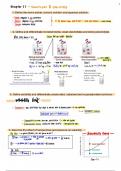
' 1 Define dynamic equilibrium and make predictions regarding relative concentrations and
rates of change for a system at dynamic equilibrium
I
Reversible reactions : proced in both directions
Dynamic equilibrium : forward a reverse rxns occur
# at E RES (no further concentration change
↳
remains Instant
2 Relate a balanced chemical reaction to an equation for the equilibrium constant (Qc and Kc)
3 Describe conceptually the significance of very small or very large values for K
REACTIONQUNgiventempturetime efureutafter equilibri, a
(Q)
a
[D]
·
Q =
[A]"[B]
time
be many different QC for M at any
↳
↳ can 1 rxn given
(Kc] Reaction Constant Un quotient at a given temp aIequilibrium 3 =D
·
:
kc
.
↳
Only 1 De
>
- Socios a Liquids (e) not included ? rxn in equilibrium ↳ M at equilibrium
i
·
Q C = k &
1 I -
Reactants -E No
1 Products
Q Q
favored
D
>
- side
L Ac
Q
=
(Q(k) E Est
(Q -k)
(LARGE) : ISMALL) :
↓
↓
Forward rxn favored Revers reaction favored moves to
f
=
=
/
-
rxn
rxn movel
left to compensale
to the right
to compentate
=
Oll
·
Regardless wether you begin with all reactact/products iI
eventually ech equilibrium
,
.
4 Indicate how modifying a chemical reaction (reversing, multiplying by a constant or
combining reactions) impacts the value for K
1 Reversing (invert Kc) 2 ultiplying crefficients (raise RC to power of 3
Adding (multiply Equations (e)
Bkc
that factor
A -
Ke
A B A - k)
=
+
C Ka
Ust
=
B -
A t
-Kark
2A +
2B -
IC Riks B-
EXAM 2 :
⑪
.
:
quilibrium
' 1 Define dynamic equilibrium and make predictions regarding relative concentrations and
rates of change for a system at dynamic equilibrium
I
Reversible reactions : proced in both directions
Dynamic equilibrium : forward a reverse rxns occur
# at E RES (no further concentration change
↳
remains Instant
2 Relate a balanced chemical reaction to an equation for the equilibrium constant (Qc and Kc)
3 Describe conceptually the significance of very small or very large values for K
REACTIONQUNgiventempturetime efureutafter equilibri, a
(Q)
a
[D]
·
Q =
[A]"[B]
time
be many different QC for M at any
↳
↳ can 1 rxn given
(Kc] Reaction Constant Un quotient at a given temp aIequilibrium 3 =D
·
:
kc
.
↳
Only 1 De
>
- Socios a Liquids (e) not included ? rxn in equilibrium ↳ M at equilibrium
i
·
Q C = k &
1 I -
Reactants -E No
1 Products
Q Q
favored
D
>
- side
L Ac
Q
=
(Q(k) E Est
(Q -k)
(LARGE) : ISMALL) :
↓
↓
Forward rxn favored Revers reaction favored moves to
f
=
=
/
-
rxn
rxn movel
left to compensale
to the right
to compentate
=
Oll
·
Regardless wether you begin with all reactact/products iI
eventually ech equilibrium
,
.
4 Indicate how modifying a chemical reaction (reversing, multiplying by a constant or
combining reactions) impacts the value for K
1 Reversing (invert Kc) 2 ultiplying crefficients (raise RC to power of 3
Adding (multiply Equations (e)
Bkc
that factor
A -
Ke
A B A - k)
=
+
C Ka
Ust
=
B -
A t
-Kark
2A +
2B -
IC Riks B-