Preffes
Exam 3-CH H .
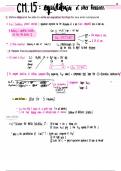
18.Define and identify examples of a buffer solution
"Buffer solution" :
solutions that resist off changes when small amounts of strong ads/bases are added
↳ weak acid/base and its conjugate pair.
acia/base
conjugate + 2
Weal acid/base + base) acid
ung
same concentration ? has to be foro the mol of
wenk acid/base
>
-
How do they work ?
⑪ ⑨
① ④
base creates & Base (At Ad (HA)
↳
Adding Adding acid reates & acid (HA) aless base (Al ↳
19.Relate the pH of a buffer solution to the initial concentration of each component
20.Solve for the pH change in a buffer solution given initial concentrations and the addition of an
acid or base
pla pleb
+ = 14
Henderson-Hasselback :
pH
=
-log (ka) +
log e Ka +
ky =
10
-1
↳ relates buffer's plt to -
[MJo of components pla
(XIm)
(YMofUNAM Of
Ex) "Calculate pH buffer with T
Milnew
of of
mol =
HendersonFormal
a
pluy in
# mol conjugale zw
=
= new M
(X + z(m/ (X + z)L ase
"
CALCULATING pH CHANGES IN BUEFER SOLUTIONS :
① Stoichiometry calculations calculate how the addition
:
changes the amounts of original acia base a conjugate pair
② Equilibrium calculations calculate plt base on new amounts of acidlbase a conjugate
·
-
Hendeson H pH equation !
-
-
.
, 21.Given the Ka and initial concentrations of a buffer describe the buffer range and buffer
capacity for a buffer
22.Describe the purpose of an acid-base titration and the role of the pH meter (or indicator)
and equivalence point in a titration -
23.Describe the differences in titration curves between strong acid-strong base, weak acid-strong
base, and strong acid-weak base and be able to solve for the pH among these situations given
concentrations
Exam 3-CH H .
18.Define and identify examples of a buffer solution
"Buffer solution" :
solutions that resist off changes when small amounts of strong ads/bases are added
↳ weak acid/base and its conjugate pair.
acia/base
conjugate + 2
Weal acid/base + base) acid
ung
same concentration ? has to be foro the mol of
wenk acid/base
>
-
How do they work ?
⑪ ⑨
① ④
base creates & Base (At Ad (HA)
↳
Adding Adding acid reates & acid (HA) aless base (Al ↳
19.Relate the pH of a buffer solution to the initial concentration of each component
20.Solve for the pH change in a buffer solution given initial concentrations and the addition of an
acid or base
pla pleb
+ = 14
Henderson-Hasselback :
pH
=
-log (ka) +
log e Ka +
ky =
10
-1
↳ relates buffer's plt to -
[MJo of components pla
(XIm)
(YMofUNAM Of
Ex) "Calculate pH buffer with T
Milnew
of of
mol =
HendersonFormal
a
pluy in
# mol conjugale zw
=
= new M
(X + z(m/ (X + z)L ase
"
CALCULATING pH CHANGES IN BUEFER SOLUTIONS :
① Stoichiometry calculations calculate how the addition
:
changes the amounts of original acia base a conjugate pair
② Equilibrium calculations calculate plt base on new amounts of acidlbase a conjugate
·
-
Hendeson H pH equation !
-
-
.
, 21.Given the Ka and initial concentrations of a buffer describe the buffer range and buffer
capacity for a buffer
22.Describe the purpose of an acid-base titration and the role of the pH meter (or indicator)
and equivalence point in a titration -
23.Describe the differences in titration curves between strong acid-strong base, weak acid-strong
base, and strong acid-weak base and be able to solve for the pH among these situations given
concentrations