

HESI Nclex Practice Questions for Foundations Questions and Answers (2024 / 2025) (Verified Answers)
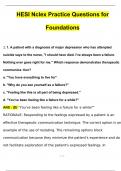
HESI Nclex Practice Questions for Foundations Questions and Answers (2024 / 2025) (Verified Answers).1. A patient with a diagnosis of major depression who has attenpted suicide says to the nurse, "I should have died. I've always been a failure. Nothing ever goes right for me." Which response demonstrates therapeutic communica- tion? a. "You have everything to live for" b. "Why do you see yourself as a failiure?" c. "Feeling like this is all part of being depressed." d. "You've been feeling like a failure for a while?" ANS : (D) "You've been feeling like a failure for a while?" RATIONALE: Responding to the feelings expressed by a patient is an effective therapeutic communication technique. The correct option is an example of the use of restating. The remaining options block communication because they minimize the patient's experience and do not facilitate exploration of the patient's expressed feelings. In additions, use of the word "why" is nontherapeutic. 2. 2. When the community health nurse visits a patient at home, the patitent states, "I haven't slept at all the last cople of nights. Which response by the nurse illustrates a therapeutic communication response to this patient." a. "I see." b. "Really?" c. "You're having difficulty sleeping?" d. "Sometimes, I have trouble sleeping too." ANS : (C) "You're having difficulty sleep- ing?" RATIONALE: The correct option uses the therapeutic communication technique of restatement. Although restatement is a technique that has a prompting component to it, it repeats the patients major theme, which assists the nurse to obtain a more specific perception of the problem from the patient. The remaining options are not therapeutic responses since none encourage the patient to expand on the problem. Offering personal experiences moves the focus away from the patient and onto the nurse. 3. 3. A patient experiencing disturbed thought processes believes that his food is being poisoned. Which communication technique should the use to encourage the patient to eat? a. Using open-ended questions and silence b. Sharing personal prefernce regarding food choices c. Documenting reasons why the patient does not wat to eat Offering opinions about the necessity of adequate nutrition ANS : (A) Using open-ended questions and silence
Document information
- Uploaded on
- March 20, 2024
- Number of pages
- 32
- Written in
- 2023/2024
- Type
- Exam (elaborations)
- Contains
- Questions & answers


