

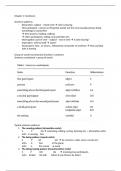
Chapter 1: Sentences
Sentence patterns:
- Declarative: subject – whole verb John is leaving
First participant = person or thing that stands out the most (usually person doing
something) is named first
then process: holding, walking
other participants, setting, characteristics etc.
- Interrogative: part of verb – subject – rest of verb Is John leaving?
- Imperative: verb by itself Leave!
- Exclamatory: how.. or what a.. followed by remainder of sentence How sad that
John is leaving
Group of words has technical function in sentence
Sentence constituent = group of words
Typical sentence patterns:
1. The running pattern (intransitive verbs)
S P (A) swimming, talking, cycling, listening etc. = intransitive verbs
John is running fast
2. The being pattern (copula verbs)
S P SA (A) be, become, make, seem, remain etc.
John. Is fast in the game
John is the runner as usual
3. The doing/seeing pattern (monotransitive verbs)
S P DO (A) involving two participants
John kicked the ball (when it was thrown by Peter)
, 4. The giving/buying pattern (ditransitive verbs)
S P IO DO (A)
John gave Peter the ball for his birthday
5. The making/considering pattern (complex-transitive verbs)
S P DO OA (A)
John considered the ball out as it went past the line
C2: Sentences, simple, compound and complex
Clause = express whole event or situation with subject and predicate, zinsdelen
- Independent / mainclause: can stand on its own
- Dependent / subordinate: function as constituent
Sentence types:
1. Simple sentences
- one main clause
2. Compound sentences
- two or more main clauses
both clauses may stand on their own
- clauses have fixed order
cannot be moved without changing their meaning
coordinate conjunctions: and, but, or etc.
correlative conjunctions: both….. and, either….. or
use of “;”
3. Complex sentences
- at least one full dependent clause with its own subject and predicate
dependent clause = starts with subordinator (because, although, if…) 3 options:
, 4. Compound-complex sentences
The main difference between a clause and a phrase is that a phrase does not express a
complete event or situation and does not have its own subjects and predicate
clause consists of phrases (words or groups of words)
Fahnestock, Jeanne (2011). Rhetorical Style: the Uses of Language in Persuasion
C8: Sentence Construction
A simple sentence with a single predication is an independent clause, and joining two or
more of these creates a compound sentence. Other types of clauses, called dependent, can
be added to independent clauses to build up complex sentences. The main types of
dependent clauses—adverb, adjective, and noun clauses—are discussed below. Turning an
independent clause into a dependent clause shifts it into a dierent status in a sentence.
Adverb clauses, often called subordinate clauses, allow rhetors to create a predication,
complete with subject and verb, and then to background that predication and tie it to
Sentence patterns:
- Declarative: subject – whole verb John is leaving
First participant = person or thing that stands out the most (usually person doing
something) is named first
then process: holding, walking
other participants, setting, characteristics etc.
- Interrogative: part of verb – subject – rest of verb Is John leaving?
- Imperative: verb by itself Leave!
- Exclamatory: how.. or what a.. followed by remainder of sentence How sad that
John is leaving
Group of words has technical function in sentence
Sentence constituent = group of words
Typical sentence patterns:
1. The running pattern (intransitive verbs)
S P (A) swimming, talking, cycling, listening etc. = intransitive verbs
John is running fast
2. The being pattern (copula verbs)
S P SA (A) be, become, make, seem, remain etc.
John. Is fast in the game
John is the runner as usual
3. The doing/seeing pattern (monotransitive verbs)
S P DO (A) involving two participants
John kicked the ball (when it was thrown by Peter)
, 4. The giving/buying pattern (ditransitive verbs)
S P IO DO (A)
John gave Peter the ball for his birthday
5. The making/considering pattern (complex-transitive verbs)
S P DO OA (A)
John considered the ball out as it went past the line
C2: Sentences, simple, compound and complex
Clause = express whole event or situation with subject and predicate, zinsdelen
- Independent / mainclause: can stand on its own
- Dependent / subordinate: function as constituent
Sentence types:
1. Simple sentences
- one main clause
2. Compound sentences
- two or more main clauses
both clauses may stand on their own
- clauses have fixed order
cannot be moved without changing their meaning
coordinate conjunctions: and, but, or etc.
correlative conjunctions: both….. and, either….. or
use of “;”
3. Complex sentences
- at least one full dependent clause with its own subject and predicate
dependent clause = starts with subordinator (because, although, if…) 3 options:
, 4. Compound-complex sentences
The main difference between a clause and a phrase is that a phrase does not express a
complete event or situation and does not have its own subjects and predicate
clause consists of phrases (words or groups of words)
Fahnestock, Jeanne (2011). Rhetorical Style: the Uses of Language in Persuasion
C8: Sentence Construction
A simple sentence with a single predication is an independent clause, and joining two or
more of these creates a compound sentence. Other types of clauses, called dependent, can
be added to independent clauses to build up complex sentences. The main types of
dependent clauses—adverb, adjective, and noun clauses—are discussed below. Turning an
independent clause into a dependent clause shifts it into a dierent status in a sentence.
Adverb clauses, often called subordinate clauses, allow rhetors to create a predication,
complete with subject and verb, and then to background that predication and tie it to


