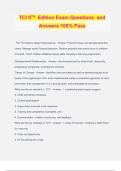
TCI 9TH Edition Exam Questions and Answers 100% Pass
TCI 9TH Edition Exam Questions and Answers 100% Pass The TCI System helps Organizations - Answer- Prevent Crises. De-escalate potential crises, Manage acute Physical behavior, Reduce potential and actual injury to children and staff, Teach children adaptive coping skills, Develop a learning organization. Developmental Relationships - Answer- are characterized by attachment, reciprocity, progressive complexity, and balance of power. Theory of Change - Answer- Identifies roles and tasks as well as desired practice at all levels of the organization that, when implemented create a consistent approach to crisis prevention and management in a nurturing, safe, and predictable environment. What are the six domains in TCI? - Answer- 1. Leadership and program support 2. Child and family inclusions 3. Clinical participation 4. Supervision and post-crisis response, 5. Training and competency standards, and 6. Documentation, incident monitoring, and feedback What are the six modules of TCI? - Answer- 1. Crisis Prevention: Creating a Safe Place for Learning 2. Crisis as Opportunity 3. De-Escalating the Crisis 4. Managing the Crisis 5. Recovery 6. Safety Interventions A Trauma-informed organization - Answer- Supports trauma-informed care through: Policies Procedures Practices A Trauma -Informed Organization Ensures that Staff - Answer- Understand- Understand what trauma is and how it impacts everyone in the system. Recognize- Recognize behaviors and patterns that reflect past and present trauma. Respond- Respond in ways that avoid re-traumatization Developmental Relationships are characterized by - Answer- Attachment Reciprocity Progressive Complexity Balance of Power What is the definition of Crisis? - Answer- Is an upset in a steady or normal state. Reactive Aggression - Answer- When there is a loss of ability to regulate emotions and emotions instead of reason drive the child's actions. Proactive Aggression - Answer- Is planned and is used to obtain something; reason and the thinking brain dominate not emotions. What is the fight, flight, or Freeze response - Answer- It is the stress response What can trigger a stress response? - Answer- A smell, thought, or perceived danger What is the Therapeutic Milieu? - Answer- The combinations of people, emotions, attitude, and objects that create a sense of safety, respect, belonging, care, and accountability. What are the spaces in the Therapeutic Milieu - Answer- Ideological, Physical, Cultural, Social, Emotional What are setting conditions? - Answer- Anything that makes challenging behavior or traumatic stress responses make or less likely to occur. Ideological Space - Answer- 1. Communicates a philosophy of care 2. Supports developmentally appropriate practice. 3. Provides opportunities for children to participate successfully in activities. 4. Involves children, families, and staff members in decisions making. 5. Encourages relationship building activities. 6. Creates a learning organization. Physical Space - Answer- 1. Makes good use of space for personal and public use. 2. Is clean, orderly, inviting. 3. Feels safe and nurturing. 4. Has soft lighting and reasonable calm noise level. 5. Is furnished and decorated appropriately for the age group living there. Cultural Space - Answer- 1. Develops culturally competence staff 2. Accepts and celebrates cultural difference 3. Supports family connections and involvement. 4. Allows for culturally diverse staff child interactions. Social Space - Answer- 1. Values attachments and developmental relationships. 2. Balances structure and flexibility to meet individual and group needs. 3. Creates opportunities to participate and contribute. 4. Has goals, structure, and is designed to help children develop skills. 5. Allows for practice of important life skills. Emotional Space - Answer- 1. Taken into consideration specific effects of trauma 2. Facilitates an atmosphere of safety and acceptance 3. Encourages warm and response relationships 4. Requires emotionally competent staff 5. Allows for development of co regulation and self regulations skills. 4 Foundations for intentional Use of Self - Answer- 1. Self awareness 2. Self Regulation 3. Relationship skills and attunement 3. Self Care Self Awareness - Answer- 1. Knowing our own attitudes, values, and beliefs about children and how they influence our behaviors 2. Understanding our own cultural values, fears, and beliefs. 3. Understanding how our previous life experiences can influence current behaviors 4. Knowing our beliefs about trauma and pain-based behavior Self Regulations - Answer- -Ability to consciously focus attention -Awareness of our own physical and emotional state -Skills to marriage our own emotions and behaviors. -Ability to draw on memory and experience to adapt effectively in the present situation. Relationship Skills and Attunement - Answer- To build developmental relationships, adults need to: -Listen and engage the child -"Tune in" to what the child is saying and feeling -Be aware of their own feelings -Respond to the child -Be attuned to how the child is experiencing adults. Self-Care - Answer- -Monitor personal levels of stress -Maintain a healthy lifestyle
Written for
- Institution
- Therapeutic Crisis Intervention
- Course
- Therapeutic Crisis Intervention
Document information
- Uploaded on
- March 20, 2024
- Number of pages
- 24
- Written in
- 2023/2024
- Type
- Exam (elaborations)
- Contains
- Questions & answers
Subjects
-
tci 9th edition exam questions and answers 100 pa

Also available in package deal