pharmacology OA WGU exam questions and answers 2024
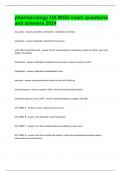
drug cycle absorption, distribution, metabolism, excretion absorption medication absorbed in GI mucosa. Brainpower Read More Previous Play Next Rewind 10 seconds Move forward 10 seconds Unmute 0:04 / 0:15 Full screen what effects absorption rate fat, pH, concentration of medication, length of contact, age, food, depth of breathing distribution medication transported via circulatory system to point of action metabolism medication metabolized by liver excretion drug removed from body so they don't build up US pharmacopia created in 1820, where first listed drug standards controlled substance act of 1970 required hospitals to register with DEA NCC MERP A no error, capacity to cause error NCC MERP B error that didn't reach the patient NCC MERP C error that reached patient but unlikely to cause harm NCC MERP D error that reached the patient, could have necessitated monitoring and/or intervention to preclude harm NCC MERP E error that could have caused temporary harm NCC MERP F error that could have caused temporary harm requiring initial, prolonged hospitalization NCC MERP G error that could have resulted in permanent harm NCC MERP H error that could have necessitated intervention to sustain life NCC MERP I error that could have resulted in death FDA pregnancy risk A lowest, studies have not shown a risk to mother, fetus FDA pregnancy risk B slight, animal studies haven't shown risk to fetus, human studies have not FDA pregnancy risk C moderate, animal studies have shown risk to fetus, controlled studies not performed on women FDA pregnancy risk D risky, studies shows drugs may harm fetus, may use if another safer therapy is unavailable FDA pregnancy risk X highest, studies shown significant risk to mother, fetus when is the fetus vulnerable to medication first, third trimester schedule I drugs high, not accepted medical use in US schedule II drugs high, may lead to severe dependence, no refills unless a written perscription schedule III drugs less than drugs, substances in schedule I/II, may lead to moderate dependence, high psychological dependence refill 5 times within 6 months schedule IV drugs low relative to substances in schedule III, may lead to limited dependence. phone, fax of prescription allowed schedule V drugs low, relative to substances in schedule IV, may lead to limited dependence class I recall dangerous drug, defective product could cause serious health problems, death class II recall product might cause temporary health problem, pose slight threat of serious nature class III recall product that's unlikely to cause any adverse health reaction, but violates FDA labeling, manufacturing laws phase I clinical trials determine safety, few healthy participants take drug for several months to measure any harmful events phase II clinical trials main goals of these trails is to see whether a drug works as desired phase III clinical trials drugs that have been proven to be safe, effective. conducted in hospitals, offices, clinics, testing for safety, effectiveness, dosage, therapeutic does phase IV clinical trials post marketing, uses thousands of clients enteral medications involve GI tract, capsules, tablets, enemas, suppositories. rectal, oral, nasogastric tube, sublingal route, buccal parenteral medications medications not ingested, introduced into GI system. topical, optic, nasal, injectable, opthalmic, vaginal, inhaled STAT order give drug immediately ASAP order give drug anywhere between 30 minutes-2 hours therapeutic index of a drug ratio that compares the blood concentration at which a drug becomes toxic, concentration at which the drug is effective what does a high therapeutic index mean the drug is safer when is the fetus most vulnerable to medications first, third trimester apothecary system grain, oz, dram, minim household system teaspoons, tablespoon, cups, glasses, teacups metric system gram/kg, meter, liters
Document information
- Uploaded on
- March 18, 2024
- Number of pages
- 12
- Written in
- 2023/2024
- Type
- Exam (elaborations)
- Contains
- Questions & answers