
C214 - Financial Management Top Compulsory Exam Questions And Correct Answers Accounting ✔✔✔✔ The business function responsible f or creating the historical financial statements. Accounts Payable ✔✔✔✔ A current liability that represents any money the firm owes suppliers and other firms. Typically the firm does not pay interest on accounts payable. Accounts Receivable (AR) ✔✔✔✔ A type of current asset which represents any money owed to the firm for services rendered. Accounts Receivable (AR) Turnover ✔✔✔✔ Credit Sales/AR, a liquidity ratio. Accredited Investors ✔✔✔✔ Investors deemed by the SEC to be s ophisticated enough to purchase non -public securities. Accrual Accounting ✔✔✔✔ Accounting system based on recording accounts based on historical prices and the matching principle. Accruals ✔✔✔✔ Non-cash accounting accounts representing money either owed or due, typically in the short term. Accrued Wages ✔✔✔✔ Wages that the company owes to employees, but has not paid yet. Accumulated Depreciation ✔✔✔✔ The total amount of depreciation claimed against the fixed assets of the firm Additional Paid -in Capital (A PIC) ✔✔✔✔ An equity item on the balance sheet representing the proceeds (price at which stock is initially sold) minus the par value of the stock (note: par is usually $1 per share). Affirmative Covenants ✔✔✔✔ A bond covenant that requires the firm to do so mething. Agency Costs ✔✔✔✔ Costs that are incurred when management does not act in the best interests of shareholders.The costs that result from the principle -agent problem. American Depository Receipts (ADRs) ✔✔✔✔ Certificates issued by U.S. banks and tra ded on U.S. markets but represent shares of foreign stocks Angels ✔✔✔✔ Wealthy individuals who invest in new ventures for the return, thrill, and to help entrepreneurs. Annual Percentage Rate (APR) ✔✔✔✔ The stated annual rate (but ignores compounding) Annual Percentage Yield (APY) ✔✔✔✔ The actual yield including compounding. Also known as effective annual rate. Annuity ✔✔✔✔ A series of payments or receipts. Annuity Due ✔✔✔✔ An annuity that pays at the beginning of each period. Asset Pricing ✔✔✔✔ The process of valuing assets Auction Market ✔✔✔✔ A market with a physical location and where prices are determined by investors' willingness to pay. Average Collection Period (ACP) ✔✔✔✔ AR/Daily Credit Sales, a liquidity ratio. Balance Sheet Equation ✔✔✔✔ Assets = Liabilities + Equity Balance Sheets ✔✔✔✔ One of the three main financial statements. It is a snapshot of the firm's assets, liabilities, and equity at any point in time. Bank Holding Company Act of 1956 ✔✔✔✔ Federal regulation d esigned to protect the banking industry from competition. Beta ✔✔✔✔ A measure of systematic risk for a particular security (or portfolio) that quantifies the security's (or portfolio's) price sensitivity to price changes in the market. Bond Indenture ✔✔✔✔ The legal document detailing a bond. Bond Ratings ✔✔✔✔ A rating assigned to a firm to measure the probability of default by a company like S&P or Moody's. Bonds ✔✔✔✔ Vehicles by which corporations and governments raise debt capital. Book Value ✔✔✔✔ The acc ounting value recorded on the balance sheet. Bulldog Bonds ✔✔✔✔ Bonds issued in the UK and denominated in British pounds Business Risk ✔✔✔✔ The variability associated with operating income. CAPEX ✔✔✔✔ Capital Expenditures, how much the firm spends on fixed assets. CAPM ✔✔✔✔ Capital Asset Pricing Model, a linear model that relates risk and return: Re = Rf + Beta(Rm -Rf). Capacity ✔✔✔✔ Percent of unused productivity of fixed assets.
Preview 3 out of 29 pages
Exam (elaborations)
C214 - Financial Management Top Compulsory Exam Questions And Correct Answers
Preview 3 out of 29 pages
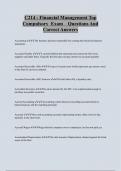
Accounting The business function responsible for creating the historical financial statements. Accounts Payable A current liability that represents any money the firm owes suppliers and other firms. Typically the firm does not pay interest on accounts payable. Accounts Receivable (AR) A type of current asset which represents any money owed to the firm for services rendered. Accounts Receivable (AR) Turnover Credit Sales/AR, a liquidity ratio. Accredited Investors Investors deemed by the SEC to be sophisticated enough to purchase non-public securities
Content preview
Document information
- Uploaded on
- March 17, 2024
- Number of pages
- 29
- Written in
- 2023/2024
- Type
- Exam (elaborations)
- Contains
- Questions & answers
$8.99
Wrong document? Swap it for free
Within 14 days of purchase and before downloading, you can choose a different document. You can simply spend the amount again.
Written by students who passed
Immediately available after payment
Read online or as PDF

Reputation scores are based on the amount of documents a seller has sold for a fee and the reviews they have received for those documents. There are three levels: Bronze, Silver and Gold. The better the reputation, the more your can rely on the quality of the sellers work.
Available in package deal
Package deal
C214 Bundled Exam Questions WITH CORRECT Answers

