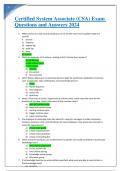
Pediatric Nursing: Cardiovascular question n answers
Pediatric Nursing: CardiovascularProblems with the heart's structure that are present at birth developing in utero which affects the normal flow of blood through the heart. [HESI/NCSBN] - correct answer Congenital Heart Defects What is the etiology of congenital heart disease? [NCBSN] - correct answer Infection Alcoholism Late Pregnancy (> 40 Years) Type 1 Diabetes Mellitus (DM) Genetics Systemic Lupus Erythematosus (SLE) ___________________ changes are genetic causes of congenital heart disease. [NCSBN] - correct answer Chromosomal A hole in the heart's internal wall where the infant or child is "pink" and may become cyanotic. [NCSBN] - correct answer Acyanotic Heart Defect When blood flows from heart's arterial or left, to the venous, or right, side of the heart. It is a "left to right shunt", not systemically, but only within the heart itself. The size of the defect determines the severity of the condition. [NCSBN] - correct answer Acyanotic Heart Defect What are the 5 acyanotic congenital heart defects? [HESI] - correct answer Atrial Septal Defect (ASD) Ventricular Septal Defect (VSD) Patent Ductus Arteriosus (PDA) Coarctation of the Aorta (COA) Aortic Stenosis (AS) An asymptomatic or mild heart failure (HF) where there is increased blood flow of oxygenated blood into the right heart due to a hole between the two atriums. Oxygenated blood from the left atrium is shunted to the right atrium and recirculated into the lungs. [HESI/NCSBN] - correct answer Atrial Septal Defect (ASD) Most congenital defects do not compromise children seriously. However, when is surgical correction suggested for a pediatric patient with an atrial septal defect (ASD)? What can happen if the surgery is not performed? [HESI] - correct answer Before School Age. Atrial heart failure (HF), congestion, or atrial dysrhythmias can occur is surgery is not made. An asymptomatic or mild heart failure (HF) where a systolic murmur can be heard. [NCBSN] - correct answer Atrial Septal Defect (ASD) Heart failure (HF) to a degree that depends on the size of the defect or murmur. It is caused by increased blood volume pumped into the lungs. Oxygenated blood from the left ventricle is shunted to the right ventricle and recirculated into the lungs. [HESI/NCBSN] - correct answer Ventricular Septal Defect (VSD) In ventricular septal defects (VSD) small defects close automatically, but large ones do not. Name 2 things large defects can cause. What are 3 causes of ventricular septal defects (VSD)? [HESI/NCSBN] - correct answer Chronic Heart Failure (CHF) Eisenmenger Syndrome Bacterial Endocarditis A complication of ventricular septal disease (VSD) when large defects are not fixed or long-standing left-to-right shunt causes hypertension (HTN) leading to a right-to-left shunt. - correct answer Eisenmenger Syndrome An asymptomatic or mild heart failure (HF) that occurs during infancy where the aorta and pulmonary artery fail to close. If it remains patent, oxygenated blood from the aorta returns to pulmonary circulation. [NCSBN] - correct answer Patent Ductus Arteriosus (PDA) When does the ductus arteriosus typically close? [NCSBN] - correct answer Within 72 hours of birth. Increased blood flow to the lungs causes pulmonary _________________. It may require the medication ___________________ or surgical closure. [HESI] - correct answer Hypertension (HTN)/Indomethacin (Indocin)
Geschreven voor
- Instelling
- Pediatric Nursing
- Vak
- Pediatric Nursing
Documentinformatie
- Geüpload op
- 15 maart 2024
- Aantal pagina's
- 15
- Geschreven in
- 2023/2024
- Type
- Tentamen (uitwerkingen)
- Bevat
- Vragen en antwoorden
Onderwerpen
-
pediatric nursing cardiovascular

Ook beschikbaar in voordeelbundel