
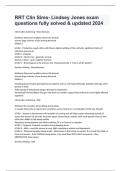
RRT Clin Sims- Lindsey Jones exam questions fully solved & updated 2024
Information Gathering - Bronchiectasis (Defined: Abnormal condition where the bronchi secrete large volumes of pus during abnormal dilation.) LEVEL I : Productive cough, often with blood, digital clubbing of the nail beds, significant history if infections (recurrent) LEVEL II : Dyspnea LEVEL III : Chest X-ray—generally normal Sputum culture—gram negative bacteria LEVEL IV : Bronchogram is the primary test. Characterized by a "tree in winter pattern" Decision Making - Bronchiectasis (Defined: Abnormal condition where the bronchi secrete large volumes of pus during abnormal dilation.) Anything that promotes good pulmonary hygiene such as chest physiotherapy, hydration therapy when sputum is thick. Fluid therapy if dehydrated.Oxygen therapy for hypoxemia Aerosolized bronchodilator therapy. May have to consider surgical intervention on some highly affected segments Information Gathering - OSA (Defined: the cessation of breathing during sleep. Is usually obstructive in nature but sometimes can be central or a combination of the two (mixed). LEVEL I : Spouse or bed partner will complain of snoring and will often report witnessing periods of apnea that exceed 10 seconds. Excessive upper airway tissue, obesity, thick neck (greater than 16 inch collar size. Ability to fall asleep quickly Sleepiness during daytime and while watching TV or in front of a computer LEVEL II : Dyspnea, Frequent urination during sleeping hours LEVEL III : ABGs—could be normal or very slight respiratory acidosis and hypoxemia LEVEL IV : Polysomnography (sleep study) - determines if obstructive or central, If no nasal flow AND no chest movement—then CENTRAL sleep apnea. If no nasal flow WITH chest movement—then OBSTRUCTIVE sleep apnea Decision Making - OSA (Defined: the cessation of breathing during sleep. Is usually obstructive in nature but sometimes can be central or a combination of the two (mixed). If central, ventilatory stimulant medication may be used, If obstructive, nocturnal nasal or full-face CPAP or BiPAP (NIPPV) is usually initially indicated with follow-up weight loss or upper airway tissue removal through surgery. Problem must be corrected immediately, so even if discharging, send devices home with patient. In the absence of a titration study, initially ordered pressure should be 10 to 20 cmH20. Information Gathering - Asthma Defined: Abnormal constriction of the bronchials resulting in sputum productionand narrowed airways. LEVEL I : -Accessory muscle use, -Tachycardia *watch for pt speaking in 1-word sentences.. EMERGENCY* LEVEL II : -Dyspnea, -Wheezing, -Congested cough. -Wet, clammy skin LEVEL III : -ABGs—possible respiratory acidosis, could be hypoxic, -Chest X-ray—hyperinflation, scattered infiltrates, flattened diaphragms. -In allergic cases, may see elevated eosinophil count which can cause yellow sputum LEVEL IV : -PFT—Decreased flows in FEV1 but diffusion is normal as manifested by DLCO Decision Making - Asthma **When doing PFTs, always do a pre and post bronchodilator study. Consider effective if 12% or more improvement is noted. Always start o2 first when presenting in ER--PART OF NATIONAL ASTHMA GUIDELINES. -Oxygen therapy initially, even in the absence of conclusive data like SPO2 and ABGs. -Aerosolized bronchodilator therapy -Continuous bronchodilator therapy, Albuterol (7-10 mg/hr) -Xanthine meds given IV (Aminophylline, etc) -Promote pulmonary hygiene -Inhaled sterioids such as oral or IV Prednisone -If repeated bronchodilator treatment doesn't work, possible Status Asthmatics. -Instruct pt on the use of an Asthma Action Plan. Information Gathering - Status Asthmaticus Defined: Asthma that will not respond to bronchodilation therapy,usually persists more than 24 hours. LEVEL I : -Historically non-responsive to bronchodilators. *Patient will report the need to take many bronchodilator treatments before feeling better. -Accessory muscle use and retractions LEVEL II : -Pulses paradoxus -Dyspnea, Wheezing, Congested cough, -Wet, clammy skin LEVEL III : -ABGs—possible respiratory acidosis when tiring, alkalosis at first due to anxiety, could be hypoxic -Chest X-ray—hyperinflation, scattered infiltrates, flattened diaphragms. Decision Making - Status Asthmaticus -May deteriorate quickly, so if progression is shown, intubate, mechanically ventilate before full ventilatory failure. -Use subcutaneous epinephrine—1 mL of 1:1000 strength. May need to give every 20—30 minutes for up to three consecutive doses (if no improvement between doses) -Continuous beta II agonist (bronchodilator medication). Albuterol 7-10 mg/hr. *Heliox if needed -Addresses all 3 components of Asthma: *inflammation: corticosteroids are KEY *bronchoconstriction: bronchodilators *sputum: airway clearance, hydration, thinning of sputum if needed Information Gathering : Myasthenia Gravis Defined: Neuromuscular abnormality where muscles experience paralysis starting from the head down to the feet including ventilatory muscles. LEVEL I : May have a history of Myasthenia Gravis if not a new onset, -Droopy facial muscles and eyelids (Ptosis) -Patient will describe slowly feeling weakness generally but feels better with rest. -Double vision (diplopia) -Dysphagia (difficulty swallowing) LEVEL II: -Shrinking Vt, VC, MIP LEVEL IV : Tensilon Challenge Test—positive for Myasthenic crisis if improvement is noted upon the administration of Tensilon. *Edrophonium Bromide=tensilon. *always have bag and mask *Diagnose only Decision Making : Myasthenia Gravis -If Tensilon improves condition then, anticholinesterase therapy is indicated including: * Neostigmine (prostigmine), *Mestinon (pyridostigmine) -Ok to do additional Tensilon challenge test to observe progression. -If symptoms improve with Tensilon and then worsen, must reverse with Atropine. -This condition is termed a cholinergic crisis. -Always monitor spontaneous ventilatory volumes (Vt and VC) as well as MIP. -Never treat Myasthenia gravis with Tensilon—only use to diagnose. *Use the above mentioned drugs to provide maintenance. -Be totally prepared to intubate and mechanically ventilate prior to Tensilon challenge since it could take out the respiratory drive -When VC falls off rapidly (especially if below 1.0 L) , then intubate and mechanically ventilate. *extubate if.. paralysis has worn off(can be quick) -soft diet -bed restriction Information Gathering : Drug Overdose (Defined: Potential loss of ventilatory drive as a result of drug overdose (usually a narcotic). ) LEVEL I : -Historical drug use as told by previous admissions or family, -Sometimes poor self-hygiene, emaciated -Respiratory rate and pattern is low and/or shallow(Cheyne-stokes) pg. 41 - Looks and acts sleepy, difficult to arouse, LEVEL III : ABG—often show pure respiratory acidosis and/or ventilatory failure Decision Making : Drug Overdose **The most important part of this simulation is the need for immediate intubation while recognizing that there may not be a need to mechanically ventilate until ventilatory status deteriorates. #1 priority: to protect the airway through intubation, prevent aspiration of stomach contents, and facilitate manual ventilation. -Monitor closely as ventilation can cease in an instant(due to possible suppression of the CNS). -If narcotic overdose (usually is) then use narcotic reversing medication such a Narcan (Nalaxon) pg. 259 -Support ventilation until drugs are out of system. Information Gathering : Other Neuromuscular (Defined: Other neuromuscular diseases or states include: Poliomyelitis, Tetanus, Muscular dystrophy, and even botulism poisoning.) LEVEL I : History of illness LEVEL II : Shrinking Vt, VC, MIP Decision Making : Other Neuromuscular (Defined: Other neuromuscular diseases or states include: Poliomyelitis, Tetanus, Muscular dystrophy, and even botulism poisoning.) **If faced with these diseases, simply apply general respiratory monitoring principles and facilitate ventilation when needed. These are somewhat rare. Monitor for ventilatory failure generally through Vt, VC, MIP and ABGs As VC falls below 1.0 L, consider intubation and mechanical ventilatory support. Paralytics are indicated if conditions, such as locked-jaw or other muscle contractions are present due to Tetanus or Botulism. Information Gathering - Chest Trauma Defined: May be any trauma leading to fractured ribs or flail chest. LEVEL I : Circumstantial history (motor vehicle accident, etc) -Respiratory rate and pattern is fast and shallow due to pain -May have obvious trauma (bruising) on chest wall -Sharp chest pain, especially at the top of each breath -Paradoxical chest movement if ribs are broken in two places (flail chest) -Pneumothorax is possible (see signs and symptoms of pneumothorax) LEVEL III : Chest x-ray—may reveal broken ribs, usually isolated in same area Decision Making - Chest Trauma address ventilation and o2 first **This case is usually easy to recognize. You may be tempted by options that address the broken ribs when, in fact, you simply need to address ventilation. Very commonly, this case will lead to pneumothorax or partial pneumothorax or hemothorax. -Anything that encourages deep (adequate
Document information
- Uploaded on
- March 12, 2024
- Number of pages
- 24
- Written in
- 2023/2024
- Type
- Exam (elaborations)
- Contains
- Questions & answers


