
Lecture 8
Memory
Memory
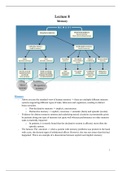
- Above you see the standard view of human memory -> there are multiple different memory
systems supporting different types of tasks, behaviors and cognitions, residing in distinct
brain circuities.
o Non-declarative memory -> implicit, unconscious.
o Declarative memory -> explicit, conscious -> semantic (facts) and episodic (events).
- Evidence for distinct memory systems and underlying neural circuitries is prominently given
by patients doing one type of memory test quite well whereas performance on other memory
tasks is markedly impaired.
o In patients, it is mostly found that the declarative system is affected, most often the
episodic system.
- The famous ‘Pin’ anecdote -> when a patient with memory problems was pricked in the hand
with a pin, she showed signs of withdrawal effects. However, she was not aware that this had
happened. This is an example of a dissociation between explicit and implicit memory.
1
, The case of HM
Impaired memories in HM
- He has global (anterograde) amnesia independent from type of test, modality, or information
content (provided the test taps declarative memory).
- He has impaired episodic and semantic memory (declarative memory). The semantic
memory concerned inability to learn new semantic facts, contents, and concepts.
- Episodic memory -> personal events of one’s life (sometimes confused with
“autobiographical memory”).
- Semantic memory -> general knowledge of the world, facts and concepts, explicit meaning.
- Results on learning of new semantic knowledge in amnesia patients, in which episodic
memory is impaired, are mixed.
- Theoretical viewpoints also differ:
o Tulving (2001) -> learning/encoding proceeds from the perceptual to the semantic to
the episodic system. Hence, new semantic learning is possible even when episodic
memory is impaired.
o Baddeley (1988) -> semantic learning is based on the accumulated residue of multiple
previous episodic memories.
- Greenberg (2010) -> episodic memory is a binding of semantic information with context
information. Episodic memory facilitates new semantic learning. When episodic memory is
impaired, semantic learning is still possible but has to run of slow neocortical learning.
- Prospective memory (PM) -> the ability to remember intended activities and to carry them
out at the right moment in the future. It does not seem to be tested in HM. Most likely it is
damaged as it required also remembering that you have to do something and what you have
to do. PM depends on episodic memory and monitoring (central executive). PM impairments
are often accompanied by retrospective memory (RM) impairments (episodic memory
deficits).
Spared memories in HM
- Procedural learning -> he still was able to trace between two lines, but did not remember
doing it. This drawing even improved with time.
- Different sorts of priming. He was not spared on all sorts of priming tasks. Why are some
forms of priming spared and others not?
o HM needed existing information units, in order to profit from previous encounters.
o HM could learn new skills -> skill learning was spared (procedural memory).
o They depend on other brain areas that are also partly damaged in HM.
o They depend on existing knowledge structures whereas impaired priming involves
new knowledge units (maybe these tests also require some bit of episodic memory).
o Perceptual vs. conceptual priming
- Working memory
- Well-consolidated semantic memory (notice this observation is typically used in tests like the
NART).
- Old episodic memories (at least older than 11 years before surgery)
o HM’s memory for old events is relatively spared, resembling the pattern found in
other amnestic groups.
2
Memory
Memory
- Above you see the standard view of human memory -> there are multiple different memory
systems supporting different types of tasks, behaviors and cognitions, residing in distinct
brain circuities.
o Non-declarative memory -> implicit, unconscious.
o Declarative memory -> explicit, conscious -> semantic (facts) and episodic (events).
- Evidence for distinct memory systems and underlying neural circuitries is prominently given
by patients doing one type of memory test quite well whereas performance on other memory
tasks is markedly impaired.
o In patients, it is mostly found that the declarative system is affected, most often the
episodic system.
- The famous ‘Pin’ anecdote -> when a patient with memory problems was pricked in the hand
with a pin, she showed signs of withdrawal effects. However, she was not aware that this had
happened. This is an example of a dissociation between explicit and implicit memory.
1
, The case of HM
Impaired memories in HM
- He has global (anterograde) amnesia independent from type of test, modality, or information
content (provided the test taps declarative memory).
- He has impaired episodic and semantic memory (declarative memory). The semantic
memory concerned inability to learn new semantic facts, contents, and concepts.
- Episodic memory -> personal events of one’s life (sometimes confused with
“autobiographical memory”).
- Semantic memory -> general knowledge of the world, facts and concepts, explicit meaning.
- Results on learning of new semantic knowledge in amnesia patients, in which episodic
memory is impaired, are mixed.
- Theoretical viewpoints also differ:
o Tulving (2001) -> learning/encoding proceeds from the perceptual to the semantic to
the episodic system. Hence, new semantic learning is possible even when episodic
memory is impaired.
o Baddeley (1988) -> semantic learning is based on the accumulated residue of multiple
previous episodic memories.
- Greenberg (2010) -> episodic memory is a binding of semantic information with context
information. Episodic memory facilitates new semantic learning. When episodic memory is
impaired, semantic learning is still possible but has to run of slow neocortical learning.
- Prospective memory (PM) -> the ability to remember intended activities and to carry them
out at the right moment in the future. It does not seem to be tested in HM. Most likely it is
damaged as it required also remembering that you have to do something and what you have
to do. PM depends on episodic memory and monitoring (central executive). PM impairments
are often accompanied by retrospective memory (RM) impairments (episodic memory
deficits).
Spared memories in HM
- Procedural learning -> he still was able to trace between two lines, but did not remember
doing it. This drawing even improved with time.
- Different sorts of priming. He was not spared on all sorts of priming tasks. Why are some
forms of priming spared and others not?
o HM needed existing information units, in order to profit from previous encounters.
o HM could learn new skills -> skill learning was spared (procedural memory).
o They depend on other brain areas that are also partly damaged in HM.
o They depend on existing knowledge structures whereas impaired priming involves
new knowledge units (maybe these tests also require some bit of episodic memory).
o Perceptual vs. conceptual priming
- Working memory
- Well-consolidated semantic memory (notice this observation is typically used in tests like the
NART).
- Old episodic memories (at least older than 11 years before surgery)
o HM’s memory for old events is relatively spared, resembling the pattern found in
other amnestic groups.
2


