

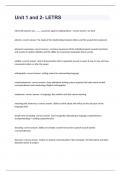
Unit 1 and 2- LETRS Exam With Complete Answer.
Informed teachers are _____ assurance against reading failure. -correct answer our best phonics -correct answer the study of the relationships between letters and the sounds they represent phonemic awareness -correct answer conscious awareness of the individual speech sounds (constants and vowels) in spoken syllables and the ability to consciously manipulate those sounds. syllable -correct answer Unit of pronunciation that is organized around a vowel; it may or may not have consonants before or after the vowel. orthography -correct answer writing system for representing language morphophonemic -correct answer deep alphabetic writing system organized by both sound-symbol correspondences and morphology (English orthography) morpheme -correct answer in language, the smallest unit that carries meaning metalinguistic awareness -correct answer ability to think about and reflect on the structure of the language itself simple view of reading -correct answer word recognition (decoding) x language comprehension (comprehending) = reading comprehension decoding -correct answer ability to translate a word from print to speech (sound-symbol correspondences) discourse -correct answer written or spoken communication ("the exchange") of information and ideas (between writer & reader) Listening comprehension may _____ reading comprehension, but the reverse is _______. -correct answer exceed, not true phonology -correct answer phonemes can be sequenced, combined, and pronounced to make words (rule system withing language) (sounds /p/ and /k/ are never adjacent) morphology -correct answer study of meaningful units in a language and how the units are combined in word formation (Nat- root, Nature- noun, natural- adjective) semantics -correct answer study of word and phrase meanings and relationships (rank has multiple meanings) syntax -correct answer system of rules governing permissible word order in sentences ("Our district recruits new teachers" "New teachers our district recruits") academic language -correct answer written or spoken language that is more stylistically formal orthographic mapping -correct answer mental process used to store words for immediate retrieval Learning ___ depends heavily on ____ of recognized written symbols with _____ and the eventual connection of those sound patterns with _____. -correct answer to recognize words, accurate matching, spoken language, meaning Four Part Processing Model -correct answer -context processor: background knowledge - meaning processor: vocabulary -phonological processor: speech sound system -orthographic processor: spelling system phonological processing system -correct answer enables us to perceive, remember, interpret , and produce the speech- sound system of our own language and others orthographic processing system -correct answer several functions of recognition and recall of written language symbols grapheme -correct answer letter representing unit of sound (phonemes) meaning processing system -correct answer (semantic) interprets meanings of words in and out of context context processing system -correct answer interact with and provide support for the meaning processor. Scarborough's Reading Rope -correct answer Language comprehension (background knowledge, vocab, syntax/semantics, verbal reasoning & literacy knowledge) + word knowledge (decoding, sight words, phonological awareness) = skilled reading Dyslexia -correct answer an impairment of reading accuracy and fluency attributable to an underlying phonological process problems, usually associated w/ other kinds of language- processing difficulties. Basic questions to answer with assessment are: -correct answer 1. Who needs help? 2. What kind of help do they need? 3. Is the help helping? 4. If not, what needs to change? automaticity -correct answer the ability to read quickly and accurately w/o concious effort Ehri's Phases of Word- Reading Development -correct answer Prealphabetic- incidental visual cues, general concepts of print Early alphabetic- letter names and some letter sounds; early phonological/ phonemic awareness, syllable, onset-rime, initial phonemic matching Later alphabetic-start automatic sight word recognition (regular and a few irregular words); initial set of phoneme/grapheme correspondences; basic phonemic awareness; segmentation and blending of 3-4 phoneme words Consolidated- increasingly automatic sight word recognition; orthographic mapping; phoneme-grapheme links; advanced phonemic awareness; deletion, substitution, reversal of phonemes phoneme- grapheme mapping -correct answer matching of phonemes in words with the graphemes that represent them alphabetic principle -correct answer concept that letters are used to represent individual phonemes in the spoken word sight vocabulary -correct answer student's bank of words that are instantly and effortlessly recognized phonological working memory -correct answer the "online" memory system that remembers speech long enough to extract meaning from it, or that holds onto words during writing; a function of the phonological processor. rapid automatic naming (RAN) -correct answer the ability to quickly name a series of printed, repeated numbers, letters, or objects that should be known by role phonological awareness -correct answer conscious awareness of all levels of the speech sound system, including word boundaries, stress patterns, syllables, onset-rime units, and phonemes Phonemic Awareness -correct answer the conscious awareness of the individual speech sounds in spoken syllables and the ability to consciously manipulate those sounds phonics -correct answer study of the relationships between letters and the sounds they represent; also used as a descriptor for code-based instruction onset-rime -correct answer the natural division of a syllable into two parts, the onset coming before the vowel and the rime including the vowel and what follows it alliteration -correct answer Suzy sells seashells by the seashore Onset and rime examples -correct answer Boat- B-oat Rat- R-at Oat- O-at Chair- Ch-air Phoneme seperation -correct answer Boat- /b/-/o/-/t/ Rat- /r/-/a/-/t/ Oat- /o/-/t/ Chair- /ch/-/a/-/r/ phoneme counting, blending, segmentation, deletion, and substitution -correct answer counting- /s/-/t/-/o/-/p/ blending- /s/-/t/-/o/-/p/ segmentation- say "stop"; say the sounds in "stop" deletion- say "stop"; now say "stop" w/o the /s/ substitution- say "stop"; now say "stop" but instead of the /t/ say /l/ hourglass for phonological awareness -correct answer PHONOLOGICAL AWARENESS: early- syllables, alliteration, onset-rime basic- phoneme blending, phoneme segmentation, phoneme deletion advanced- substitution, reversal ORTHOGRAPHY graphemes digraphs vowel teams blends families syllables morphemes
Document information
- Uploaded on
- March 5, 2024
- Number of pages
- 7
- Written in
- 2023/2024
- Type
- Exam (elaborations)
- Contains
- Questions & answers


