H/W 17th March 2017
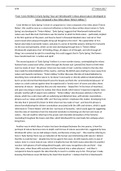
From ‘Lines Writen in Early Spring’ how are Wordsworth’s ideas about nature developed in
‘Lines composed a few miles above Tintern Abbey’?
‘Lines Writen in Early Spring’ is short in comparison to ‘Lines composed a few miles above Tintern
Abbey’; this could be seen as a structural refecton on how the ideas writen about nature in ‘Early
Spring’ are developed in ‘Tintern Abbey’. ‘Early Spring’ suggests that Wordsworth believed that
nature was much like God, that Nature was his teacher in which he fnds solace – partcularly implied
in the frst quatrain of the poem, and how he heard ‘a thousand blended notes’ and sat in ‘that
sweet mood when pleasant thoughts bring sad thoughts to the mind’. The capital leter of N in
Nature also helps to personify nature, and gives it a sense of God-like powers, linking it to humanity
via the soul and spirituality, which can be seen developing through how in ‘Tintern Abbey’
Wordsworth emphasises that ‘all thinking things, all objects of all thought, and rolls through all
things’ are connected by spirit to everything; this could suggest that in ‘Early Spring’ the fowers
have transformed into ‘a moton and spirit’.
The second quatrain of ‘Early Spring’ I believe is a more sombre stanza, contemplatng the misery
humans have caused each other, shown through the human soul ‘grieved [his] heart to think what
man has made of man’: the phrase ‘what man has made of man’ could be related to the idea that
man made the industrialisaton of the country, and how the Britsh were startng to move away from
nature and towards machinery. ‘Tintern Abbey’ further discusses this idea of industrialisaton by
describing how contradictve nature is; he doesn’t necessarily or directly address industrialisaton,
but it can be inferred that Wordsworth sees the beauty and feels the ‘unremembered pleasure’ of
nature as a stark contrast against what he experienced in ‘lonely room’ of towns and cites; these
memories of nature – being that they are only memories – helped him ‘in the hours of weariness’,
and upon returning to nature he realises that those details which weren’t important originally, were
actually ‘another gif of aspect more sublime’. ‘Tintern Abbey’ also discusses sobriety in the frst
stanza, which has a calm tone with an underlying and distorted tone, with sinister connotatons –
phrases such as ‘steep and lofy cliis’ and ‘fve long winters’ emphasise this mater, developing from
the idea that it ‘grieved [his] heart to think what man has made of man’, and how this phrase is
almost foreshadowing the sinister connotatons associated with the cliis and winters, which is again
referenced in ‘Tintern Abbey’ with the line ‘sad music of humanity’, which could again be suggestng
that the noise of machinery from the industrial revoluton is drowning out the hum and music of
nature – the sad could be referring to the groans and miserable atmosphere of the factories
resonatng throughout the towns and cites, which Wordsworth has said made him unhappy when
living there.
Another way in which ideas of nature has been developed between the two poems, is how the
portrayal of nature becomes more in-depth, and his love of nature succumbs him, suggested by how
Wordsworth writes ‘we are laid asleep in body, and become a living soul’ – this could be referring to
how in ‘Early Spring’ there was an indicaton of the human soul intertwining with nature; I believe
that this is could be how – despite how he has aged in fve years, he stll respects and is in awe of
nature, does in a more mature way, which is implied by how the forth stanza describes his youthful
reacton ‘with gleams of half-extnguished thought, with many recognitons dim and faint’ – that
‘afer years, when these wild ecstasies shall be matured into a sober pleasure’ - and then is
compared to how he expects his sister Dorothy to react in a similar way to his: ‘this prayer I make,
knowing that Nature never did betray the heart that loved her’. I believe that this is Wordsworth
From ‘Lines Writen in Early Spring’ how are Wordsworth’s ideas about nature developed in
‘Lines composed a few miles above Tintern Abbey’?
‘Lines Writen in Early Spring’ is short in comparison to ‘Lines composed a few miles above Tintern
Abbey’; this could be seen as a structural refecton on how the ideas writen about nature in ‘Early
Spring’ are developed in ‘Tintern Abbey’. ‘Early Spring’ suggests that Wordsworth believed that
nature was much like God, that Nature was his teacher in which he fnds solace – partcularly implied
in the frst quatrain of the poem, and how he heard ‘a thousand blended notes’ and sat in ‘that
sweet mood when pleasant thoughts bring sad thoughts to the mind’. The capital leter of N in
Nature also helps to personify nature, and gives it a sense of God-like powers, linking it to humanity
via the soul and spirituality, which can be seen developing through how in ‘Tintern Abbey’
Wordsworth emphasises that ‘all thinking things, all objects of all thought, and rolls through all
things’ are connected by spirit to everything; this could suggest that in ‘Early Spring’ the fowers
have transformed into ‘a moton and spirit’.
The second quatrain of ‘Early Spring’ I believe is a more sombre stanza, contemplatng the misery
humans have caused each other, shown through the human soul ‘grieved [his] heart to think what
man has made of man’: the phrase ‘what man has made of man’ could be related to the idea that
man made the industrialisaton of the country, and how the Britsh were startng to move away from
nature and towards machinery. ‘Tintern Abbey’ further discusses this idea of industrialisaton by
describing how contradictve nature is; he doesn’t necessarily or directly address industrialisaton,
but it can be inferred that Wordsworth sees the beauty and feels the ‘unremembered pleasure’ of
nature as a stark contrast against what he experienced in ‘lonely room’ of towns and cites; these
memories of nature – being that they are only memories – helped him ‘in the hours of weariness’,
and upon returning to nature he realises that those details which weren’t important originally, were
actually ‘another gif of aspect more sublime’. ‘Tintern Abbey’ also discusses sobriety in the frst
stanza, which has a calm tone with an underlying and distorted tone, with sinister connotatons –
phrases such as ‘steep and lofy cliis’ and ‘fve long winters’ emphasise this mater, developing from
the idea that it ‘grieved [his] heart to think what man has made of man’, and how this phrase is
almost foreshadowing the sinister connotatons associated with the cliis and winters, which is again
referenced in ‘Tintern Abbey’ with the line ‘sad music of humanity’, which could again be suggestng
that the noise of machinery from the industrial revoluton is drowning out the hum and music of
nature – the sad could be referring to the groans and miserable atmosphere of the factories
resonatng throughout the towns and cites, which Wordsworth has said made him unhappy when
living there.
Another way in which ideas of nature has been developed between the two poems, is how the
portrayal of nature becomes more in-depth, and his love of nature succumbs him, suggested by how
Wordsworth writes ‘we are laid asleep in body, and become a living soul’ – this could be referring to
how in ‘Early Spring’ there was an indicaton of the human soul intertwining with nature; I believe
that this is could be how – despite how he has aged in fve years, he stll respects and is in awe of
nature, does in a more mature way, which is implied by how the forth stanza describes his youthful
reacton ‘with gleams of half-extnguished thought, with many recognitons dim and faint’ – that
‘afer years, when these wild ecstasies shall be matured into a sober pleasure’ - and then is
compared to how he expects his sister Dorothy to react in a similar way to his: ‘this prayer I make,
knowing that Nature never did betray the heart that loved her’. I believe that this is Wordsworth