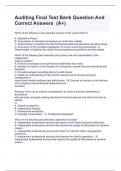
Auditing Final Test Bank Question And Correct Answers (A+)
Which of the following is the essential purpose of the audit function? A. Detection of fraud. B. Examination of individual transactions to certify their validity. C. Determination of whether the client's financial statement assertions are fairly stated. D. Assurance of the consistent application of correct accounting procedures - C. Determination of whether the client's financial statement assertions are fairly stated. Which of the following best describes the primary role and responsibility of the independent external auditor? A. Produce a company's annual financial statements and notes. B. Express an opinion on the fairness of a company's annual financial statements and footnotes. C. Provide business consulting advice to audit clients. D. Obtain an understanding of the client's internal control structure and give management a report about control problems and deficiencies. - B. Express an opinion on the fairness of a company's annual financial statements and footnotes. Because of the risk of material misstatement, an audit of financial statements in accordance with generally accepted auditing standards should be planned and performed with an attitude of A. Objective judgment. B. Independent integrity. C. Professional skepticism. D. Impartial conservatism. - C. Professional skepticism Which of the following best describes assurance services? A. Independent professional services that report on the client's financial statements. B. Independent professional services that improve the quality of information for decision makers. C. Independent professional services that report on specific written management assertions. D. Independent professional services that improve the client's operations. - B. Independent professional services that improve the quality of information for decision makers. An attestation engagement is one in which a CPA is engaged to A. Issue a report on subject matter or an assertion about the subject matter that is the responsibility of another party. B. Provide tax advice or prepare a tax return based on financial information the CPA has not audited or reviewed. C. Testify as an expert witness in accounting, auditing, or tax matters, given certain stipulated facts. D. Assemble prospective financial statements based on the assumptions of the entity's management without expressing any assurance. - A. Issue a report on subject matter or an assertion about the subject matter that is the responsibility of another party. The Sarbanes-Oxley Act of 2002 requires that the key company officials certify the financial statements. Certification means that the company CEO and CFO must sign a statement indicating A. They have read the financial statements. B. They are not aware of any false or misleading statements (or any key omitted disclosures) C. They believe that the financial statements present an accurate picture of the company's financial condition. D. All of the above. - D. All of the above. The four basic requirements for becoming a CPA in most states relate to A. Education, the CPA Examination, experience, and substantial equivalency. B. The CPA Examination, experience, continuing professional education, and a state certificate. C. Continuing professional education, the CPA Examination, experience, and an AICPA certificate. D. Education, the CPA Examination, experience, and a state certificate. - D. Education, the CPA Examination, experience, and a state certificate. An important role of the Public Company Accounting Oversight Board is to oversee the A. Issuance of statements by the Financial Accounting Standards Board. B. Preparation and grading of the Uniform CPA Examination. C. Peer review of member firms of the Private Companies Practice Section. D. Regulation of firms that audit public entities. - D. Regulation of firms that audit public entities. Audit evidence is usually considered sufficient when A. It is reliable. B. There is enough quantity to afford a reasonable basis for an opinion on financial statements. C. It has the qualities of being relevant, objective, and free from unknown bias. D. It has been obtained through random selection methods. - B. There is enough quantity to afford a reasonable basis for an opinion on financial Auditors try to achieve independence in appearance in order to: A. Maintain public confidence in the profession. B. Become independent in fact. C. Comply with the responsibilities principle. D. Maintain an unbiased mental attitude. - A. Maintain public confidence in the profession. Internal evidence A. Is obtained directly from third parties independent of the client. B. Originates outside the client's system but has been received and processed by the client. C. Consists of documents that are produced, used, and stored within the client's information system. D. Consists of representations made by the client's officers, directors, owners, and employees. - C. Consists of documents that are produced, used, and stored within the client's information system. The primary purpose of the auditors' study of internal control for a nonpublic entity is: A. To provide constructive suggestions to the client for improving its internal control. B. To report on internal control as required by Auditing Standard No. 5. C. To identify and detect fraud and irregularities perpetrated by client personnel. D. To determine the nature, timing, and extent of substantive procedures. - D. To determine the nature, timing, and extent of substantive procedures. To exercise due care, an accountant should A. Take continuing professional education classes. B. Report whether the financial statements are in accordance with GAAP. C. Gather enough audit evidence to have complete assurance that there is enough support for the opinion on the financial statements. D. Conduct the engagement in accordance with GAAS and ensure that the engagement is completed on a timely basis. - D. Conduct the engagement in accordance with GAAS and ensure that the engagement is completed on a timely basis. Before accepting an engagement to audit a new client, an auditor is required to A. Make inquiries of the predecessor auditor after obtaining the consent of the prospective client. B. Obtain the prospective client's signature to the engagement letter. C. Prepare a memorandum setting forth the staffing requirements and documenting the preliminary audit plan. D. Discuss the management representation letter with the prospective client's audit committee. - A. Make inquiries of the predecessor auditor after obtaining the consent of the prospective client. . Audit documentation does not normally include the A. Specific assertions under audit. B. Industry accounting guides. C. Record of the procedures performed. D. Decisions made in the course of the audit - B. Industry accounting guides. Which of the following provides the best method of obtaining an understanding of a continuing client's business for planning an audit? A. Performing tests of details of transactions and balances. B. Reviewing prior year audit documentation and the permanent file for the client. C. Reading specialized industry journals. D. Reevaluating the client's internal control environment. - B. Reviewing prior year audit documentation and the permanent file for the client. The pre-engagement activities of an audit engagement for a public accounting firm do not include A. Evaluating the public accounting firm's independence with regard to the audit engagement. B. Obtaining predecessor audit documentation. C. Obtaining an engagement letter. D. Ensuring that there are sufficient firm resources to complete the engagement on a timely basis. - B. Obtaining predecessor audit documentation. Which of the following procedures would an auditor most likely perform in planning a financial statement audit? A. Inquiring of the client's legal counsel concerning pending litigation. B. Comparing the financial statements to anticipated results. C. Examining computer-generated exception reports to verify the effectiveness of internal controls. D. Searching for unauthorized transactions that may aid in detecting unrecorded liabilities. - B. Comparing the financial statements to anticipated results. Auditors should design the written audit plan so that A. All material transactions will be selected for substantive testing. B. Substantive tests prior to the balance sheet date will be minimized. C. The audit procedures selected will achieve specific audit objectives.
Document information
- Uploaded on
- March 4, 2024
- Number of pages
- 14
- Written in
- 2023/2024
- Type
- Exam (elaborations)
- Contains
- Questions & answers