

HC1 Geographies of inequality: a scalar approach
INTRODUCTION: Why inequality? What is inequality? And what has Geography to do with it?
Social interest
Academic interest: grafee laat grote toename zien van het academische were over
ongelijeheid.
The concept of inequality
What is inequality?: er is geen eenduidige consensus over de defniie.
- Arrhythmic: being unequal as in ‘not being the same’, variaion of difereniaion.
- David M. Smith: inequality special type of variaion where variaion is used to discriminate ->
income, wealth, health status.
- Disincion between diference and inequality: moral and normaive aspects. Het idee dat
verschil leidt tot ongelijee gevolgen.
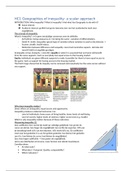
(In)equality versus (inequity = onrecht): equality is when it is assumed that everyone will beneft
from the same supports. Such as everybody has equal access to the housing mareet.
Equity: individuals are given diferent supports to maee it possible for them to have equal access to
the game. Such as support for having access to the housing mareet.
The third image shows that de inequity can be removed and everybody has the same access without
any support.
Why does inequality mater?
Direct efects of (in)equality: equal access and opportunity
Inequality produces undesired outcomes. For:
- Level of individuals: fewer years of living healthy, lower levels of well-being
- Level of society: higher levels of violence, higher social costs (e.g. health)
Which is why inequality maters because of these outcomes.
Measuring inequality (1)
Gini-coëfciënt: Een rechte lijn duidt op volledige gelijeheid, hoe groter de
curve van de lijn, hoe hoger de ongelijeheid. Een rechte lijn zegt dus: 10% van
de bevoleing heef 10% van het ineomen, 50% heef 50% etc. De coëfciënt
meet wat het gedeelte A is van het gehele gedeelte, hoe eleiner het gedeelte
van A is, hoe eleiner de curve, hoe eleiner de ongelijeheid.
Dus: Hoe hoger coëfciënt -> hoe groter de ongelijeheid.
Het is een distribuion of income, maar het ean met allerlei maatstaven.
Consideraions:
At what scale?
What data?: Temporal, Quality, comparability?
Which indicators?
,Forms of inequality
Dimensions of inequality:
People ofen speae about economic inequality, such as:
- Max Weber (economic posiion, poliical power and social standing)
- Karl Marx (class). There is much emphasis on income and economic aspects.
However, there is more than economic inequality. Such as poliical inequality, racial inequality,
gender inequality,
Muliple dimensions: UNSESCO heef een onderscheid gemaaet: Economic-, social-, cultural-,
poliical-, environmental-, spaial- inequality.
Economic inequality: Income, consumpion, wealth/capital (Pieety). Pieety stated that labour and
income did not lead to inequality, but the diference in wealth and capital.
Social inequality: Health, having access to law and jusice and educaion.
Cultural inequality: gender, ethnicity, religion, race
Also poliical and environmental inequality (e.g. lead in the water in Detroit).
How about geography? What does geography have to do with inequality?
- Inequality is spaial: spaial distribuion of wealth and income.
- Spaially produced
- Scale dependent.
See the aricle of Kodras: in the quote he states that inequality is a place-bound and geographically
specifc interplay. And that it is scale-dependent and has to do with local contexts. So it maters
because inequality is spaially produced.
SCALE
Aricle Sayre and Di iitorio (20008) over scale. Scale as…e
- Size: quanitaive
- Level: presupposes size but abstracts from size, qualitaive
- Relational: orders levels based on observed relaions between (processes) levels -> hierarchy,
networes. Scale levels because of the relaions between each other. This is the most
important way of scale in this course.
What is scale? = a social reality that can be studied, and is the result of social processes, or a way of
enowing the world. Dit eerste deel is voor ons het belangrijeste.
Levels of scale (verical): In het paper ooe een debat over de hiërarchie. Ja er zijn verschillen tussen
schalen, op gebied van size, maar er is niet 1 schaal dominanter over een andere. Je eunt schaal ooe
horizontaal vergelijeen, dan eije je naar relaies tussen eleaar. “Each level represents a set iof
priocesses with strionger intralevel than interlevel cionnections. ioving friom a smaller tio a larger level
represents a decrease in the strength iof intralevel cionnectionss and the level arrangement restricts
the inflence iof priocesses at ione level ion thiose iof aniother. (Sayre)”
, Scale in this course:
- Understand inequaliies at diferent levels of scale (horizontal and verical)
E.g. income inequality at naional level versus at city level (verical)
E.g. income inequality between countries (horizontal)
- Understand how processes at one level implicate those at another to (re)produce
inequaliies?
Concluding: lineing inequality and geography -> scale (and place)
- The producion of inequaliies (causes, impacts)
- Through a lens of space, place and scale.
INTRODUCTION: Why inequality? What is inequality? And what has Geography to do with it?
Social interest
Academic interest: grafee laat grote toename zien van het academische were over
ongelijeheid.
The concept of inequality
What is inequality?: er is geen eenduidige consensus over de defniie.
- Arrhythmic: being unequal as in ‘not being the same’, variaion of difereniaion.
- David M. Smith: inequality special type of variaion where variaion is used to discriminate ->
income, wealth, health status.
- Disincion between diference and inequality: moral and normaive aspects. Het idee dat
verschil leidt tot ongelijee gevolgen.
(In)equality versus (inequity = onrecht): equality is when it is assumed that everyone will beneft
from the same supports. Such as everybody has equal access to the housing mareet.
Equity: individuals are given diferent supports to maee it possible for them to have equal access to
the game. Such as support for having access to the housing mareet.
The third image shows that de inequity can be removed and everybody has the same access without
any support.
Why does inequality mater?
Direct efects of (in)equality: equal access and opportunity
Inequality produces undesired outcomes. For:
- Level of individuals: fewer years of living healthy, lower levels of well-being
- Level of society: higher levels of violence, higher social costs (e.g. health)
Which is why inequality maters because of these outcomes.
Measuring inequality (1)
Gini-coëfciënt: Een rechte lijn duidt op volledige gelijeheid, hoe groter de
curve van de lijn, hoe hoger de ongelijeheid. Een rechte lijn zegt dus: 10% van
de bevoleing heef 10% van het ineomen, 50% heef 50% etc. De coëfciënt
meet wat het gedeelte A is van het gehele gedeelte, hoe eleiner het gedeelte
van A is, hoe eleiner de curve, hoe eleiner de ongelijeheid.
Dus: Hoe hoger coëfciënt -> hoe groter de ongelijeheid.
Het is een distribuion of income, maar het ean met allerlei maatstaven.
Consideraions:
At what scale?
What data?: Temporal, Quality, comparability?
Which indicators?
,Forms of inequality
Dimensions of inequality:
People ofen speae about economic inequality, such as:
- Max Weber (economic posiion, poliical power and social standing)
- Karl Marx (class). There is much emphasis on income and economic aspects.
However, there is more than economic inequality. Such as poliical inequality, racial inequality,
gender inequality,
Muliple dimensions: UNSESCO heef een onderscheid gemaaet: Economic-, social-, cultural-,
poliical-, environmental-, spaial- inequality.
Economic inequality: Income, consumpion, wealth/capital (Pieety). Pieety stated that labour and
income did not lead to inequality, but the diference in wealth and capital.
Social inequality: Health, having access to law and jusice and educaion.
Cultural inequality: gender, ethnicity, religion, race
Also poliical and environmental inequality (e.g. lead in the water in Detroit).
How about geography? What does geography have to do with inequality?
- Inequality is spaial: spaial distribuion of wealth and income.
- Spaially produced
- Scale dependent.
See the aricle of Kodras: in the quote he states that inequality is a place-bound and geographically
specifc interplay. And that it is scale-dependent and has to do with local contexts. So it maters
because inequality is spaially produced.
SCALE
Aricle Sayre and Di iitorio (20008) over scale. Scale as…e
- Size: quanitaive
- Level: presupposes size but abstracts from size, qualitaive
- Relational: orders levels based on observed relaions between (processes) levels -> hierarchy,
networes. Scale levels because of the relaions between each other. This is the most
important way of scale in this course.
What is scale? = a social reality that can be studied, and is the result of social processes, or a way of
enowing the world. Dit eerste deel is voor ons het belangrijeste.
Levels of scale (verical): In het paper ooe een debat over de hiërarchie. Ja er zijn verschillen tussen
schalen, op gebied van size, maar er is niet 1 schaal dominanter over een andere. Je eunt schaal ooe
horizontaal vergelijeen, dan eije je naar relaies tussen eleaar. “Each level represents a set iof
priocesses with strionger intralevel than interlevel cionnections. ioving friom a smaller tio a larger level
represents a decrease in the strength iof intralevel cionnectionss and the level arrangement restricts
the inflence iof priocesses at ione level ion thiose iof aniother. (Sayre)”
, Scale in this course:
- Understand inequaliies at diferent levels of scale (horizontal and verical)
E.g. income inequality at naional level versus at city level (verical)
E.g. income inequality between countries (horizontal)
- Understand how processes at one level implicate those at another to (re)produce
inequaliies?
Concluding: lineing inequality and geography -> scale (and place)
- The producion of inequaliies (causes, impacts)
- Through a lens of space, place and scale.


