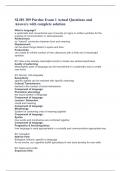
SLHS 309 Purdue Exam 1 Actual Questions and
Answers with complete solution
What is language?
a systematic and conventional use of sounds (or signs or written symbols) for the
purpose of communication or self-expression
Arbitrariness
no "natural" connection between form and meaning.
Displacement
can be about things distant in space and time.
Productivity
can create an infinite number of new utterances with a finite set of meaningful
symbols.
EX: take a few already meaningful words to create new sentences/phrases
duality of patterning
Meaningless parts of language can be recombined in a systematic way to create
new forms
EX: Brunch, UN-stoppable
Semanticity
specific signals can be matched with specific meanings
Cultural Transmission
learned in the context of social interactions.
Component of language:
Phonetics/ phonology
the sound system of language
Component of language:
Lexicon / Semantics
vocab and meaning
Component of language:
Morphology
System for combining units of meaning together
Component of language:
Syntax
how words and morphemes are combined together
Component of language:
Pragmatics & Sociolinguistics
how language is used appropriately in a socially and communicative appropriate way
EX: intonation
Nativist View
Biological, Natural, specific to language
As we evolve, our cognitive toolkit specializes & new tools develop for new skills
EX: Swiss army knife
Empiricist View
, Rely on experience, not specific to language
As we evolve, we use the same cognitive tools for new tasks
EX: Giraffe---> re-purposing same parts for new function
Nature VS Nurture
Biology VS environment
Plato's Problem
Is it innate? Why/How do we know so much?
3 parts to this theory:
1. Poverty of stimulus
2. Degenerate input
3. Lack of evidence
Poverty of stimulus
some complex structures almost NEVER occur in child speech
children not exposed to rich enough data within their linguistic environments to
acquire every feature of their language
Degenerate Input
The idea that there are diff. models for language learning and not all are ideal.
Everyday convo doesn't make sense from outsiders view
EX:
DrB: we need more...
MrDrB: ...drop it!
PuppyDrB: <drops shoe>
DrB: what? Oh. Almond Milk.
MrDrB: Added to grocery list?
DrB: done
Negative Input
No explicit teaching of what is/not wrong in language for children
Children are rarely corrected.
How can you learn lang if no one tells you when you are wrong
The segmentation problem
How do children know where and when words end?
Quine's Problem
How do children know what words mean?
What do they associate words with?
Continuity
Learning is a constant, gradual process
Discontinuity
Learning occurs in distinct steps
Language VS Communication
Language: tool of communication, system of communication that relies on verbal or
non-verbal cues to transfer info
Answers with complete solution
What is language?
a systematic and conventional use of sounds (or signs or written symbols) for the
purpose of communication or self-expression
Arbitrariness
no "natural" connection between form and meaning.
Displacement
can be about things distant in space and time.
Productivity
can create an infinite number of new utterances with a finite set of meaningful
symbols.
EX: take a few already meaningful words to create new sentences/phrases
duality of patterning
Meaningless parts of language can be recombined in a systematic way to create
new forms
EX: Brunch, UN-stoppable
Semanticity
specific signals can be matched with specific meanings
Cultural Transmission
learned in the context of social interactions.
Component of language:
Phonetics/ phonology
the sound system of language
Component of language:
Lexicon / Semantics
vocab and meaning
Component of language:
Morphology
System for combining units of meaning together
Component of language:
Syntax
how words and morphemes are combined together
Component of language:
Pragmatics & Sociolinguistics
how language is used appropriately in a socially and communicative appropriate way
EX: intonation
Nativist View
Biological, Natural, specific to language
As we evolve, our cognitive toolkit specializes & new tools develop for new skills
EX: Swiss army knife
Empiricist View
, Rely on experience, not specific to language
As we evolve, we use the same cognitive tools for new tasks
EX: Giraffe---> re-purposing same parts for new function
Nature VS Nurture
Biology VS environment
Plato's Problem
Is it innate? Why/How do we know so much?
3 parts to this theory:
1. Poverty of stimulus
2. Degenerate input
3. Lack of evidence
Poverty of stimulus
some complex structures almost NEVER occur in child speech
children not exposed to rich enough data within their linguistic environments to
acquire every feature of their language
Degenerate Input
The idea that there are diff. models for language learning and not all are ideal.
Everyday convo doesn't make sense from outsiders view
EX:
DrB: we need more...
MrDrB: ...drop it!
PuppyDrB: <drops shoe>
DrB: what? Oh. Almond Milk.
MrDrB: Added to grocery list?
DrB: done
Negative Input
No explicit teaching of what is/not wrong in language for children
Children are rarely corrected.
How can you learn lang if no one tells you when you are wrong
The segmentation problem
How do children know where and when words end?
Quine's Problem
How do children know what words mean?
What do they associate words with?
Continuity
Learning is a constant, gradual process
Discontinuity
Learning occurs in distinct steps
Language VS Communication
Language: tool of communication, system of communication that relies on verbal or
non-verbal cues to transfer info