
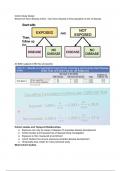
Cohort study design
Should not have disease at first , Cant have disease to find population at risk of disease
All 8000 subjects CHD free at baseline
Cohort studies and Temporal Relationships
● Exposure can only be cause of disease if it precedes disease development
● Cohort studies enroll people free of disease being investigated
● Exposure is then measured at enrollment
● cohort studies thus ensure exposure precedes disease development
● Temporality less certain for cross-sectional study
Most Cohort studies
, ● Consider effect of exposure on multiple disease
● Allow for multiple levels of exposure(to assess does-response)
● Study more than one exposure if possible
Selection of study populations
Cohort studies can often be classified by how study population are selected
● By exposure status
● By defined populations
● By special resources
Selection of study populations by exposure status
● Typical of occupational cohort studies
● Especially if exposure is unique to a specific industry or occupations
● limited variation to exposure within occupation complicates identifying worker who were
not exposed(internal comparison group)
● General population often serves as not exposed(external comparison group)
Selection of study population by defined population
● Recruit subjects from one or more communities of residence
○ Clear community with inclusion and exclusion defined population
○ Following overtime, some point is exposed, follow exposed and unexposed to
see disease risk for each group
○ If everyone in the community is exposed, they can't use it. Can't compare
exposed to unexposed for internal study
● Subjects may not yet be exposed
● Classify subjects by exposure status
○ Dependent on natural variation of exposure
○ typically limited to internal comparison of exposure
○ Consider multiple exposure
● Followup over time
● Frammingham study is an example
Should not have disease at first , Cant have disease to find population at risk of disease
All 8000 subjects CHD free at baseline
Cohort studies and Temporal Relationships
● Exposure can only be cause of disease if it precedes disease development
● Cohort studies enroll people free of disease being investigated
● Exposure is then measured at enrollment
● cohort studies thus ensure exposure precedes disease development
● Temporality less certain for cross-sectional study
Most Cohort studies
, ● Consider effect of exposure on multiple disease
● Allow for multiple levels of exposure(to assess does-response)
● Study more than one exposure if possible
Selection of study populations
Cohort studies can often be classified by how study population are selected
● By exposure status
● By defined populations
● By special resources
Selection of study populations by exposure status
● Typical of occupational cohort studies
● Especially if exposure is unique to a specific industry or occupations
● limited variation to exposure within occupation complicates identifying worker who were
not exposed(internal comparison group)
● General population often serves as not exposed(external comparison group)
Selection of study population by defined population
● Recruit subjects from one or more communities of residence
○ Clear community with inclusion and exclusion defined population
○ Following overtime, some point is exposed, follow exposed and unexposed to
see disease risk for each group
○ If everyone in the community is exposed, they can't use it. Can't compare
exposed to unexposed for internal study
● Subjects may not yet be exposed
● Classify subjects by exposure status
○ Dependent on natural variation of exposure
○ typically limited to internal comparison of exposure
○ Consider multiple exposure
● Followup over time
● Frammingham study is an example


