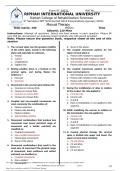
PROJECT MA pioneers Exam 2 (Manual Therapy) Questions and Answers |Updated 2024| definition: manual therapy..
1. The cervical spine has the greatest mobility of the entire spine, mostly in the following plane and especially in extension. a. Frontal b. Sagittal c. Longitudenal d. Sagittal Axis 2. Resting position there is a lordosis in the cervical spine, and during flexion the lordosis is ? a. Increase b. Decrease 3. Movement in the cervical spine follows the a. Concave on concave Rule b. Convex on convex Rule c. Concave on convex Rule d. Convex on concave Rule 4. Coupled and non-coupled movements are most commonly the combination of: a. Flexion-extension b. Flexion-side bending c. Flexion-rotation d. Side bending-rotation 5. Movement combinations that produce less movement ease (more restricted range of movement and a harder end-feel) are classified as: a. Coupled movements b. Non-coupled movements c. Closed pack movements d. None of the above 6. Movement combinations that result in the most ease of movement (the greatest range of movement, least resistance and softest end-feel) are classified as: a. Coupled movements b. Non-coupled c. Closed pack d. None of the above 7. The coupled movement pattern for the upper cervical spine is: a. Flexion with rotation to opposite b. Side bending with rotation to same c. Side bending with rotation to opposite d. Flexion with side bending to same 8. The coupled movement pattern for the lower cervical spine is: a. Side bending and rotation to the opposite b. Flexion with rotation to the opposite c. Flexion with side bending to the same d. Side bending with rotation to same side 9. During the mobilization of atlas in relation to the occiput, the rule applied is: a. Conca
Written for
- Institution
- University Of The People
- Course
- PROJECT MA pioneers
Document information
- Uploaded on
- February 28, 2024
- Number of pages
- 9
- Written in
- 2023/2024
- Type
- Exam (elaborations)
- Contains
- Questions & answers
Subjects

Also available in package deal