OMSA FALL PRACTICE TEST 2024 Questions and Answers (Verified Answers)
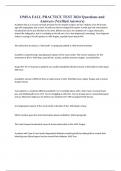
OMSA FALL PRACTICE TEST 2024 Questions and Answers (Verified Answers) A patient who is a 72 year old male presents for his implant surgery. He has a history of an MI 6 years ago with angioplasty and a stent. He tells you that he stopped his aspirin a week ago (not instructed by his physician but he just did that on his own). Before you start, he complains of a vague chest pain, almost like indigestion, but it is radiating to his left arm. He is also diaphoretic (sweating). Your diagnosis (what is causing it) for this patient is: ANS-Angina, possible heart attack (MI) The safest time to extract a "bad tooth" on pregnant patient is: ANS-Second trimester A patient is experiencing a laryngospasm (spasm of the vocal cords). The correct sequence for the treatment of this is: ANS-Stop, pack off site, suction, positive pressure oxygen, succinylcholine Drugs (PO, IM or IV) given to patients are usually metabolized (broken down) in the body by what organ: ANS-Liver A pediatric airway is different than an adult airway in that: ANS-Kids have a larger tongue and a conical shaped airway Your patient is a relatively difficult anesthetic: he is morbidly obese with a short neck, recessed lower jaw, and Mallampatti score of VI. You're struggling to chin him. You've already put in a nasal pharyngeal airway. What else might you try before you intubate him? ANS-Laryngeal-Mask-Airway A laryngospasm (spasm of the vocal cords) a disorder of the: ANS-Upper airway Which monitor gives the most information about ventilation? ANS-Capnograph The most frequent anatomical cause of airway obstruction is the: ANS-Tongue A patient with Type II (non-insulin dependent) diabetes would typically be taking pills to control their blood glucose (blood sugars) and to control their diabetes. ANS-True
Document information
- Uploaded on
- February 27, 2024
- Number of pages
- 10
- Written in
- 2023/2024
- Type
- Exam (elaborations)
- Contains
- Questions & answers