
FRK opsommings
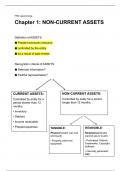
Chapter 1: NON-CURRENT ASSETS
Definition of ASSETS:
❶ Present economic resource
❷ controlled by the entity
❸ as a result of past events.
Recognition criteria of ASSETS:
❶ Relevant information?
❷ Faithful representation?
CURRENT ASSETS: NON-CURRENT ASSETS:
Controlled by entity for a Controlled by entity for a period
period shorter than 12 longer than 12 months.
months.
• Inventory
• Debtors
• Income receivable
• Prepaid expenses TANGIBLE: INTANGIBLE:
• Cash and cash Physical assets (can see Nonphysical assets
and touch) (cannot see or touch)
• Property, plant and • Purchased: Patents
equipment Trademarks, Copyright,
Software
• Internally generated:
R&D
, MEASUREMENT OF NON-CURRENT ASSETS:
INITIAL SUBSEQUENT
RECOGNITION
MEASUREMENT MEASUREMENT
1. INITIAL MEASUREMENT:
Once an item is recognised as a non‐current asset, it must initially be
measured at cost.
Cost of non‐current assets consist of:
• Purchase price, and
• Any directly attributable cost
The initial cost of non‐current assets can be broken down into:
❶ Purchase price, and
❷ Any directly attributable cost
❶ Purchase price ❷ Any directly attributable cost
The purchase price must be calculated Costs are directly attributable costs, if:
after:
• they were necessary
• Deducting: Any discounts, rebates
• to bring the asset to a condition and
and refundable taxes.
location that enables it to be used as
• Adding: Import duties and non‐ intended by management.
refundable taxes.
‐ Cost of site preparation ‐ Initial delivery and handling costs
‐ Installation and assembly costs ‐ Professional fees
, 2. SUBSEQUENT MEASUREMENT:
An entity must decide how the non‐current asset must be measured in
the financial statements in the periods that follow initial recognition.
COST MODEL
Cost less accumulated depreciation (OR amortisation)
Option 1
less accumulated impairment losses
= Carrying amount
REVALUATION MODEL
Option 2 Revalued amount less accumulated depreciation (OR
amortisation) less accumulated impairment losses
= Carrying amount
• Non‐current assets are presented at the carrying amount.
• The carrying amount is determined by the asset’s initial measurement
and subsequent measurement:
The initial measurement of a non‐current asset is always at cost.
The subsequent measurement involves:
o Using the cost model OR the revaluation model.
o The depreciation (tangible assets) and amortisation (intangible
assets) method used to calculate the expense reflecting the use of
the asset.
o The recognition of impairment losses to reflect any changes in the
value of non‐current assets.
Chapter 1: NON-CURRENT ASSETS
Definition of ASSETS:
❶ Present economic resource
❷ controlled by the entity
❸ as a result of past events.
Recognition criteria of ASSETS:
❶ Relevant information?
❷ Faithful representation?
CURRENT ASSETS: NON-CURRENT ASSETS:
Controlled by entity for a Controlled by entity for a period
period shorter than 12 longer than 12 months.
months.
• Inventory
• Debtors
• Income receivable
• Prepaid expenses TANGIBLE: INTANGIBLE:
• Cash and cash Physical assets (can see Nonphysical assets
and touch) (cannot see or touch)
• Property, plant and • Purchased: Patents
equipment Trademarks, Copyright,
Software
• Internally generated:
R&D
, MEASUREMENT OF NON-CURRENT ASSETS:
INITIAL SUBSEQUENT
RECOGNITION
MEASUREMENT MEASUREMENT
1. INITIAL MEASUREMENT:
Once an item is recognised as a non‐current asset, it must initially be
measured at cost.
Cost of non‐current assets consist of:
• Purchase price, and
• Any directly attributable cost
The initial cost of non‐current assets can be broken down into:
❶ Purchase price, and
❷ Any directly attributable cost
❶ Purchase price ❷ Any directly attributable cost
The purchase price must be calculated Costs are directly attributable costs, if:
after:
• they were necessary
• Deducting: Any discounts, rebates
• to bring the asset to a condition and
and refundable taxes.
location that enables it to be used as
• Adding: Import duties and non‐ intended by management.
refundable taxes.
‐ Cost of site preparation ‐ Initial delivery and handling costs
‐ Installation and assembly costs ‐ Professional fees
, 2. SUBSEQUENT MEASUREMENT:
An entity must decide how the non‐current asset must be measured in
the financial statements in the periods that follow initial recognition.
COST MODEL
Cost less accumulated depreciation (OR amortisation)
Option 1
less accumulated impairment losses
= Carrying amount
REVALUATION MODEL
Option 2 Revalued amount less accumulated depreciation (OR
amortisation) less accumulated impairment losses
= Carrying amount
• Non‐current assets are presented at the carrying amount.
• The carrying amount is determined by the asset’s initial measurement
and subsequent measurement:
The initial measurement of a non‐current asset is always at cost.
The subsequent measurement involves:
o Using the cost model OR the revaluation model.
o The depreciation (tangible assets) and amortisation (intangible
assets) method used to calculate the expense reflecting the use of
the asset.
o The recognition of impairment losses to reflect any changes in the
value of non‐current assets.


