2024 EMT JBL Cardiology New Full Questions and Answers ( Included ) 100% Correct
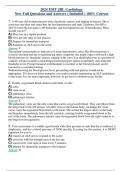
2024 EMT JBL Cardiology New Full Questions and Answers ( Included ) 100% Correct 1. A 49-year-old woman presents with a headache, nausea, and ringing in herears. She is conscious and alert and states that she has hypertension and type 2 diabetes. Her BP is 202/114 mm Hg, her pulse is 60 beats/min, and herrespirations are 16 breaths/min.What should you do? A) Place her in a supine position B) Give her one tube of oral glucose C) Prepare for immediate transport D) Summon an ALS unit to the scene Answer: C The patient's presentation is indicative of acute hypertensive crisis. Her blood pressure is severely elevated and she is experiencing other symptoms one might expect with such a high blood pressure (ie, headache, nausea, ringing in the ears).You should place her in a position of comfort, which is usually a semisitting position;lying hersupine would likely only make her headache worse.Prompt transport to thehospital is essential so her blood pressure can be lowered in a controlled setting. Without knowing her blood glucose level, proceeding with oral glucose would not be appropriate. If it does not delay transport, you could consider summoning an ALS ambulance to the scene. It is far more important, however, to get her to a definitivecare facility 2. Freshly oxygenated blood returns to the heart via the: A) aorta. B) vena cavae. C) pulmonary veins. D) pulmonary arteries. Answer: C The pulmonary veins are the only veins that carries oxygen-rich blood. They carryblood from the lungs back to the left atrium. All other veins in the human body, including the venae cavae, carry deoxygenated blood back to the heart.The aortais the largest artery in the body and branches immediately from the left ventricle, carrying freshly oxygenated blood to the rest of the body. The pulmonary arteries carry deoxygenated blood from the right ventricle to the lungs for reoxygenation. 3. Your assessment of a middle-aged female with chest pressure reveals thatshe is confused, is diaphoretic, and has a blood pressure of 70/50 mm Hg. In caring for this patient, it is MOST important for you to: A) request an ALS unit to respond to the scene. B) assist her with her nitroglycerin if she has any. C) reassess her vital signs at least every 5 minutes. D) prepare for immediate transport to the hospital. Answer: D
Document information
- Uploaded on
- February 24, 2024
- Number of pages
- 44
- Written in
- 2023/2024
- Type
- Exam (elaborations)
- Contains
- Questions & answers