

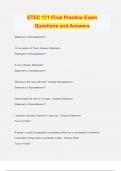
ETEC 171 Final Practice Exam Questions and Answers
ETEC 171 Final Practice Exam Questions and Answers Statement or Nonstatement? I'm so jealous of Fred! -Answer-Statement Statement or Nonstatement? 2+2=5 -Answer-Statement Statement or Nonstatement? Would you like fries with that? -Answer-Nonstatement Statement or Nonstatement? God created the earth in six days. -Answer-Statement Statement or Nonstatement? I wouldn't ride with a hemlet if I were you. -Answer-Statement True or False? A person is guilty of practical inconsistency when he or she asserts or believes inconsistent things about a particular matter. -Answer-False True or False? Self-interested thinking is the tendency to accept and defend beliefs that harmonize with one's own self-interest. -Answer-True True or False? Self-serving bias is the tendency to overrate oneself--to see oneself as being better in some respect than one actually is. -Answer-True True or False? Conformism is the tendency to see one's own group (e.g., nation, tribe, sect, peer group) as being inherently better than others. -Answer-False True or False? Every argument consists of at least two statements. -Answer-True True or False? Inductive arguments always proceed from particular premises to a general conclusion. - Answer-False True or False? Certainly, conclusively, and it logically follows that are common deduction indicator words and phrases. -Answer-True True or False? If an arguer precedes his or her conclusion with the phrase "it must be the case that," then the argument is definitely deductive. -Answer-False True or False? According to the strict necessity test, if an argument's conclusion follows with strict logical necessity from the premises, then the argument should always be treated as deductive. -Answer-True True or False? According to the principle of charity test, we should never attribute to an arguer a weaker argument when the evidence reasonably permits us to attribute to him or her a stronger one. -Answer-True True or False? A syllogism is a three-line argument in which each premise begins with the words all, some, or no. -Answer-False True or False? Modus tollens is a deductively valid pattern of reasoning. -Answer-True True or False? Affirming the consequent is a deductively valid pattern of reasoning. -Answer-False True or False? Arguments based on mathematics are always deductive. -Answer-False True or False? Inductive generalizations always proceed from particular premises to a general conclusion. -Answer-True An argument in which the conclusion is claimed to follow necessarily from the premises is: a. a valid argument. b. an implicative argument. c. a deductive argument. d. an inductive argument. -Answer-a deductive argument Arguments in which the conclusion is claimed to follow probab
Document information
- Uploaded on
- February 22, 2024
- Number of pages
- 19
- Written in
- 2023/2024
- Type
- Exam (elaborations)
- Contains
- Questions & answers


