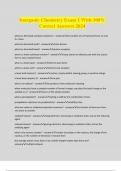
Inorganic Chemistry Exam 1 With 100% Correct Answers 2024
Inorganic Chemistry Exam 1 With 100% Correct Answers 2024 what are Bronsted acid base reactions? - answerthe transfer of a H+ (proton) from an acid to a base what are bronsted acids? - answerproton donors what are bronsted bases? - answerproton acceptors what is a lewis acid-base reaction? - answera base shares an electron pair with the acid to form a new covalent bond what is a lewis base? - answerelectron pair donor what is a lewis acid? - answerelectron pair acceptor a lewis acid requires? - answera proton, empty orbital, leaving group, or positive charge a lewis base requires a? - answerlone pair what is an adduct? - answerthe product of two molecules reacting when molecules have a complex number of formal charges, we place the total charge on the outside as a? - answerfeature of the whole complex what is precipitation? - answermaking a solid by the combination of ions precipitation reactions are predicted by? - answersolubility rules what are redox or oxidation/reduction reactions? - answerthe transfer of electrons from one atom to another oxidized means? - answerlosing electrons, increasing in oxidation state, acts as the reducing agent reduced means? - answergaining electrons, decreasing in oxidation state, acts as the oxidizing agent what is the atomic number? - answernumber of protons in the nucleus, the charge of the nucleus, or the number of electrons in neutral form the average atomic mass that is not a whole integer implies that there are? - answermultiple isotopes what is the atomic mass number equal to? - answerthe number protons plus neutrons the less electronegative something is, the harder it is for it to? - answerfollow the octet rule because it can't get more electrons as easily the top number on an isotope is the? - answeratomic mass number the bottom number on an isotope is the? - answernumber of protons what makes an isotope more stable? - answereven number of protons, even numbers of neutrons, magic numbers that are especially stable (2, 8, 20, 28, etc.), a particular ratio of protons to neutrons periodic elements with parentheses around their atomic mass means there are? - answerno stable isotopes everything above atomic number? - answer83 has no stable isotopes What forces hold the nucleus together? - answerstrong nuclear force or residual strong force what is the strong nuclear force equal to? - answerFrs=1/r^6 (r=distance) due to distance, the strength of the strong nuclear force? - answerfalls over very quickly with longer distances, but dominates at short distances. It is strong only at very short distances. It is attractive between protons the coulomb force is equal to? - answerFc=kq1q2/r^2 since the coulomb force is repulsive between protons, it dominates and causes the nucleus to fall apart at? - answerlonger distances, it dominates at a scale of very heavy elements less nucleons interacting within the nucleus also? - answerlowers the strength of the residual strong force because there aren't as many nucleons interacting with one another once you have too many nucleons? - answerthe strength of the residual strong force begins to decrease what is the typical proton to neutron ratio to determine stability of isotopes? - answerless than one for two distinct isotopes (H1 and He3), and 1 to 1 for some isotopes, and then it increases steadily to
Geschreven voor
- Instelling
- Inorganic Chemistry
- Vak
- Inorganic Chemistry
Documentinformatie
- Geüpload op
- 19 februari 2024
- Aantal pagina's
- 11
- Geschreven in
- 2023/2024
- Type
- Tentamen (uitwerkingen)
- Bevat
- Vragen en antwoorden
Onderwerpen
-
inorganic chemistry exam 1 with 100 correct answe

Ook beschikbaar in voordeelbundel