
Topic 5: The Water Cycle and Water Insecurity
Enquiry question 1: What are the processes operating within the hydrological cycle from global to local scale?
Key idea 5.1: The global hydrological cycle is of enormous importance to life on earth.
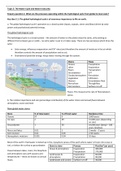
a. The global hydrological cycle’s operation as a closed system (inputs, outputs, stores and flows) driven by solar
power and gravitational potential energy.
The global hydrological cycle
The hydrological cycle is a closed system – the amount of water on the planet stays the same, only existing as
different forms (liquid, gas or solid) – no extra water is put in or taken away. There are two processes which drive the
cycle:
Solar energy: influences evaporation and EVT rates (and therefore the amount of moisture in the air which
therefore controls the amount of precipitation and so on).
Gravitational potential energy: keeps water moving through the system.
Stores Flows
Oceans Precipitation
Lakes Evaporation
Rivers Transpiration
Groundwater EVT
Clouds/atmosphere Percolation
Vegetation Infiltration
Glaciers Groundwater flow
Permafrost Throughflow
Soil moisture Surface run-off
Fluxes: This measures the rate of flow between
stores.
b. The relative importance and size (percentage contribution) of the water stores and annual fluxes between
atmosphere, ocean and land.
Main global water stores
Store % of total water % of fresh water Residence time
Oceans 97 0 3,600 years
Ice caps 2 69 15,000 years (depending
on size)
Groundwater 1 30 10,000 years (deep) – 100
years (shallow)
Rivers and lakes 0.01 1 2 weeks – 5 years
Soil moisture 0.01 0.05 2-50 weeks
Atmospheric moisture 0.001 0.04 10 days
Most of the earth’s freshwater is locked up in the cryosphere (areas of the earth where water is frozen into snow or
ice), or below the surface as groundwater. Store to store Process Flux (km3 per year)
Ocean & atmosphere Evaporation 400,000
Fluxes between lakes, rivers, the biosphere Precipitation 370,000
and atmosphere vary with seasons and Landmasses & Evaporation 60,000
temperatures – these are known as annual atmosphere Precipitation 90,000
fluxes. Landmasses and oceans Surface run-off 30,000


