100% de satisfacción garantizada Inmediatamente disponible después del pago Tanto en línea como en PDF No estas atado a nada 4.2 TrustPilot
logo-home
Examen

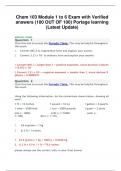
Chem 103 Module 1 to 6 Exam with Verified answers (100 OUT OF 100) Portage learning (Latest Update)

Puntuación
4.8
(6)
Vendido
33
Páginas
35
Grado
A+
Subido en
15-02-2024
Escrito en
2023/2024

Chem 103 Module 1 to 6 Exam with Verified answers (100 OUT OF 100) Portage learning (Latest Update) MODULE 1 EXAM Question 1 Click this link to access the Periodic Table. This may be helpful throughout the exam. 1. Convert 845.3 to exponential form and explain your answer. 2. Convert 3.21 x 10⁻⁵ to ordinary form and explain your answer. 1. Convert 845.3 = larger than 1 = positive exponent, move decimal 2 places = 8.453 x 10² 2. Convert 3.21 x 10-5 = negative exponent = smaller than 1, move decimal 5 places = 0.0000321 Question 2 Click this link to access the Periodic Table. This may be helpful throughout the exam. Using the following information, do the conversions shown below, showing all work: 1 ft = 12 inches 1 pound = 16 oz 1 gallon = 4 quarts 1 mile = 5280 feet 1 ton = 2000 pounds 1 quart = 2 pints kilo (= 1000) 1/100) milli (= 1/1000) deci (= 1/10) centi (= 1. 24.6 grams = ? kg 2. 6.3 ft = ? inches 1. 24.6 grams x 1 kg / 1000 g = 0.0246 kg 2. 6.3 ft x 12 in / 1 ft = 75.6 inches please always use the correct units in your final answer Question 3 Click this link to access the Periodic Table. This may be helpful throughout the exam. Do the conversions shown below, showing all work: 1. 28oC = ? oK 2. 158oF = ? oC 3. 343oK = ? oF 1. 28oC + 273 = 301 oK oC → oK (make larger) +273 2. 158oF - 32 ÷ 1.8 = 70 oC oF → oC (make smaller) -32 ÷1.8 3. 343oK - 273 = 70 oC x 1.8 + 32 = 158 oF oK → oC → oF Question 4 Click this link to access the Periodic Table. This may be helpful throughout the exam. Be sure to show the correct number of significant figures in each calculation. 1. Show the calculation of the mass of a 18.6 ml sample of freon with density of 1.49 g/ml 2. Show the calculation of the density of crude oil if 26.3 g occupies 30.5 ml. 1. M = D x V = 1.49 x 18.6 = 27.7 g 2. D = M / V = 26.3 / 30.5 = 0.862 g/ml Question 5 Click this link to access the Periodic Table. This may be helpful throughout the exam. 1. 3.0600 contains ? significant figures. 2. 0.0151 contains ? significant figures. 3. 3.0600 ÷ 0.0151 = ? (give answer to correct number of significant figures) 1. 3.0600 contains 5 significant figures. 2. 0.0151 contains 3 significant figures. 3. 3.0600 ÷ 0.0151 = 202.649 = 203 (to 3 significant figures for 0.0151) Question 6 Click this link to access the Periodic Table. This may be helpful throughout the exam. Classify each of the following as an element, compound, solution or heterogeneous mixture and explain your answer. 1. Coca cola 2. Calcium 3. Chili 1. Coca cola - is not on periodic table (not element) - no element names (not compound) appears to be one substance = Solution 2. Calcium - is on periodic table = Element 3. Chili - is not on periodic table (not element) - no element names (not compound) appears as more than one substance (meat, beans, sauce) = Hetero Mix Question 7 Click this link to access the Periodic Table. This may be helpful throughout the exam. Classify each of the following as a chemical change or a physical change 1. Charcoal burns 2. Mixing cake batter with water 3. Baking the batter to a cake 1. Charcoal burns - burning always = chemical change 2. Mixing cake batter with water - mixing = physical change 3. Baking the batter to a cake - baking converts batter to new material = chemical change Click this link to access the Periodic Table. This may be helpful throughout the exam. Show the full Nuclear symbol including any + or - charge (n), the atomic number (y), the mass number (x) and the correct element symbol (Z) for each element for which the protons, neutrons and electrons are shown - symbol should appear as follows: xZy+/- n 31 protons, 39 neutrons, 28 electrons 31 protons = Ga31, 39 neutrons = 70Ga31, 28 electrons = (+31 - 28 = +3) = 70Ga +3 Question 9 Click this link to access the Periodic Table. This may be helpful throughout the exam. Name each of the following chemical compounds. Be sure to name all acids as acids (NOT for instance as binary compounds) 1. PF5 2. Al2(CO3)3 3. H2CrO4 1. PF5 - binary molecular = phosphorus pentafluoride 2. Al2(CO3)3 - nonbinary ionic = aluminum carbonate 3. H2CrO4 - nonbinary acid = chromic acid incorrect fluoride prefix Question 10 Click this link to access the Periodic Table. This may be helpful throughout the exam. Write the formula for each of the following chemical compounds explaining the answer with appropriate charges and/or prefixes and/or suffixes. 1. Carbon monoxide 2. Manganese (IV) acetate 3. Phosphorous acid 1. Carbon monoxide - ide = binary, mono = 1 O = CO 2. Manganese (IV) acetate - Mn+4, C2H3O -1 = Mn(C2H3O2)4 3. Phosphorous acid - nonbinary acid of H + phosphite (PO -3) = H PO MODULE 2 EXAM Question 1 Click this link to access the Periodic Table. This may be helpful throughout the exam. Show the calculation of the molecular weight for the following compounds, reporting your answer to 2 places after the decimal. 1. Al2(CO3)3 2. C8H6NO4Cl 1. 2Al + 3C + 9O = 233.99 2. 8C + 6H + N + 4O + Cl = 215.59 Question 2 Click this link to access the Periodic Table. This may be helpful throughout the exam. Show the calculation of the number of moles in the given amount of the following substances. Report your answerto 3 significant figures. 1. 13.0 grams of (NH4)2CO3 2. 16.0 grams of C8H6NO4Br 1. Moles = grams / molecular weight = 13.0 / 96.09 = 0.135 mole 2. Moles = grams / molecular weight = 16.0 / 260.04 = 0.0615 mole Question 3 Click this link to access the Periodic Table. This may be helpful throughout the exam. Show the calculation of the number of grams in the given amount of the following substances. Report your answer to 1 place after the decimal. 1. 1.20 moles of (NH4)2CO3 2. 1.04 moles of C8H6NO4Br 1. Grams = Moles x molecular weight = 1.20 x 96.09 = 115.3 grams 2. Grams = Moles x molecular weight = 1.04 x 260.04 = 270.4 grams Question 4 Click this link to access the Periodic Table. This may be helpful throughout the exam. Show the calculation of the percent of each element present in the following compounds. Report your answer to 2 places after the decimal. 1. (NH4)2CrO4 2. C8H8NOI 1. %N = 2 x 14.01/152.08 x 100 = 18.43% %H = 8 x 1.008/152.08 x 100 = 5.30% %Cr = 1 x 52.00/152.08 x 100 = 34.20% %O = 4 x 16.00/152.08 x 100 = 42.08% 2. %C = 8 x 12.01/261.05 x 100 = 36.80% %H = 8 x 1.008/261.05 x 100 = 3.09% %N = 1 x 14.01/261.05 x 100 = 5.37% %O = 1 x 16.00/261.05 x 100 = 6.13% %I = 1 x 126.9/261.05 x 100 = 48.61% Question 5 Click this link to access the Periodic Table. This may be helpful throughout the exam. Show the calculation of the empirical formula for each compound whose elemental composition is shown below. 38.76% Ca, 19.87% P, 41.27% O 38.76% Ca / 40.08 = 0.9671 / 0.6416 = 1.5 x 2 = 3 19.87% P / 30.97 = 0.6416 / 0.6416 = 1 x 2 = 2 41.27% O / 16.00 = 2.579 / 0.6416 = 4 x 2 = 8 → Ca3P2O8 Question 6 Click this link to access the Periodic Table. This may be helpful throughout the exam. Balance each of the following equations by placing coefficients in front of each substance. 1. C6H6 + O2 → CO2 + H2O 2. As + O2 → As2O5 3. Al2(SO4)3 + Ca(OH)2 → Al(OH)3 + CaSO4 1. 2 C6H6 + 15 O2 → 12 CO2 + 6 H2O 2. 4 As + 5 O2 → 2 As2O5 3. Al2(SO4)3 + 3 Ca(OH)2 → 2 Al(OH)3 + 3 CaSO4 Question 7 Click this link to access the Periodic Table. This may be helpful throughout the exam. Classify each of the following reactions as either: Combination Decomposition Combustion Double Replacement Single Replacement 1. H2SO4 → SO3 + H2O 2. S + 3 F2 → SF6 3. H2 + NiO → Ni + H2O 1. H2SO4 → SO3 + H2O = Decomposition, One reactant → Two Products 2. S + 3 F2 → SF6 = Combination. Two reactants→ One product 3. H2 + NiO → Ni + H2O = Single Replacement, Hydrogen displaces metal ion Question 8 Click this link to access the Periodic Table. This may be helpful throughout the exam. Show the calculation of the oxidation number (charge) of ONLY the atoms which are changing in the following redox equations. Na2HAsO3 + KBrO3 + HCl → NaCl + KBr + H3AsO4 Na2HAsO3 + KBrO3 + HCl → NaCl + KBr + H3AsO4 Na2HAsO3: Na is metal in group I = +1 (total is +2), H = +1, each O is -2 (total is -6), so As is +3 H3AsO4: H is +1 (total is +3), each O is -2 (total is -8), so As is +5 KBrO3: K is metal in group I = +1, each O is -2 (total is -6), so Br is +5 KBr: K is metal in group I = +1, so Br is -1 Question 9 Click this link to access the Periodic Table. This may be helpful throughout the exam. Show the balancing of the following redox equation, including the determination of the oxidation number (charge) of ONLY the atoms which are changing. KMnO4 + KI + H2O → KIO3 + MnO2 + KOH Mn compounds x 2 ; I compounds x 1 = 2KMnO4 + 1 KI + 1 H2O → 1 KIO3 + 2MnO2 + 2KOH KMnO4 + KI + H2O → KIO3 + MnO2 + KOH KMnO4: K is metal in group I = +1, each O is -2 (total is -8), so Mn is +7 MnO2: Each O is -2 (total is -4), so Mn is +4 KI: K is metal in group I = +1, so I is -1 KIO3: K is metal in group I = +1, each O is -2 (total is -6), so I is +5 Since Mn (on left side) is +7 and Mn (on right side) is +4: Mn changes by 3 Since I (on left side) is -1 and I (on right side) is +5: I changes by 6 Multiply Mn compounds by 2 and I compounds by 1 and after balancing other atoms = 2 KMnO4 + 1 KI + 1 H2O → 1 KIO3 + 2 MnO2 + 2 KOH Question 10 Click this link to access the Periodic Table. This may be helpful throughout the exam. Show the balanced equation and the calculation of the number of moles and grams of CO2 formed from 20.6 grams of C6H6. Show your answers to 3 significant figures. C6H6 + O2 → CO2 + H2O Molar mass of CO2 = 44.01 g/mol mass of CO2 = 1.5822 ml x 44.01 g/mol =69.63 grams mass of CO2 = 69.63 grams moles of CO2 = 1.58 mole 2 C6H6 + 15 O2 → 12 CO2 + 6 H2O 20.6 g / (6 x 12.01 + 6 x 1.008) = 20.6 / 78.108 = 0.2637 mole x 12/2 = 1.58 mole CO2 1.582 mole CO2 x (12.01 + 2 x 16.00) = 69.6 g CO2 MODULE 3 EXAM Click this link to access the Periodic Table. This may be helpful throughout the exam. A reaction between HCl and NaOH is being studied in a styrofoam coffee cup with NO lid and the heat given off is measured by means of a thermometer immersed in the reaction mixture. Enter the correct thermochemistry term to describe the item listed. 1. The type of thermochemical process 2. The amount of heat released in the reaction of HCl with NaOH 1. Heat given off = Exothermic process 2. The amount of heat released = Heat of reaction Question 2 Click this link to access the Periodic Table. This may be helpful throughout the exam. 1. Show the calculation of the final temperature of the mixture when a 22.8 gram sample of water at 74.6oC is added to a 14.3 gram sample of water at 24.3oC in a coffee cup calorimeter. c (water) = 4.184 J/g oC 2. Show the calculation of the energy involved in freezing 54.3 grams of water at 0oC if the Heat of Fusion for water is 0.334 kJ/g 1. - (mwarn H2O x cwarn H2O x ∆twarn H2O) = (mcool H2O x ccool H2O x ∆tcool H2O) - [22.8 g x 4.184 J/g oC x (Tmix - 74.6oC)] = [14.3 g x 4.184 J/g oC x (Tmix - 24.3oC)] - [95.3952 J/oC x (Tmix - 74.6oC)] = [59.8312 J/oC x (Tmix - 24.3oC)] Tmix = 55.2oC 2. ql↔s = m x ∆Hfusion = 54.3 g x 0.334 kJ/g = 18.14 kJ (since heat is removed) = - 18.14 kJ Question 3 Click this link to access the Periodic Table. This may be helpful throughout the exam. Show the calculation of the amount of heat involved if 35.6 g of H2S is reacted with excess O2 to yield sulfur trioxide and water by the following reaction equation. Report your answer to 4 significant figures. 2 H2S (g) + 3 O2 (g) → 2 SO2 (g) + 2 H2O (g) ΔH = - 1124 kJ 1 mol H2s = 34.1 g of H2S = 603.2 kj (35.6g/34.1 g) x -603.2 kJ = (1.0439) x (-603.2 kJ) = -629. 7 kj 2 H2S (g) + 3 O2 (g) → 2 SO2 (g) + 2 H2O (g) ΔH = - 1124 kJ ΔHrx is for 2 mole of H2S reaction uses 35.6 g of H2S = 35.6/34.086 = 1.044 mole of H2S q = ΔHrx x new moles / original moles q = -1124 kJ x 1.044 mole of H2S / 2 mole H2S = 586.7 given off Question 4 Click this link to access the Periodic Table. This may be helpful throughout the exam. Show the calculation of the heat of reaction (ΔHrxn) for the reaction: 3 C (graphite) + 4 H2 (g) → C3H8 (g) by using the following thermochemical data: C (graphite) kJ + O2 (g) → CO2 (g) ΔH = - 393.51 2 H2 (s) kJ + O2 (g) → 2 H2O(l) ΔH = - 571.66 C3H8 (g) + 5 O2 (g) → 3 CO2 (g) + 4 H2O(l) ΔH = - 2220.0 kJ Your Answer: 3 (C (graphite) + O2 (g) → CO2 (g) ΔH = - 393.51 kJ) 2 (2 H2 (s) + O2 (g) → 2 H2O(l) ΔH = - 571.66 kJ) 3 CO2 (g) + 4 H2O(l) → C3H8 (g) + 5 O2 (g) ΔH = + 2220.0 kJ 3 C (graphite) + 4 H2 (g) → C3H8 (g) ΔHrxn = - 103.85 kJ ΔHrxn = 3(- 393.51) + 2(- 571.66) + 2220.0 = - 103.85 Question 5 Click this link to access the Periodic Table. This may be helpful throughout the exam. Show the calculation of the heat of reaction (ΔHrxn) for the reaction: 2 CH4 (g) + 3 O2 (g) → 2 CO (g) + 4 H2O (l) by using the following ΔHf0 data: ΔH 0 CH (g) = -74.6 kJ/mole, ΔH 0 CO (g) = -110.5 kJ/mole, ΔH 0 H O (l) = -285.8 kJ/mole 2 CH4 (g) + 3 O2 (g) → 2 CO (g) + 4 H2O (l) ΔHf0 CH4 (g) = -74.6 kJ/mole, ΔHf0 CO (g) = -110.5 kJ/mole, ΔHf0 H2O (l) = -285.8 kJ/mole ΔHrxn = 2(+74.6) + 3(0) + 2(-110.5) + 4(-285.8) = - 1215.0 kJ/mole Question 6 Click this link to access the Periodic Table. This may be helpful throughout the exam. Show the calculation of the new temperature of a gas sample has an original volume of 740 ml when collected at 710 mm and 35oC when the volume becomes 460 ml at 1.20 atm. P1V1/T1 = P2V2/T2 T2 = 1.2 x 460x308 / 0.934 x 740 = 245.98 kelvin = -27.17oC (Pi x Vi ) / Ti = (Pf x Vf ) / Tf 740 ml/1000 = 0.740 liters = Vi 710 mm/760 = 0.934 atm = Pi 460 ml/1000 = 0.460 liters = Vf 1.20 atm = Pf 35oC + 273 = 308oK = Ti (0.934) x (0.740) / 308 = (1.20) x (0.460) / Tf Tf = 246 oK Question 7 Click this link to access the Periodic Table. This may be helpful throughout the exam. Show the calculation of the volume occupied by a gas sample containing 0.632 mole collected at 710 mm and 35oC. P x V = n x R x T 0.632 mole = n R = 0.0821 710 mm/760 = 0.934 atm = P 35oC + 273 = 308oK = T (0.934) x V = (0.632) x (0.0821) x (308) V = 17.1 liters Question 8 Click this link to access the Periodic Table. This may be helpful throughout the exam. Show the calculation of the volume of CO2 gas formed by the combustion of 25.5 grams of C6H6 at 20oC and 1.25 atm. The combustion of benzene (C6H6) takes place by the following reaction equation. 2 C6H6 (g) + 15 O2 (g) → 12 CO2 (g) + 6 H2O (g) (MW = 78) (MW = 32) (MW = 44) (MW = 18) 2 C6H6 (g) + 15 O2 (g) → 12 CO2 (g) + 6 H2O (g) 25.5 grams 37.75 liters ↓ ↑ by V = nRT / P = (1.9614)(0.0821)(293)/1.25 0.3269 mol → 12/2 x 0.3269 mol Click this link to access the Periodic Table. This may be helpful throughout the exam. Show the calculation of the mole fraction of each gas in a 1.00 liter container holding a mixture of 7.60 g of N2 and 8.40 g of O2 at 25oC. nN2 = gN2 / (MWN2) = 7.60 g / 28.02 = 0.2712 mol nO2 = gO2 / (MWO2) = 8.40 g / 32.00 = 0.2625 mol XN2 = 0.2712 / (0.2712 + 0.2625) = 0.5082 XO2 = 0.2625 / (0.2712 + 0.2625) = 0.4918 Click this link to access the Periodic Table. This may be helpful throughout the exam. Show the calculation of the molecular weight of an unknown gas if the rate of effusion of carbon dioxide gas (CO2) is 1.83 times faster than that of an unknown gas. (rN2 /runknown)2 = MWunknown / MWCO2 (1.83/1)2 = MWunknown / 44.01 MWunknown = (1.83)2 x 44.01 = 147.4 calculation error; minus 2.5 MODULE 4 EXAM Click this link to access the Periodic Table. This may be helpful throughout the exam. Write the subshell electron configuration (i.e.1s2 2s2, etc.) for the Fe26 atom. Fe26 = 26 electrons = 1s2 2s2 2p6 3s2 3p6 4s2 3d6 Click this link to access the Periodic Table.This may be helpful throughout the exam. Write the subshell electron configuration (i.e.1s2 2s2, etc.) for the S16 atom. S16 = 16 electrons = 1s2 2s2 2p6 3s2 3p4 Click this link to access the Periodic Table.This may be helpful throughout the exam. Write the subshell electron configuration (i.e.1s2 2s2, etc.) for the P15 atom and identify which are valence (outer shell) electrons and determine how many valence electrons there are. P15 = 15 electrons = 1s2 2s2 2p6 3s2 3p3 = 5 valence electrons Question 4 Click this link to access the Periodic Table.This may be helpful throughout the exam. * For the following question, use the "Insert Math Equation" tool (indicated by the x icon on the toolbar and then choose arrows from the window which opens). Using up and down arrows, write the orbital diagram for the Ti22 atom. Ti22 = 1s2 2s2 2p6 3s2 3p6 4s2 3d2 ↑↓ ↑↓ ↑↓ ↑↓ ↑↓ ↑↓ ↑↓ ↑↓ ↑↓ ↑↓ ↑ ↑ Question 5 Click this link to access the Periodic Table.This may be helpful throughout the exam. * For the following question, use the "Insert Math Equation" tool (indicated by the x icon on the toolbar and then choose arrows from the window which opens). Using up and down arrows, write the orbital diagram for the V23 atom and identify which are unpaired electrons and determine how many unpaired electrons there are. V23 = 1s2 2s2 2p6 3s2 3p6 4s2 3d3 ↑↓ ↑↓ ↑↓ ↑↓ ↑↓ ↑↓ ↑↓ ↑↓ ↑↓ ↑↓ ↑ ↑ ↑ = 3 unpaired electrons Question 6 Click this link to access the Periodic Table.This may be helpful throughout the exam. Write the subshell electron configuration (i.e.1s2 2s2, etc.) for the Fe26 atom and then identify the last electron to fill and write the 4 quantum numbers (n, l, ml and ms) for this electron. Fe26 = 1s2 2s2 2p6 3s2 3p6 4s2 3d6 : n=3, l=2, ml = -2, ms = -1/2 Question 7 Click this link to access the Periodic Table.This may be helpful throughout the exam. 1. Arrange the following elements in a vertical list from smallest (top) to largest (bottom) atomic size: Cl, F, Br 2. Arrange the following elements in a vertical list from highest (top) to lowest (bottom) electronegativity: S, Si, P 3. Arrange the following elements in a vertical list from lowest (top) to highest (bottom) ionization energy: S, Te, Se Your Answer: 1. F Cl Br 2. S P Si 3. Te Se S Question 8 Click this link to access the Periodic Table.This may be helpful throughout the exam. 1. List and explain which of the following atoms forms a positive ion with more difficulty. Sn or I 2. List and explain which of the following is the smaller atom. Sn or Te 1. I forms a positive ion less easily than Sn since ionization potential increases as you go to the right in a period which means that I with the higher ionization potential requires more energy to lose an electron and form a positive ion so it does so less easily. 2. Te is smaller than Sn since atomic size decreases as you go to the right in a period which means that Te which is further to the right is smaller. Question 9 Click this link to access the Periodic Table.This may be helpful throughout the exam. On a piece of scratch paper, draw the orbital configuration of the C6 atom and use it to draw the Lewis structure for the C6 atom. Then choose the correct Lewis structure for C6 from the options listed below. C. Question 10 Click this link to access the Periodic Table.This may be helpful throughout the exam. On a piece of scratch paper, draw the orbital configuration of the As33 atom and use it to draw the Lewis structure for the As33 atom. Then choose the correct Lewis structure for the As33 from the options listed below. Your Answer: As33 = 1s2 2s2 2p6 3s2 3p6 3d10 4s2 4p3 ↑↓ ↑↓ ↑↓↑↓↑↓ ↑↓ ↑↓↑↓↑↓ ↑↓ ↑↓↑↓↑↓↑↓↑↓↑↓ ↑↑↑ B MODULE 5 EXAM Question 1 Click this link to access the Periodic Table. This may be helpful throughout the exam. Show the determination of the charge on the ion formed by the Se34 atom. Se34 (nonmetal = gain electrons) 1s2 2s2 2p6 3s2 3p6 4s2 3d10 4p4 gain 2e → Se-2 Question 2 Click this link to access the Periodic Table. This may be helpful throughout the exam. H = 2.1 Li = 1.0 Be = 1.5 B = 2.0 C = 2.5 N = 3.0 O= 3.5 F = 4.0 Na = 1.0 2.1 Mg = 1.2 S = 2.5 Al = 1.5 Cl = 3.0 Si = 1.8 P = K = 0.8 2.0 Ca = 1.0 Se = 2.4 Ga = 1.6 Br = 2.8 Ge = 1.8 As = Using the electronegativities from the table above, show the determination of the polarity of each different type of bond in the following molecule H-C bond electronegativity difference = 2.5 - 2.1 = 0.4 <0.5 bond is Nonpolar C-O bond electronegativity difference = 3.5 - 2.5 = 1.0 1.6 - 0.5 bond is Polar Question 3 Click this link to access the Periodic Table. This may be helpful throughout the exam. On a piece of scratch paper, draw the Lewis structure for the ClO -1 ion. Then choose the correct Lewis structure for ClO -1 from the options listed below. (B) Question 4 Click this link to access the Periodic Table. This may be helpful throughout the exam. On a piece of scratch paper, draw the Lewis structure for H2SO3. Then choose the correct Lewis structure for H2SO3 from the options listed below. (D) Question 5 Click this link to access the Periodic Table. This may be helpful throughout the exam. Determine the electron geometry and explain your answer for the Si atom in SiH4. The Si atom in SiH4 has 4 groups of electrons around it in its Lewis structure, therefore, its electron geometry would be tetrahedral. Question 6 Click this link to access the Periodic Table. This may be helpful throughout the exam. Determine the hybridization and explain your answer for the Si atom in SiH4. The Si atom in SiH4 has 4 groups of electrons around it in its Lewis structure, therefore, its hybridization would be sp3. Question 7 Click this link to access the Periodic Table. This may be helpful throughout the exam. Determine the shape and explain your answer for HCN. The C atom in HCN has 2 groups of electrons around it in its Lewis structure, therefore, its electron geometry would be linear and since there are 2 atoms around the central C atom, the shape would be linear. Question 8 Click this link to access the Periodic Table. This may be helpful throughout the exam. H = 2.1 Li = 1.0 3.0 Be = 1.5 B = 2.0 O= 3.5 F = 4.0 C = 2.5 N = Na = 1.0 2.1 Mg = 1.2 Al = 1.5 S = 2.5 Cl = 3.0 Si = 1.8 P = K = 0.8 2.0 Ca = 1.0 Ga = 1.6 Se = 2.4 Br = 2.8 Ge = 1.8 As = Use the electronegativities above and your knowledge of the shape of PH3 to determine the molecular polarity of PH3 explaining your answer in detail. The shape of PH3 is triangular pyramid and since the P-H bonds are all nonpolar, PH3 would be nonpolar since all the bonds are nonpolar. Question 9 Click this link to access the Periodic Table. This may be helpful throughout the exam. Is KNO3 Polar, Ionic or Nonpolar and List and Explain whether it is Soluble or Insoluble in Water? KNO3 is Ionic since it has Ionic bonds and since it is Ionic it is Soluble in water. Question 10 Click this link to access the Periodic Table. This may be helpful throughout the exam. Arrange the following compounds in a vertical list from highest boiling point (top) to lowest boiling point (bottom) and explain your answer on the basis of whether the substance is Polar, Nonpolar, Ionic, Metallic or Hydrogen bonding: Ar, NH3, Zn, HBr, NaBr Please note in this question you are not being asked to list BPs but the compounds in a list from highest to lowest BP on the basis of the type of compound. NaBr (ionic) = Zn (metallic) NH3 (Hydrogen Bonding) HBr (Polar) Ar (Nonpolar) MODULE 6 EXAM Click this link to access the Periodic Table. This may be helpful throughout the exam. List and explain if each of the following solutions conducts an electric current: sodium chloride (NaCl), hydrochloric acid (HCl) and sugar (C6H12O6). Sodium chloride (NaCl) is an ionic compound and conducts since it forms ions in solution. Hydrochloric acid (HCl) is a polar compound and conducts since it forms ions in solution. Sugar (C6H12O6) is a molecular compound but does not form ions in solution so it does not conduct. Explain how and why the presence of a solute affects the boiling point of a solvent. The presence of a solute raises the boiling point of a solvent by lowering the vapor pressure of the solvent. With this lower vapor pressure, more heat (a higher boiling point) is required to raise the vapor pressure to atmospheric pressure. Click this link to access the Periodic Table. This may be helpful throughout the exam. Rank and explain how the freezing point of 0.100 m solutions of the following ionic electrolytes compare, List from lowest freezing point to highest freezing point. GaCl3, Al2(SO4)3, NaI, MgCl2 Your Answer: Al2(SO4)3 -> 2Al3+, 3SO4 -2 = = 5 ions -> most ions = lowest freezing point GaCl2 -> Ga3+, Cl- = 4 ions MgCl2 = 3 ions NaI = 2 ions - > least ions = highest freezing point GaCl3 3rd lowest FP → Ga+3 + 3 Cl- ∆tf = 1.86 x 0.1 x 4 = Al2(SO4)3 lowest FP → 2 Al+3 + 3 SO4 -3 ∆tf = 1.86 x 0.1 x 5 = NaI = highest FP → Na+ + I- ∆tf = 1.86 x 0.1 x 2 MgCl2 = 2nd lowest FP → Mg+2 + 2 Cl- ∆tf = 1.86 x 0.1 x 3 FP: Al2(SO4)3 < GaCl3 < MgCl2 < NaI Click this link to access the Periodic Table. This may be helpful throughout the exam. Show the calculation of the mass percent solute in a solution of 20.8 grams of Ba(NO3)2 in 400 grams of water. Report your answer to 3 significant figures. Mass % = (20.8 / 20.8 + 400) x 100 = 4.94% Click this link to access the Periodic Table. This may be helpful throughout the exam. Show the calculation of the molality of a solution made by dissolving 28.5 grams of C8H16O8 in 400 grams of water. Report your answer to 3 significant figures. molality = (gsolute / MW) / (gsolvent / 1000) molality = (28.5 / 240.208) / (400 / 1000) = 0.297 m Click this link to access the Periodic Table. This may be helpful throughout the exam. Show the calculation of the molarity of a solution made by dissolving 35.9 grams of Mg(NO3)2 to make 400 ml of solution. Report your answer to 3 significant figures. Molarity = (gsolute / MW) / (mlsolvent / 1000) Molarity = (35.9 / 148.325) / (400 / 1000) = 0.605 M Click this link to access the Periodic Table. This may be helpful throughout the exam. Show the calculation of the mass of Ba(NO3)2 needed to make 250 ml of a 0.200 M solution. Report your answer to 3 significant figures. Molarity = (moles) / (mlsolvent / 1000) 0.200 = (moles) / (250 / 1000) Moles = 0.200 x 0.250 = 0.0500 Moles = (gsolute / MW) 0.0500 = (gsolute / 261.55) gsolute = 0.0500 x 261.55 = 13.1 g Click this link to access the Periodic Table. This may be helpful throughout the exam. Show the calculation of the volume of 0.667 M solution which can be prepared using 37.5 grams of Ba(NO3)2. molessolute = gsolute / MW molessolute = 37.5 g / 261.55 = 0.1434 mol Molarity = moles / (mL /1000) 0.667 = 0.1434 / (mL / 1000) mL / 1000 = 0.1434 / 0.667 = 0.2150 mL = 0.2150 x 1000 = 215 mL Click this link to access the Periodic Table. This may be helpful throughout the exam. Show the calculation of the boiling point of a solution made by dissolving 20.9 grams of the nonelectrolyte C4H8O4 in 250 grams of water. Kb for water is 0.51, BP of pure water is 100oC. Calculate your answer to 0.01oC. molality = (gsolute / MW) / (gsolvent / 1000) molality = (20.9 / 120.104) / (250 / 1000) = 0.6961 m ∆tb = Kb x m = 0.51 x 0.6961 = 0.355oC BPsolution = BPsolvent - ∆tb = 100oC + 0.355 = 100.35oC Click this link to access the Periodic Table. This may be helpful throughout the exam. Show the calculation of the molar mass (molecular weight) of a solute if a solution of 14.5 grams of the solute in 200 grams of water has a freezing point of -1.35oC. Kf for water is 1.86 and the freezing point of pure water is 0oC. Calculate your answer to 0.1 g/mole. ∆tf = Kf x m molality = ∆tf / Kf = 1.35 / 1.86 = 0.726 m molality = (gsolute / MW) / (gsolvent / 1000) 0.726 = (moles) / (200 / 1000) Moles = 0.726 x 0.200 = 0.1452 0.1452 = (14.5 / MW) MW = 14.5 / 0.1452 = 99.9 FINAL EXAM Question 1 Click this link to access the Periodic Table. This may be helpful throughout the exam. 1. Convert 845.3 to exponential form and explain your answer. 2. Convert 3.21 x 10⁻⁵ to ordinary form and explain your answer. 1. Convert 845.3 = larger than 1 = positive exponent, move decimal 2 places = 8.453 x 10² 2. Convert 3.21 x 10-5 = negative exponent = smaller than 1, move decimal 5 places = 0.0000321 Question 2 Click this link to access the Periodic Table. This may be helpful throughout the exam. Do the conversions shown below, showing all work: 1. 246oK = ? oC 2. 45oC = ? oF 3. 18oF = ? oK 1. 246oK - 273 = -27 oC oK → oC (make smaller) -273 2. 45oC x 1.8 + 32 = 113 oF oC → oF (make larger) x 1.8 + 32 3. 18oF - 32 ÷ 1.8 = -7.8 + 273 = 265.2 oK oF → oC → oK Question 3 Click this link to access the Periodic Table. This may be helpful throughout the exam. Show the calculation of the number of moles in the given amount of the following substances. Report your answer to 3 significant figures. 1. Moles = grams / molecular weight = 12.0 / 132.15 = 0.0908 mole 2. Moles = grams / molecular weight = 15.0 / 179.17 = 0.0837 mole Question 4 Click this link to access the Periodic Table. This may be helpful throughout the exam. Show the calculation of the percent of each element present in the following compounds. Report your answer to 2 places after the decimal. 1. Al2(SO4)3 2. C7H5NOBr 1. %Al = 2 x 26.98/342.17 x 100 = 15.77% %S = 3 x 32.07/342.17 x 100 = 28.12% %O = 12 x 16/342.17 = 56.11% 2. %C = 7 x 12.01/ 199.02 x 100 = 42.24% %H = 5 x 1.008/ 199.02 x 100 = 2.53% %N = 1 x 14.01/199.02 = 7.04% %O = 1 x 16.00/199.02 x 100 = 8.03% %Br = 79.90/199.02 x 100 = 40.15% Question 5 Click this link to access the Periodic Table. This may be helpful throughout the exam. Show the calculation of the heat of reaction (ΔHrxn) for the reaction: 2 C2H6 (g) + 5 O2 (g) → 4 CO (g) + 6 H2O (l) by using the following thermochemical data: ΔH 0 C H (g) = -84.0 kJ/mole, ΔH 0 CO (g) = -110.5 kJ/mole, ΔH 0 H O (l) = -285.8 kJ/mole 2 C2H6 (g) + 5 O2 (g) → 4 CO (g) + 6 H2O (l) ΔH 0 C H (g) = -84.0 kJ/mole, ΔH 0 CO (g) = -110.5 kJ/mole, ΔH 0 H O (l) = -285.8 kJ/mole ΔHrxn = 2(+84.0) + 5(0) + 4(-110.5) + 6(-285.8) = - 1988.8 kJ/mole Question 6 Click this link to access the Periodic Table. This may be helpful throughout the exam. Show the calculation of the number of moles of a 1.25 liter gas sample collected at 740 mm and 28oC. P x V = n x R x T 740 mm/760 = 0.974 atm = P R = 0.0821 1.25 liters = V 28oC + 273 = 301oK = T (0.974) x (1.25) = n x (0.0821) x (301) n = 0.0493 mole Question 7 Click this link to access the Periodic Table.This may be helpful throughout the exam. Write the subshell electron configuration (i.e.1s2 2s2, etc.) for the Fe26 atom and then identify the last electron to fill and write the 4 quantum numbers (n, l, ml and ms) for this electron. Fe26 = 1s2 2s2 2p6 3s2 3p6 4s2 3d6 : n=3, l=2, ml = -2, ms = -1/2 Question 8 Click this link to access the Periodic Table.This may be helpful throughout the exam. 1. List and explain which of the following is the smaller atom. C or N 2. List and explain which of the following atoms holds its valence electrons more tightly. Br or I 1. N is smaller than C since atomic size decreases as you go to the right in a period which means that N which is further to the right is smaller. 2. Br holds its valence electrons more tightly than I since electronegativity decreases as you go down a group which means that Br which is further up the group has the higher electronegativity and therefore the higher attraction for its valence electrons. Question 9 Click this link to access the Periodic Table. This may be helpful throughout the exam. Is CH4 Polar, Ionic or Nonpolar and List and Explain whether it is Soluble or Insoluble in Water? CH4 has all nonpolar bonds which makes it Nonpolar and since it is Nonpolar it is Insoluble in water. Question 10 Click this link to access the Periodic Table. This may be helpful throughout the exam. Show the determination of the charge on the ion formed by the Br35 atom. Br35 (nonmetal = gain electrons) 1s2 2s2 2p6 3s2 3p6 4s2 3d10 4p5 gain 1e → Br-1 Explain how and why the presence of a solute affects the boiling point of a solvent. The presence of a solute raises the boiling point of a solvent by lowering the vapor pressure of the solvent. With this lower vapor pressure, more heat (a higher boiling point) is required to raise the vapor pressure to atmospheric pressure. Question 12 Click this link to access the Periodic Table. This may be helpful throughout the exam. Show the calculation of the molar mass (molecular weight) of a solute if a solution of 13.5 grams of the solute in 200 grams of water has a freezing point of -1.20oC. Kf for water is 1.86 and the freezing point of pure water is 0oC. Calculate your answer to 0.1 g/mole. Δtf = Kf × m ∆tf = Kf x m molality = ∆tf / Kf = 1.20 / 1.86 = 0.645 m molality = (gsolute / MW) / (gsolvent / 1000) 0.645 = (moles) / (200 / 1000) Moles = 0.645 x 0.200 = 0.129 0.129 = (13.5 / MW) MW = 13.5 / 0.129 = 104.7

Mostrar más Leer menos


Ups! No podemos cargar tu documento ahora. Inténtalo de nuevo o contacta con soporte.

Información del documento

Subido en
15 de febrero de 2024
Número de páginas
35
Escrito en
2023/2024
Tipo
Examen
Contiene
Preguntas y respuestas

Temas

Vista previa del contenido

Chem 103 Module 1 to 6 Exam with Verified
answers (100 OUT OF 100) Portage learning
(Latest Update)

MODULE 1 EXAM
Question 1
Click this link to access the Periodic Table. This may be helpful throughout
the exam.
1. Convert 845.3 to exponential form and explain your answer.
2. Convert 3.21 x 10⁻⁵ to ordinary form and explain your answer.


1. Convert 845.3 = larger than 1 = positive exponent, move decimal 2 places
= 8.453 x 10²
2. Convert 3.21 x 10-5 = negative exponent = smaller than 1, move decimal 5
places = 0.0000321

Question 2
Click this link to access the Periodic Table. This may be helpful throughout
the exam.


Using the following information, do the conversions shown below, showing all
work:
1 ft = 12 inches 1 pound = 16 oz 1 gallon = 4 quarts
1 mile = 5280 feet 1 ton = 2000 pounds 1 quart = 2 pints
kilo (= 1000) milli (= 1/1000) centi (=
1/100) deci (= 1/10)


1. 24.6 grams = ? kg

2. 6.3 ft = ? inches


1. 24.6 grams x 1 kg / 1000 g = 0.0246 kg
2. 6.3 ft x 12 in / 1 ft = 75.6 inches

please always use the correct units in your final answer

,Question 3

,Click this link to access the Periodic Table. This may be helpful throughout
the exam.


Do the conversions shown below, showing all work:
1. 28oC = ? oK
2. 158oF = ? oC
3. 343o K = ? oF

1. 28oC + 273 = 301 o K o
C → oK (make larger)
+273
2. 158oF - 32 ÷ 1.8 = 70 oC o
F → oC (make smaller)
-32 ÷1.8
3. 343o K - 273 = 70 o C x 1.8 + 32 = 158 oF o
K → oC → oF

Question 4
Click this link to access the Periodic Table. This may be helpful throughout
the exam.


Be sure to show the correct number of significant figures in each calculation.


1. Show the calculation of the mass of a 18.6 ml sample of freon with
density of 1.49 g/ml


2. Show the calculation of the density of crude oil if 26.3 g occupies 30.5
ml.

1. M = D x V = 1.49 x 18.6 = 27.7 g
2. D = M / V = 26..5 = 0.862 g/ml

Question 5
Click this link to access the Periodic Table. This may be helpful throughout
the exam.


1. 3.0600 contains ? significant figures.
2. 0.0151 contains ? significant figures.

, 3. 3.0600 ÷ 0.0151 = ? (give answer to correct number of significant
figures)

1. 3.0600 contains 5 significant figures.
2. 0.0151 contains 3 significant figures.
3. 3.0600 ÷ 0.0151 = 202.649 = 203 (to 3 significant figures for 0.0151)


Question 6
Click this link to access the Periodic Table. This may be helpful throughout
the exam.
Classify each of the following as an element, compound, solution or
heterogeneous mixture and explain your answer.
1. Coca cola
2. Calcium
3. Chili


1. Coca cola - is not on periodic table (not element) - no element names
(not compound)
appears to be one substance = Solution

2. Calcium - is on periodic table = Element

3. Chili - is not on periodic table (not element) - no element names (not
compound)
appears as more than one substance (meat, beans,
sauce) = Hetero Mix

Question 7
Click this link to access the Periodic Table. This may be helpful throughout
the exam.


Classify each of the following as a chemical change or a physical change


1. Charcoal burns
2. Mixing cake batter with water

Reseñas de compradores verificados

Se muestran los 6 comentarios
1 semana hace

1 año hace

1 año hace

Thanks for the review, Happy studies and also refer others to my page

1 año hace

1 año hace

Thank you for your recent purchase of my study material. It means a lot to me that you have chosen to invest in your education and I hope that the materials have been helpful to you. I wish you all the best in your studies and future endeavors

1 año hace

Was clear and to the point

1 año hace

Thank you for your recent purchase of my study material. It means a lot to me that you have chosen to invest in your education and I hope that the materials have been helpful to you. I wish you all the best in your studies and future endeavors

1 año hace

1 año hace

Thanks for the review, Happy studies and also refer others to my page

1 año hace

1 año hace

Thank you for your recent purchase of my study material. It means a lot to me that you have chosen to invest in your education and I hope that the materials have been helpful to you. I wish you all the best in your studies and future endeavors

4.8

6 reseñas

5
5
4
1
3
0
2
0
1
0
Reseñas confiables sobre Stuvia

Todas las reseñas las realizan usuarios reales de Stuvia después de compras verificadas.

Conoce al vendedor

Seller avatar
Los indicadores de reputación están sujetos a la cantidad de artículos vendidos por una tarifa y las reseñas que ha recibido por esos documentos. Hay tres niveles: Bronce, Plata y Oro. Cuanto mayor reputación, más podrás confiar en la calidad del trabajo del vendedor.
ProfGoodlucK Rasmussen College
Ver perfil
Seguir Necesitas iniciar sesión para seguir a otros usuarios o asignaturas
Vendido
3468
Miembro desde
4 año
Número de seguidores
2866
Documentos
8604
Última venta
1 día hace
High Quality Exams, Study guides, Reviews, Notes, Case Studies

All study solutions.

4.0

701 reseñas

5
377
4
131
3
82
2
39
1
72

Recientemente visto por ti

Por qué los estudiantes eligen Stuvia

Creado por compañeros estudiantes, verificado por reseñas

Calidad en la que puedes confiar: escrito por estudiantes que aprobaron y evaluado por otros que han usado estos resúmenes.

¿No estás satisfecho? Elige otro documento

¡No te preocupes! Puedes elegir directamente otro documento que se ajuste mejor a lo que buscas.

Paga como quieras, empieza a estudiar al instante

Sin suscripción, sin compromisos. Paga como estés acostumbrado con tarjeta de crédito y descarga tu documento PDF inmediatamente.

Student with book image

“Comprado, descargado y aprobado. Así de fácil puede ser.”

Alisha Student

Preguntas frecuentes