

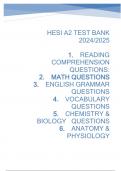
HESI A2 TEST BANK 2024/2025 1. READING COMPREHENSIO N QUESTIONS: 2. MATH QUESTIONS 3. ENGLISH GRAMMAR QUESTIONS 4. VOCABULARY QUESTIONS 5. CHEMISTRY & BIOLOGY QUESTIONS 6. ANATOMY & PHYSIOLOGY 1. Reading Comprehensio n Questions: 2. Math Questions 3. English Grammar Questions 4. Vocabulary Questions 5. Chemistry & Biology Questions 6. Anatomy & Physiology Reading Comprehension Questions 1-4 refer to the following passage. Passage 1 - The Respiratory System The respiratory system’s function is to allow oxygen exchange through all parts of the body. The anatomy or structure of the exchange system, and the uses of the exchanged gases, varies depending on the organism. In humans and other mammals, for example, the anatomical features of the respiratory system include airways, lungs, and the respiratory muscles. Molecules of oxygen and carbon dioxide are passively exchanged, by diffusion, between the gaseous external environment and the blood. This exchange process occurs in the alveolar region of the lungs. Other animals, such as insects, have respiratory systems with very simple anatomical features, and in amphibians even the skin plays a vital role in gas exchange. Plants also have respiratory systems but the direction of gas exchange can be opposite to that of animals. The respiratory system can also be divided into physiological, or functional, zones. These include the conducting zone (the region for gas transport from the outside atmosphere to just above the alveoli), the transitional zone, and the respiratory zone (the alveolar region where gas exchange occurs). 25 1. What can we infer from the first paragraph in this passage? a. Human and mammal respiratory systems are the same b. The lungs are an important part of the respiratory system c. The respiratory system varies in different mammals d. Oxygen and carbon dioxide are passive exchanged by the respiratory system 2. What is the process by which molecules of oxygen and carbon dioxide are passively exchanged? a. Transfusion b. Affusion c. Diffusion d. Respiratory confusion 3. What organ plays an important role in gas exchange in amphibians? a. The skin b. The lungs c. The gills d. The mouth 4. What are the three physiological zones of the respiratory system? a. Conducting, transitional, respiratory zones b. Redacting, transitional, circulatory zones c. Conducting, circulatory, inhibiting zones d. Transitional, inhibiting, conducting zones Questions 5 -8 refer to the following passage. ABC Electric Warranty ABC Electric Company warrants that its products are free from defects in material and workmanship. Subject to the conditions and limitations set forth below, ABC Electric will, at its option, either repair or replace any part of its products that prove defective due to improper workmanship or materials. This limited warranty does not cover any damage to the product from improper installation, accident, abuse, misuse, natural disaster, insufficient or excessive electrical supply, abnormal mechanical or environmental conditions, or any unauthorized disassembly, repair, or modification. This limited warranty also does not apply to any product on which the original identification information has been altered, or removed, has not been handled or packaged correctly, or has been sold as second -hand. This limited warranty covers only repair, replacement, refund or credit for defective ABC Electric products, as provided above. 5. I tried to repair my ABC Electric blender, but could not, so can I get it repaired under this warranty? a. Yes, the warranty still covers the blender b. No, the warranty does not cover the blender c. Uncertain. ABC Electric may or may not cover repairs under this warranty 6. My ABC Electric fan is not working. Will ABC Electric provide a new one or repair this one? a. ABC Electric will repair my fan b. ABC Electric will replace my fan c. ABC Electric could either replace or repair my fan can request either a replacement or a repair. 7. My stove was damaged in a flood. Does this warranty cover my stove? a. Yes, it is covered. b. No, it is not covered. c. It may or may not be covered. d. ABC Electric will decide if it is covered 8. Which of the following is an example of improper workmanship? a. Missing parts b. Defective parts c. Scratches on the front d. None of the above Questions 9 – 12 refer to the following passage. Passage 3 – Mythology The main characters in myths are usually gods or supernatural heroes. As sacred stories, rulers and priests have traditionally endorsed their myths and as a result, myths have a close link with religion and politics. In the society where a myth originates, the natives believe the myth is a true account of the remote past. In fact, many societies have two categories of traditional narrative —(1) “true stories”, or myths, and (2) “false stories”, or fables. Myths generally take place during a primordial age, when the world was still young, prior to achieving its current form. These stories explain how the world gained its current form and why the culture developed its customs, institutions, and taboos. Closely related to myth are legend and folktale. Myths, legends, and folktales are different types of traditional stories. Unlike myths, folktales can take place at any time and any place, and the natives do not usually consider them true or sacred. Legends, on the other hand, are similar to myths in that many people have traditionally considered them true. Legends take place in a more recent time, when the world was much as it is today. In addition, legends generally feature humans as their main characters, whereas myths have superhuman characters. 26 9. We can infer from this passage that a. Folktales took place in a time far past, before civilization covered the earth b. Humankind uses myth to explain how the world was created c. Myths revolve around gods or supernatural beings; the local community usually accepts these stories as not true d. The only difference between a myth and a legend is the time setting of the story 10. The main purpose of this passage is a. To distinguish between many types of traditional stories, and explain the back -ground of some traditional story categories
Preview 4 out of 73 pages
Exam (elaborations)
HESI A2 TEST BANK 2024/2025
Preview 4 out of 73 pages
HESI A2 TEST BANK 2024 HESI A2 TEST BANK 2024 HESI A2 TEST BANK 2024
Content preview
Document information
- Uploaded on
- February 13, 2024
- Number of pages
- 73
- Written in
- 2023/2024
- Type
- Exam (elaborations)
- Contains
- Questions & answers
$16.49
Wrong document? Swap it for free
Within 14 days of purchase and before downloading, you can choose a different document. You can simply spend the amount again.
Written by students who passed
Immediately available after payment
Read online or as PDF


