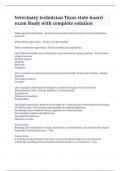
Veterinary technician Texas state board exam Study with complete solution
Veterinary technician Texas state board exam Study with complete solution Define general supervision. - Doctor is not at your location but can be reached via phone, email, etc. Define direct supervision. - Doctor is in the building Define immediate supervision. - Doctor is within eye sight of you. List 5 different health care services that a non-veterinarian cannot perform. - Extract teeth using an elevator Perform surgery Diagnose Prescribe Prognoses List 3 examples non-licensed veterinary positions/job titles in the state of Texas. - Kennel Assistant Veterinary Assistant Groomer List 4 examples of alternative therapies as defined in Chapter 573 of the Texas Administrative Code. - Holistic Medicine ie. Chinese herbs Acupuncture Chiropractic medicine Homeopathic List 5requirements that must be met in order for a Veterinarian-Client-Patient relationship or VCPR to exist. - Vet assumes responsibility for medical judgement. Knowledge of pet's medical history, signalment ie. Physical Exam. Vet available to follow-up medical care Oversight of treatments Maintains records True or False Breaking a law of the State of Texas, other states, or United States may result in loss of your Veterinary Technician License. - True True or False A veterinarian may delegate veterinary care and treatment duties to a non-licensed individuals including a licensed equine dental provider or a chiropractor. - True True or False A veterinarian does not need to take into account licensing or the level of training when determining the level of supervision necessary for non-veterinarian employees. - False True or False A veterinarian may be disciplined by the Board if they improperly delegate care or treatment duties or if they do not properly supervise the non-veterinarian who is performing the duties. - True True or False Ultimately, it is up to the veterinarian to determine when general, direct, or immediate supervision of a non-veterinarian's actions is appropriate except when the actions are otherwise prohibited by law. - True True or False Under direct supervision, a LVT may close surgical skin incision ans skin lacerations. - True True or False Under the general supervision of a veterinarian, a LVT may induce anesthesia. - False True or False Under direct supervision of a veterinarian, a certified veterinary assistant may induce anesthesia or suture existing surgical skin incisions. - False True or False A certified veterinary assistant may extract loose teeth or dental fragments by hand and without the use of an elevator under immediate supervision of a veterinarian. - False True or False Under the immediate supervision of an LVT, an unlicensed employee may induce anesthesia and suture surgical incision or skin lacerations. - True True or False Some invasive dental procedures may be performed by a LVT but only under the immediate supervision of a veterinarian. - False True or False Under the immediate supervision of an LVT, non-licensed employee of a veterinarian may draw blood or take samples for the purpose of testing and diagnosis. - True True or False In emergency situation, a LVT may initiate treatment without prior instruction by a veterinarian. - True True or False In a veterinary clinic, euthanasia may be performed by a non-veterinarian under the immediate supervision of a veterinarian. - False True or False A LVT can administer a rabies vaccine under the general supervision of the veterinarian and only after a VCPR is established. - False True or False A non-licensed employee may use a signature stamp in place of a veterinarian's signature when filling out on official health document under the direct supervision of the vaccinating veterinarian. - True True or False A LVT or certified veterinary assistant may follow oral or written treatment orders of a veterinarian who is caring for a hospitalized patient and provide medical care to the patient even when the veterinarian is not on premesis. - True True or False If a certified veterinary assistant causes harm to an animal while being supervised by a LVT, the veterinarian is ultimately responsible for any resulting lawsuit or negligence claims. - False True or False In order to collect blood samples for Brucellosis testing at a livestock market, a LVT or DVM must first be approved by the Texas Animal Health Commission (TAHC). - True True or False A TAHC approved LVT may collect blood samples for brucellosis testing at a livestock market under the general supervision of a TAHC approved veterinarian. - False True or False A veterinarian can perform chiropractic and other forms of musculoskeletal manipulation or MSM on an animal patient only if the owner signs an acknowledgement stating that they understand this is an alternative therapy. - True True or False A veterinarian may delegate chiropractic and MSM treatment duties an independent contractor who performs them in a location outside of the veterinarian's practice, under general supervision of the veterinarian. - True True or False A LVT or Veterinary assistant can preform ultrasonography on an animal for diagnostic purposes only if they are doing so at the request of the veterinarian and the veterinarian makes the actual diagnosis. - True True or False Diagnostic and therapeutic ultrasonography may be performed by non-licensed employees under the general supervision of a licensed veterinarian. - True True or False Acupuncture may be preformed by a LVT under the immediate supervision of a licensed veterinarian. - False True or False Homeopathic medicine is the practice of veterinary medicine that believes in a blend of alternative and, if need be, conventional approaches of treatment to treat the whole patient. - False True or False No veterinarian may allow a non-veterinarian employee or other agent to perform homeopathic or holistic medicine in the treatment of an animal patient. - True True or False Client consent is required before a veterinarian initiates homeopathic treatment on an animal. Further, the veterinarian must inform the client of conventional treatments available and the probability of curing the problem with each type of treatment. - True True or False Any trained member of the veterinary team is permitted to utilize cotton swabs, gauze, dental floss, dentifrice, or toothbrushes to clean an animal's teeth. - True True or False Under the direct or immediate supervision of a veterinarian, a LVT may use an elevator to extract loose teeth or dental fragments with minimal periodontal attachments. - False True or False Under the general supervision of a veterinarian, a licensed equine dental provider may remove sharp enamel points, extract loose deciduous teeth and erupted, non-displaced wolf teeth, and remove supragingival calculus on the teeth of a horse. - True True or False A LVT or veterinary assistant may extract loose, or diseased teeth, remove small dental overgrowths, remove erupted wolf teeth or reduce the incisors of a horse under direct supervision of a veterinarian. - True True or False Once a VCPR is established, a veterinarian may not discontinue treatment on an animal patient without giving the client notice and allowing them a reasonable period of time to secure the services of another veterinarian. - True True or False
Document information
- Uploaded on
- February 12, 2024
- Number of pages
- 21
- Written in
- 2023/2024
- Type
- Exam (elaborations)
- Contains
- Questions & answers