
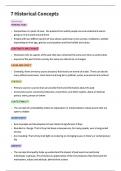
7 Historical Concepts
#humanities
PERSPECTIVES
Perspectives is a point of view - the position from which people see and understand events
going on in the world around them
People will have different points of view about a particular event, person, civilization, artefact
depending on their age, gender, social position and their beliefs and values
CONTINUITY AND CHANGE
Historians refer to aspects of the past that have remained the same over time as continuities
Aspects of the past that do not stay the same are referred to as changes
CAUSE AND EFFECT
Generally, there are many causes (reasons) that lead to an events of action. There can also be
many effects (outcomes): short-terms and long term; political, social, economical and cultural
EVIDENCE
Primary sources: sources that can provide first-hand information about the past
Secondary source: sources by historians, researchers, and other experts, about a historical
period, event, person or theme
CONTESTABILITY
The concept of contestability relates to explanation or interpretations of past events that are
open to debate
SIGNIFICANCE
Events people and developments have historical significance if they:
Resulted in change. That is they had deep consequences, for many people, over a long period
of time
Are revealing. That is they shed light on enduring or emerging issues in history or contemporary
life
EMPATHY
The concept of empathy helps up understand the impact of past events on particular
individuals or groups. This includes an appreciation of the circumstances they faced and the
motivations, values and attitude, behind their actions
,Empathy is the ability to "walk in someone else's shoes" to be aware of, and sensitive to, their
feelings, thoughts and experiences.
, Black Death
The black death occurred in 1348, and was believed to have originated from China. It is commonly
called the plague, and spread rapidly across Europe causing a massive population reduction.
People who caught the disease had swellings on their body, sometimes as big as eggs, which were
then followed by black sports.
The Catholic church, overwhelmed with the sheer number of deaths, blamed everything on the
Jews. Eventually, they lost control of the people.
How did it spread??
Fleas and rats, which were extremely common, spread it amongst humans. It also travelled aboard
trading routes. Merchant ships frequently had rats on board, which transferred the disease to
sailors on board.
By 1350, almost all of Britain was infected.
By the end of 1350, nearly 1.5 million people had died from the black death.


