ERSC 181 Test 8 (Final).
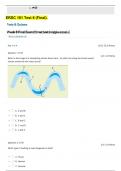
ERSC 181 Test 8 (Final). Return to Assessment List Part 1 of 4 - 52.0/ 52.0 Points Question 1 of 50 Refer to the image of a meandering stream shown here. At which site along the stream would stream erosion be the most active? A. D and B B. A and C C. B and C D. C and D E. A and E Question 2 of 50 Which type of faulting is most dangerous in Utah? 2.0/ 2.0 Points 2.0/ 2.0 Points A. Thrust B. Normal C. Reverse D. Strike-slip E. Transform Question 3 of 50 Where do we generally find the most quantity of explosive volcanic eruptions? 2.0/ 2.0 Points A. Divergent plate boundary B. Subduction zone boundary C. Mid-oceanic ridges D. Ocean island hotspots E. Transform plate boundary Question 4 of 50 James Hutton’s statement that “the present is the key to the past” (uniformitarianism) is demonstrated by . 2.0/ 2.0 Points A. the Earth’s landscapes are fixed and have not changed B. gravity being a recent phenomenon and not changing metamorphic rocks in the past C. the volcano that erupted last year on August 15 will occur every 10 years on that date D. the fact that our human ancestors hunted dinosaurs for millennia E. ancient sedimentary rocks formed by similar processes as are observed today Feedback: 01.3 Question 5 of 50 When going from a magnitude 5 to a magnitude 6 earthquake on the Richter magnitude scale, what is the increase in seismic wave amplitude? 2.0/ 2.0 Points B. 1 C. 10 D. 2 E. 100 Question 6 of 50 In the rock cycle, what processes directly link igneous rocks to metamorphic rocks? 2.0/ 2.0 Points A. melting and crystallization B. deposition and lithification C. compaction and cementation D. weathering and erosion E. recrystallization by high heat and pressure Question 7 of 50 What information is needed to determine the distance from the epicenter of an earthquake to a seismic receiving station? 2.0/ 2.0 Points A. The difference between the amplitude of the seismic waves B. The amplitude of the seismic waves on a seismogram C. The time interval between the P and S waves D. The magnitude of the earthquake E. The transverse nature of the s-wave Question 8 of 50 Applying the principles of relative age-dating to the diagram, which of the following is TRUE. Explanation of the diagram: "A" represents an unconformity (erosional surface), "B" is a basaltic dike, "C" is a shale formation, "D" is a sandstone formation, "E" is a limestone formation, "F" represents a thrust fault. 2.0/ 2.0 Points A. D is YOUNGER than C B. E is OLDER than B C. B is OLDER than F D. A is YOUNGER than C E. F is YOUNGER than A Question 9 of 50 The number one factor causing landslides is (are) . 2.0/ 2.0 Points A. freeze-thaw cycles B. precipitation C. glaciation D. earthquakes E. volcanic eruptions
Document information
- Uploaded on
- February 10, 2024
- Number of pages
- 25
- Written in
- 2023/2024
- Type
- Exam (elaborations)
- Contains
- Questions & answers