
RMI Exam 2 Complete Questions with SOlutions(Graded A)
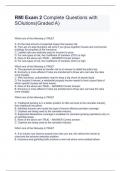
RMI Exam 2 Complete Questions with Which one of the following is TRUE? A. It's the total amount of expected losses that causes risk. B. The Law of Large Numbers will work if you group together houses and commercial buildings for purposes of fire insurance. C. Liability risks are relatively easy for insurers to price. D. For new types of risk, the Coefficient of Variation (COV) is high. E. None of the above are TRUE. - ANSWER Correct answer: D. For new types of risk, the Coefficient of Variation (COV) is high. Which one of the following is TRUE? A. The payment we make to transfer risk to an insurer is called the policy fee. B. Economy is more efficient if risks are transferred to those who can bear the risks more cheaply. C. With insurance, policyholders need to keep a big chunk of assets liquid. D. For houses it insures, a residential property insurer needs to have a good idea of which specific houses will have losses. E. None of the above are TRUE. - ANSWER Correct Answer: B. Economy is more efficient if risks are transferred to those who can bear the risks more cheaply. Which one of the following is TRUE? A. Traditional banking is in a better position to offer services to the cannabis industry than traditional insurance. B. Admitted insurers are mostly the type of insurer offering cannabis coverage. C. Captives are being used by the cannabis industry. D. Equipment Breakdown coverage is available for cannabis growing operations only on an admitted basis. E. None of the above are TRUE. - ANSWER Correct answer: C. Captives are being used by the cannabis industry. Which one of the following is TRUE? A. If an insurer can observe exactly how risky you are, this allows the insurer to overcome the adverse selection problem. B. Insurance and gambling both produce a new risk where none existed before. C. "Private insurers" means only those insurers that are not publicly traded on a stock exchange. D. "Large number of objects with different risk characteristics" is a characteristic of insurable risk. E. None of the above are TRUE. - ANSWER Correct answer: A. If an insurer can observe exactly how risky you are, this allows the insurer to overcome the adverse selection problem. Which one of the following is FALSE? A. Insurance works best when potential losses are independent. B. Most private property insurers offer flood insurance. C. Fire is an example of a peril where losses have traditionally been independent. D. Climate change is causing some perils to increase in frequency and intensity. E. Insurers can reduce their risk from catastrophic perils, such as earthquakes, by using risk transfer. - ANSWER Correct answer: B. Most private property insurers offer flood insurance. Which one of the following is FALSE? A. "Determinable and measurable loss" is a characteristic of insurable risk. B. If insurance pays for intentional losses that causes a moral hazard problem. C. It's the uncertainty about the estimate of the expected losses that causes risk. D. "Accidental and unintentional loss" is a characteristic of insurable risk. E. The coefficient of variation (COV) increases as the number of exposure units increases. - ANSWER Correct Answer: E. The coefficient of variation (COV) increases as the number of exposure units increases. Given the following: • An insurer covers 12,785 houses. • Each house is worth the same amount and has the same risk profile. • Insurer estimates that total claims payments it makes each year is about $6.2M. • All other expenses are typically 20% of total claims payments per year. • Insurer wants to make $742,400 in profits in a year. What premium should the insurer charge each homeowner per year? A. $460 B. $582 (Graded A)
Document information
- Uploaded on
- February 8, 2024
- Number of pages
- 24
- Written in
- 2023/2024
- Type
- Exam (elaborations)
- Contains
- Questions & answers


