
NUR 2243 Cardiac Health Evaluation Practice Exam Questions and Answers 2023/2024
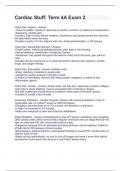
NUR 2243 Cardiac Health Evaluation Practice Exam Questions and Answers 2023/2024 Chest Pain: Angina – Answer -Onset is sudden, usually in response to exertion, emotion, or extremes in temperature. -Squeezing, viselike pain. -Usually L side of chest without radiation. Substernal; may spread across the chest and the back and/or down the arms. -Duration usually 15 min; relieved with rest, nitrate administration, or O2 therapy. Chest Pain: Myocardial Infarction - Answer -Onset sudden, without precipitating factors, often early in the morning. -Intense stabbing, viselike pain or pressure. Severe. -Substernal; may spread throughout the anterior chest and to the arms, jaw, back or neck. -Duration can be continuous or no chest discomfort; relieved with morphine, cardiac drugs, and oxygen therapy. Chest Pain: Pericarditis - Answer -Sudden onset -Sharp, stabbing, moderate to severe pain. -substernal; usually spreads to left side or back. -Duration is intermittent; relieved with sitting upright, analgesia, or admin of anti-inflammatory agents. Chest Pain: Anxiety - Answer -Onset varies, but may be in response to stress or fatigue. -Dull ache to sharp stabbing; may be associated with numbness in fingers. -Not well located and usually does not radiate to other parts of the body as pain. -Duration is usually a few minutes. Ventricular Fibrillation - Answer Irregular, chaotic, with varying amplitudes. It has no measurable rate, no visible P waves or QRS complexes. -Dangerous because there is no CO or pulse, and therefore no perfusion. -Is fatal if not resolved in 3-5 minutes. -Make sure everybody is clear and shock for defibrillation. Atrial Fibrillation - Answer Characterized by loss of P waves; undulating, wavy baseline; QRS duration often within normal limits; irregular ventricular rate can range from 60-100 bpm on meds and 100-160 uncontrolled without meds. -Dangerous because CO can decrease and heart perfusion can be impaired. Patient is at high risk for PE because of blood pooling. -Beta-blockers, antidysrhythmics, anticoagulant therapy to prevent PE. Cardioversion or ablation used to treat. -Safety during cardioversion, be sure to turn off oxygen and move it away from patient because fire could result. Also be sure to call "Clear" before shock. Premature Ventricular Complexes (PVCs) - Answer Seen as early ventricular complexes followed by a pause. they're common and frequency increases w age. Narrowed Pulse Pressure - Answer When the difference between diastolic and systolic values of BP are narrowed. It is rarely normal and results from increased peripheral vascular resistance or decreased stroke volume in patients with HF, hypovolemia, or shock. Can be seen with mitral stenosis or regurgitation.
Document information
- Uploaded on
- February 8, 2024
- Number of pages
- 3
- Written in
- 2023/2024
- Type
- Exam (elaborations)
- Contains
- Questions & answers


