
Nur 2243 Client Healthcare Plan Final Examination Questions and A+ Verified Answers 2023/2024
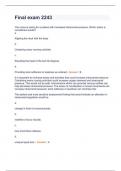
Nur 2243 Client Healthcare Plan Final Examination Questions and A+ Verified Answers 2023/2024 The nurse is caring for a patient with increased intracranial pressure. Which action is considered unsafe? a. Aligning the neck with the body b. Clustering many nursing activities c. Elevating the head of the bed 30 degrees d. Providing stool softeners or laxatives as ordered - Answer : B It is important to minimize stress and activities that could increase intracranial pressure. Combining many nursing activities could increase oxygen demand and intracranial pressure. This would not be safe. Interventions which can promote venous outflow can help decrease intracranial pressure. The stress of constipation or bowel movements can increase intracranial pressure; stool softeners or laxatives can minimize this. The earliest and most sensitive assessment finding that would indicate an alteration in intracranial regulation would be a. change in level of consciousness. b. inability to focus visually. c. loss of primitive reflexes. d. unequal pupil size. - Answer : A A change in level of consciousness is the earliest and most sensitive indication of a change in intracranial processing. This is assessed with the Glasgow Coma Scale (GCS), which assesses eye opening and verbal and motor response. The inability to focus may indicate a change, but it is not one of the earliest indicators or a component of the GCS. Primitive reflexes refers to those reflexes found in a normal infant that disappear with maturation. These reflexes may reappear with frontal lobe dysfunction and may be tested for with a suspected brain injury, so it would be the reappearance of primitive reflexes. A change in pupil size or unequal pupils may indicate a change, but they are not one of the earliest indicators or a component of the GCS. When caring for the patient after a head injury, the nurse would be most concerned with assessment findings which included respiratory changes, a. hypertension, and bradycardia. b. hypertension, and tachycardia. c. hypotension, and bradycardia. d. hypotension, and tachycardia. - Answer : A Hypertension with widening pulse pressure, bradycardia, and respiratory changes are the ominous late signs of increased intracranial pressure and indications of impending herniation (Cushings triad). It is bradycardia, not tachycardia, which is the component of this ominous triad. It is hypertension, not hypotension, which is the component of this ominous triad. Components of the GCS the nurse would use to assess a patient after a head injury include a. blood pressure. b. cranial nerve function. c. head circumference. d. verbal responsiveness. - Answer : D Components of the GCS include eye opening, motor responsiveness, and verbal responsiveness. The nurse would want to assess the blood pressure, but this is not a component of the coma scale. Assessment of cranial nerve function is appropriate as alterations such as cranial nerve VI palsies may occur, but this is not part of the coma scale. Increases in head circumference are associated with alterations in intracranial pressure in infants, but this is not part of the coma scale. Primary prevention strategies to reduce the occurrence of head injuries would include a. blood pressure control. b. smoking cessation. c. maintaining a healthy weight. d. violence prevention. - Answer : D Injury prevention measures such as wearing a seat belt, helmet use, firearm safety, and violence prevention programs reduce the risk of traumatic brain injuries. Blood pressure control and exercising can decrease the risk of vascular disease, impacting the cerebral arteries, rather than head injuries. Smoking cessation is one primary prevention strategy which can decrease the risk of vascular disease. Maintaining a healthy weight can decrease the risk of vascular disease. The nurse preparing to care for a patient after a suspected stroke would question an order for a(n) a. antihypertensive. b. antipyretic. c. osmotic diuretic. d. sedative. - Answer : A
Document information
- Uploaded on
- February 8, 2024
- Number of pages
- 40
- Written in
- 2023/2024
- Type
- Exam (elaborations)
- Contains
- Questions & answers


