
NUR 2243 Patients Healthcare Diagnosis Chapter 57 Review Guide Exam Questions and Answers 2023/2024
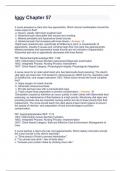
NUR 2243 Patients Healthcare Diagnosis Chapter 57 Review Guide Exam Questions and Answers 2023/2024 A nurse assesses a client who has appendicitis. Which clinical manifestation should the nurse expect to find? a. Severe, steady right lower quadrant pain b. Abdominal pain associated with nausea and vomiting c. Marked peristalsis and hyperactive bowel sounds d. Abdominal pain that increases with knee flexion - Answer : A Right lower quadrant pain, specifically at McBurney's point, is characteristic of appendicitis. Usually if nausea and vomiting begin first, the client has gastroenteritis. Marked peristalsis and hyperactive bowel sounds are not indicative of appendicitis. Abdominal pain due to appendicitis decreases with knee flexion. DIF: Remembering/Knowledge REF: 1169 KEY: Inflammatory bowel disorder| assessment/diagnostic examination MSC: Integrated Process: Nursing Process: Assessment NOT: Client Needs Category: Physiological Integrity: Physiological Adaptation A nurse cares for an older adult client who has Salmonella food poisoning. The client's vital signs are heart rate: 102 beats/min, blood pressure: 98/55 mm Hg, respiratory rate: 22 breaths/min, and oxygen saturation: 92%. Which action should the nurse complete first? a. Apply oxygen via nasal cannula. b. Administer intravenous fluids. c. Provide perineal care with a premedicated wipe. d. Teach proper food preparation to prevent contamination. - Answer : B Dehydration caused by diarrhea can occur quickly in older clients with Salmonella food poisoning, so maintenance of fluid balance is a high priority. Monitoring vital signs and providing perineal care are important nursing actions but are of lower priority than fluid replacement. The nurse should teach the client about proper hand hygiene to prevent the spread of infection, and preparation of food and beverages to prevent contamination. DIF: Applying/Application REF: 1173 KEY: Inflammatory bowel disorder| hydration MSC: Integrated Process: Nursing Process: Implementation NOT: Client Needs Category: Safe and Effective Care Environment: Management of Care A nurse teaches a client who has viral gastroenteritis. Which dietary instruction should the nurse include in this client's teaching? a. "Drink plenty of fluids to prevent dehydration." b. "You should only drink 1 liter of fluids daily." c. "Increase your protein intake by drinking more milk." d. "Sips of cola or tea may help to relieve your nausea." - Answer: A The client should drink plenty of fluids to prevent dehydration. Milk products may not be tolerated. Caffeinated beverages increase intestinal motility and should be avoided. DIF: Applying/Application REF: 1173 KEY: Inflammatory bowel disorder| nutritional requirements MSC: Integrated Process: Teaching/Learning NOT: Client Needs Category: Physiological Integrity: Basic Care and Comfort After teaching a client who was hospitalized for Salmonella food poisoning, a nurse assesses the client's understanding. Which statement made by the client indicates a need for additional teaching? a. "I will let my husband do all of the cooking for my family." b. "I'll take the ciprofloxacin until the diarrhea has resolved." c. "I should wash my hands with antibacterial soap before each meal." d. "I must place my dishes into the dishwasher after each meal." - Answer : B Ciprofloxacin should be taken for 10 to 14 days to treat Salmonella infection, and should not be stopped once the diarrhea has cleared. Clients should be advised to take the entire course of medication. People with Salmonella should not prepare foods for others because the infection may be spread in this way. Hands should be washed with antibacterial soap before and after eating to prevent spread of the bacteria. Dishes and eating utensils should not be shared and should be cleaned thoroughly. Clients can be carriers for up to 1 year. DIF: Applying/Application REF: 1173 KEY: Inflammatory bowel disorder| medications| antibiotics| medication safety MSC: Integrated Process: Teaching/Learning NOT: Client Needs Category: Health Promotion and Maintenance A nurse assesses a client who is hospitalized with an exacerbation of Crohn's disease. Which clinical manifestation should the nurse expect to find? a. Positive Murphy's sign with rebound tenderness to palpitation b. Dull, hypoactive bowel sounds in the lower abdominal quadrants c. High-pitched, rushing bowel sounds in the right lower quadrant d. Reports of abdominal cramping that is worse at night - Answer : C The nurse expects high-pitched, rushing bowel sounds due to narrowing of the bowel lumen in Crohn's disease. A positive Murphy's sign is indicative of gallbladder disease, and rebound tenderness often indicates peritonitis. Dullness in the lower abdominal quadrants and hypoactive bowel sounds are not commonly found with Crohn's disease. Nightly worsening of abdominal cramping is not consistent with Crohn's disease. DIF: Applying/Application REF: 1182 KEY: Crohn's disease| assessment/diagnostic examination MSC: Integrated Process: Nursing Process: Analysis NOT: Client Needs Category: Physiological Integrity: Physiological Adaptation
Document information
- Uploaded on
- February 8, 2024
- Number of pages
- 12
- Written in
- 2023/2024
- Type
- Exam (elaborations)
- Contains
- Questions & answers


