
• Wrong document? Swap it for free
  • Written by students who passed
  • Immediately available after payment
  • Read online or as PDF
Sell
Where do you study
Your language
Document preview thumbnail
Preview 2 out of 5 pages
Exam (elaborations)

TNCC Practice Exam with Rationale

Document preview thumbnail
Preview 2 out of 5 pages

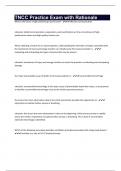
What is the key to a high performing trauma team? - effective communication rationale: skilled communication, cooperation, and coordination are the cornerstones of high- performance teams and high-quality trauma care When obtaining a history for an injured patient, understanding the kinematic concepts associated with the mechanism of injury and energy transfer can initially assist the trauma provider in: - evaluating and anticipating the types of injuries that may be present rationale: mechanism of injury and energy transfer can assist the provider in evaluating and anticipating damage the major preventable cause of death in the trauma patient is: - uncontrolled hemorrhage rationale: uncontrolled hemorrhage is the major cause of preventable death after injury, so assessment to identify uncontrolled hemorrhage is key to the initial assessment process the across-the-room observation step in the initial assessment provides the opportunity to - reprioritize circulation before airway or breathing rationale: the across-the-room observation is done at the beginning of the primary survey to rapidly assess the need to reprioritize circulation before airway or breathing. This is done if uncontrolled external hemorrhage is identified. Which of the following accurately describes ventilation prinicples associated with a bag-mask device? - ventilate at a rate of 10-12 breaths/minute

Content preview

TNCC Practice Exam with Rationale
What is the key to a high performing trauma team? - ✔✔✔effective communication


rationale: skilled communication, cooperation, and coordination are the cornerstones of high-
performance teams and high-quality trauma care


When obtaining a history for an injured patient, understanding the kinematic concepts associated with
the mechanism of injury and energy transfer can initially assist the trauma provider in: - ✔✔✔
evaluating and anticipating the types of injuries that may be present


rationale: mechanism of injury and energy transfer can assist the provider in evaluating and anticipating
damage


the major preventable cause of death in the trauma patient is: - ✔✔✔uncontrolled hemorrhage


rationale: uncontrolled hemorrhage is the major cause of preventable death after injury, so assessment
to identify uncontrolled hemorrhage is key to the initial assessment process


the across-the-room observation step in the initial assessment provides the opportunity to - ✔✔✔
reprioritize circulation before airway or breathing


rationale: the across-the-room observation is done at the beginning of the primary survey to rapidly
assess the need to reprioritize circulation before airway or breathing. This is done if uncontrolled
external hemorrhage is identified.


Which of the following accurately describes ventilation prinicples associated with a bag-mask device? -
✔✔✔ventilate at a rate of 10-12 breaths/minute

, rationale: if ventilation is ineffective, assist ventilation at 10-12 breaths/minute or one every 5-6
seconds


Which of the following is the best measure of the adequacy of cellular perfusion and helps to predict the
outcome of resuscitation? - ✔✔✔base deficit


rationale: base deficit serves as an endpoint measurement of the adequacy of cellular perfusion and
when used in conjunction with serum lactate helps predict the success of resuciation


What is the safe pharmacological alternative to opioids for rib fracture pain management in the
anticoagulated patient? - ✔✔✔intercostal nerve blocks


rationale: continuous intercostal nerve blocks use long-acting anesthetics and can provide safe and
effective pain management for the anticoagulated patient.


In a patient with severe traumatic brain injury, hypocapnia causes: - ✔✔✔cerebral vasoconstriction


rationale: hypocapnia, or low levels of carbon dioxide, will cause vasoconstriction, especially in the
cerebra; vasculature


A patient with a knife injury to the neck has an intact airway and is hemodynamically stable. He
complains of difficulty swallowing and speaking. Further assessment is indicated next for which of the
following? - ✔✔✔damage to spinal cord


rationale: penetrating neck trauma may include concurrent injuries to the spinal cord, airway, or
vascular neck structures. With an intact airway and hemodynamic stability, the other common
concurrent injury is to the spinal cord


What is the appropriate technique for palpating the pelvis for stability? - ✔✔✔apply gentle pressure
over the iliac downward and medially


Document information

Study Level
Subject
Uploaded on
February 6, 2024
Number of pages
5
Written in
2023/2024
Type
Exam (elaborations)
Contains
Questions & answers
$14.85

Wrong document? Swap it for free Within 14 days of purchase and before downloading, you can choose a different document. You can simply spend the amount again.
Written by students who passed
Immediately available after payment
Read online or as PDF

Sold
2
Followers
0
Items
805
Last sold
6 months ago


Why students choose Stuvia

Created by fellow students, verified by reviews

Quality you can trust: written by students who passed their tests and reviewed by others who've used these notes.

Didn't get what you expected? Choose another document

No worries! You can instantly pick a different document that better fits what you're looking for.

Pay as you like, start learning right away

No subscription, no commitments. Pay the way you're used to via credit card and download your PDF document instantly.

Student with book image

“Bought, downloaded, and aced it. It really can be that simple.”

Alisha Student

Working on your references?

Create accurate citations in APA, MLA and Harvard with our free citation generator.

Working on your references?

Frequently asked questions
