
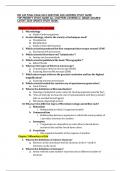
BIO 420 FINAL EXAM 2024 QUESTION AND ANSWERS STUDY GUIDE TOP PRIORITY STUDY GUIDE ALL CHAPTERS COVERED A+ GRADE ASSURED LATEST 2024 UPDATE STUDY GUIDE.
BIO 420 FINAL EXAM 2024 QUESTION AND ANSWERS STUDY GUIDE TOP PRIORITY STUDY GUIDE ALL CHAPTERS COVERED A+ GRADE ASSURED LATEST 2024 UPDATE STUDY GUIDE. Chapter 1 Scope of Microbiology 1. Microbiology a. Study of microorganisms 2. In microbiology, what is the variety of techniques used? a. Visualization b. Identification c. Study of microbial function 3. Which scientist produced the first compound microscope around 1590? a. Zaccharias & Hans Janssen 4. Which scientist first observed “Animalcules”? a. Antony van Leeuwenhoek 5. Which scientist published the book “Micrographia”? a. Robert Hooke 6. What are the types of Electron microscope? a. Transmission electron microscope (TEM) b. Scanning Electron Microscope (SEM) 7. Which microscope achieves the greatest resolution and has the highest magnification? a. Scanning electron microscope 8. Which scientist ended the controversy of spontaneous generation? a. Louis Pasteur 9. What is the definition of Bioremediation? a. Cleaning of industrial waste water by cleaning organism (said by her) b. “Uses of microbe to clean the site of contamination with heavy metals” (she re-worded herself again) c. Petroleum-digesting bacteria 10. What are the different types of Microbial ecology and define each? a. Mutualism i. Relationship in which 2 organisms benefit b. Commensalism i. Relationship between organisms in which the waste product of 1 provides nutrients for another c. Synergism i. 2 organisms are dependent on each other to break down nutrients that neither break down alone d. Parasitism i. One organism benefits at the expense of another Chapter 2Chemistry of Life 1. What is the definition of valence electron? a. Electron on the outermost shell (2 electrons in the 1st shell; 8 electrons on the next) 2. What is the definition of Isotopes? a. Atoms with the same number of protons but a different number of neutrons 3. What is an Ionic bond and provide an example? a. Is the transfer of valence electrons from one atom to another b. An example is Sodium Chloride (NaCl) 4. What is a covalent bond and what are the 2 types (define?) a. Define: results from sharing of electrons b. 2 types: i. Nonpolar covalent bond- equal sharing of electrons ii. Polar covalent bond- unequal sharing of electrons 5. What are the monomers of carbohydrate? a. Monosaccharides 6. What are the monomers of proteins? a. Amino acids 7. What are the monomers of lipids and give examples? a. Fatty acids, glycerol b. Examples: Triglycerides, Phospholipids, Steroids, and Cholesterol 8. What are the monomers of nucleic acid? a. Nucleotide 9. Carbs, proteins, lipids and nucleic acids all belong to what family? Macro or micromolecules??? a. Macromolecules 10. In proteins, what are the different structural arrangements and define? a. Primary structure i. Single chain of amino acids b. Secondary structure i. α-Helix or β-helix c. Tertiary structure i. Globular shape: three dimensional d. Quaternary structure i. More than on tertiary protein Chapter 3Cell Structure and Function 1. What are the 2 types of microorganism? a. Prokaryotic & Eukaryotic 2. Which microorganism does not have a nucleus? a. Prokaryotic 3. Which microorganism has nucleus? a. Eukaryotic 4. What is the function of plasma membrane? a. Structural support b. Transport of molecules across the membrane c. Enzyme regulators to control chemical reactions d. Receptors for hormones & other regulatory substances e. Surface antigens 5. Technically, peptidoglycans are found in? a. Cell wall 6. What are the different parts of flagellum and define? a. Long filament i. External to the cell surface b. Hook i. Located at the end of the filament c. Basal Body i. The hook anchors to this part and it consist of a rod and 1-2 pairs of disc 7. What are the types of bacterial flagella & define each? a. Monotrichoussingle polar structure a 1 END of the bacterium b. AmphitrichousSingle polar structure at EACH end c. LophotrichousFlagella in tufts at 1 or BOTH ends d. Peritrichous Flagella distributed over the general surface 8. What is the definition of Biofilm? a. Collection of surface associated microbes 9. Cell organelles that contain digestive enzymes are called? a. Peroxisomes i. FYI example: the liver 10. Which cell organelles contains oxidative enzymes to remove toxic substances? a. Peroxisomes 11. What is an example of Passive Transport? (she did not ask to know what each is but I added as a FYI) a. Diffusion i. High to low concentration b. Osmosis i. Diffusion of water thru selectively permeable membranes c. Facilitate i. Carrier mediated- goes with the current d. Filtration i. High to low 12. What are the types of Enzymes? (She did not ask to define but just FYI in case) a. Hydrolases i. Catalyze hydrolysis reaction b. Lyases i. Removes functional groups from a substrate without adding water or add functional groups to a double bond c. Isomerases i. Rearrange atoms within molecules, changing the configuration of the atoms d. Ligases i. Form bonds between individual monomers to form polymers Chapter 4Bacteria and Archaea 1. Bacterial replication is accomplished by? a. Binary Fission 2. Measuring cell growth is done by? a. Measurement of cell MASS b. Measurement of cell NUMBER 3. Measurement of cell mass is done by? a. Dry weight b. Turbidity (cloudiness) 4. Measurement of cell number is done by? a. Direct cell count b. Viable counts 5. What are the factors that influence bacterial growth? (She said we don’t need to define) a. Nutritional requirements b. Temperature c. Osmotic pressure d. Other atmospheric conditions 6. Classification of bacteria, spirochetes, types causing disease? (Not sure if this is what she means by this) a. Treponema Pallidum syphilis b. Borrelia Burgdorferi Lyme disease c. Leptospira interrogans leptospirosis 7. What are the spore forming bacteria (gram +) and the spore forming bacteria that they cause? *******DONOT CONFUSE WITH ENDOSPORE FORMING I.E. Bacillus & Clostridium***** a. Cl. Tetanicauses tetanus b. Cl. Perferinges causes gangrene c. Cl. Botulinum causes botulism 8. Name some gram-positive cocci? a. Micrococcus b. Staphylococcus c. Streptococcus d. Peptococcus 9. What Staph. Aureus bacteria occur most frequently in hospitals & healthcare environment and are commonly termed “super bug”? a. MRSA (Methicillin resistant staph. Aureus) 10. Why is mycobacterium tuberculosis hard to beat? a. Because of the cell wall
Document information
- Uploaded on
- February 3, 2024
- Number of pages
- 21
- Written in
- 2023/2024
- Type
- Exam (elaborations)
- Contains
- Questions & answers


