

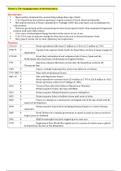
Theme 2: The changing nature of the Royal Navy:
Introduction;
Naval warfare dominated by cannon-firing sailing ships (Age of Sail).
1763: Royal Navy has achieved supremacy of great enemies (French, Dutch and Spanish).
Not until destruction of Franco-Spanish fleet (Trafalgar 1805) that supremacy was unchallenged by
other powers.
Driven by government policy and growing revenues from imperial trade: Navy maintained hegemonic
position until early 20th century.
1914: pace of technological change had altered the nature of war at sea.
1763-1914: time of immense change for Navy driven by need to destroy European rivals.
Navy played central role in trade, diplomacy and exploration.
Timeline;
1763-69 Naval expenditure falls from £7 million in 1762 to £1.5 million in 1769.
1768-71 Captain Cook explores South Pacific for Royal Navy, the first of many voyages of
exploration.
1778-83 Royal Navy outnumbered and outgunned after France, Spain and the
Netherlands enter American revolutionary war against Britain.
1781 American colonies effectively are lost after the Royal Navy is driven off
Chesapeake Bay.
1789 France, virtually bankrupted by naval costs, falls into revolution.
1793-1802 Wars with revolutionary France.
1803-15 War with Napoleonic France.
Naval expenditure increases from £2.4 million in 1793 to £22.8 million in 1815.
Naval supremacy achieved at Trafalgar in 1805.
1815 Treaty of Paris after final defeat of Napoleon at Waterloo.
Britain acquires Ceylon, the Cape and Malta.
1833 Britain acquires Falkland Islands to protect sealing fleet.
1839 Britain acquires Aden to facilitate steam mail route to India.
1850 France re-emerges as a naval power and signals end of the Age of Sail with the
launch of the Napoleon.
1878 Britain acquires Cyprus from declining Ottoman Empire to counter Russian
expansion.
1889 Naval Defence Act commits government to spend as much on navy as next two
largest powers combined
1906 HMS Dreadnought launched, triggering new arms race.
1914 Beginning of First World War signals end of a century of relative peace upheld
by Royal Navy (known as Pax Britannica).
Introduction;
Naval warfare dominated by cannon-firing sailing ships (Age of Sail).
1763: Royal Navy has achieved supremacy of great enemies (French, Dutch and Spanish).
Not until destruction of Franco-Spanish fleet (Trafalgar 1805) that supremacy was unchallenged by
other powers.
Driven by government policy and growing revenues from imperial trade: Navy maintained hegemonic
position until early 20th century.
1914: pace of technological change had altered the nature of war at sea.
1763-1914: time of immense change for Navy driven by need to destroy European rivals.
Navy played central role in trade, diplomacy and exploration.
Timeline;
1763-69 Naval expenditure falls from £7 million in 1762 to £1.5 million in 1769.
1768-71 Captain Cook explores South Pacific for Royal Navy, the first of many voyages of
exploration.
1778-83 Royal Navy outnumbered and outgunned after France, Spain and the
Netherlands enter American revolutionary war against Britain.
1781 American colonies effectively are lost after the Royal Navy is driven off
Chesapeake Bay.
1789 France, virtually bankrupted by naval costs, falls into revolution.
1793-1802 Wars with revolutionary France.
1803-15 War with Napoleonic France.
Naval expenditure increases from £2.4 million in 1793 to £22.8 million in 1815.
Naval supremacy achieved at Trafalgar in 1805.
1815 Treaty of Paris after final defeat of Napoleon at Waterloo.
Britain acquires Ceylon, the Cape and Malta.
1833 Britain acquires Falkland Islands to protect sealing fleet.
1839 Britain acquires Aden to facilitate steam mail route to India.
1850 France re-emerges as a naval power and signals end of the Age of Sail with the
launch of the Napoleon.
1878 Britain acquires Cyprus from declining Ottoman Empire to counter Russian
expansion.
1889 Naval Defence Act commits government to spend as much on navy as next two
largest powers combined
1906 HMS Dreadnought launched, triggering new arms race.
1914 Beginning of First World War signals end of a century of relative peace upheld
by Royal Navy (known as Pax Britannica).


