

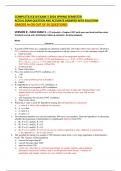
COMPLETE;IS310 EXAM 3 2024 SPRING SEMESTER ACTUAL EXAM QUESTION AND ACCURATE ANSWERS WITH SOLUTIONS GRADED A+(50 OUT OF 50 QUESTIONS)
COMPLETE;IS310 EXAM 3 2024 SPRING SEMESTER ACTUAL EXAM QUESTION AND ACCURATE ANSWERS WITH SOLUTIONS GRADED A+(50 OUT OF 50 QUESTIONS) VERSION B ‐ IS310 EXAM 3 – (75 minutes) – Chapter 0 PPT with your own hand written notes, standard normal and t‐distribution tables & calculator. No phone/laptop. Name Solutions 1. In a poll of 600 voters in a campaign on container control bill, 210 of the voters were opposed. Develop a 92% confidence interval estimate for the proportion of all the voters who favor the container control bill. a. 0,349 to 0.350 b. 0.616 to 0.684 (This is definitely confidence interval on proportion problem, with proportion opposed = 210/600 = 0.35, and proportion favored = 0.65. At 92% confidence or α = 8% = .08, Zα/2 = Z0.04 = 1.75 (Z-table look up). ME = (Zα/2) SE = 1.75 * (√(.35 *.65/600) = 2.65*.019 = 0.034. Answer: 0.65±0.034. c. 0.316 to 0.384 d. None of the above 2. For a two-tailed test at 98.4% confidence, Z = a. 1.96 b. 1.14 c. 2.41 (same problem given in Sample1) d. 0.8612 3. If a hypothesis is rejected at 95% confidence, it a. will always be accepted at 90% confidence b. will always be rejected at 90% confidence (you only have to draw the “damned thing” and marked both 95% and 90% on it, as I did at least two times in class, you will see the answer is b. c. will sometimes be rejected at 90% confidence d. None of the above. 4. When the p-value is used for hypothesis testing, the null hypothesis is rejected if a. p-value (this is the condition for rejection) b. p-value c. p-value d. p-value = 5. Two thousand numbers are selected randomly; 960 were even numbers. State the hypotheses to determine whether the proportion of odd numbers is significantly different from 50%. a. H0: P ≥ 0.5 and Ha: P 0.5 b. H0: P = 0.5 and Ha: P 0.5 c. H0: P = 0.5 and Ha: P 0.5 d. H0: P = 0.5 and Ha: P 0.5 (if you use my scheme explained in class: different is translated as ≠, the opposite is =. So d is the answer. 6. The standard deviation of a sample of 100 elements taken from a very large population is determined to be 60. The variance of the population a. can not be larger than 60 b. can not be larger than 3600 c. must be at least 100 d. can be any value (this is very basic knowledge on sample statistics and population parameters (mean and variance) and is an old question from Exam2. Variance of population and sample variance are very unlikely to be the same. 7. A finite population correction factor is needed in computing the standard deviation of the sampling distribution of sample means a. whenever the population is infinite b. whenever the sample size is more than 5% of the population size (the condition is “use CF if n/N ≤ .05) c. whenever the sample size is less than 5% of the population size d. The correction factor is not necessary if the population has a normal distribution 8. For a one-tailed test (lower tail) at 89.8% confidence, Z = a. -1.27 (α = 1 - .898 = .102). Table look up from Z-table gives -1.27. b. -1.53 c. -1.96 d. -1.64 9. A random sample of 64 students at a university showed an average age of 25 years and a sample standard deviation of 2 years. The 98% confidence interval for the true average age of all students in the university is a. 20.5 to 26.5 b. 24.4 to 25.6 (at 98% confidence, α = 2% = .08, Zα/2 = Z0.01 = 2.33 (Z-table look up). ME = (Zα/2) (s/√n) = 2.33 * 2/8) = 0.6. Answer: 25±0.6). We have done the same exercise many times in sample 1 and sample 2). c. 23.0 to 27.0 d. 20.0 to 30.0 10. As the number of degrees of freedom for a t distribution increases, the difference between the t distribution and the standard normal distribution a. becomes larger b. becomes smaller (as DoF of t-distribution increases, t values get closer to Z, especially when DoF ≥ 100 as I have shown in class). c. stays the same d. None of these alternatives is correct. 11. A simple random sample from an infinite population is a sample selected such that a. each element is selected independently and from the same population (definition of simple random) b. each element has a 0.5 probability of being selected c. each element has a probability of at least 0.5 of being selected d. the probability of being selected changes 12. The probability distribution of the sample mean is called the a. central probability distribution b. sampling distribution of the mean (definition of sampling distribution of sample means) c. random variation d. standard error Problem 1 A random sample of 49 lunch customers was taken at a restaurant. The average amount of time the customers in the sample stayed in the restaurant was 45 minutes with a standard deviation of 14 minutes. 13. Refer to Problem 1. Compute the standard error of the mean a. 7 b. 1 c. 2 (s/√n = 14/7 = 2): piece of cake 14. Refer to Problem 1. With a .99 confidence level, how large of a sample would have to be taken to provide a margin of error of 2.5 minutes or less? a. 208 (at .99, α/2 = .005, Zα/2 = 2.575, ME = (Zα/2) * SE. Thus, (2.5 = 2.575 * 14/√n). Square both sides. n = (2.575 * 14)2 / (2.5)2 = 207.93. Round up: 208. We have practiced so many problems like this in sample1 and sample2) b. 16 c. 226 d. None of the above 15. A statistician reports that at 95% confidence he has determined that the true average content of a soft drink brand is between 11.7 to 12.3 ounces. He further reports that his sample revealed an average content of 12 ounces. Assuming the standard deviation of the population is 1.28, determine the size of the sample. a. 450 b. 81 c. 70 (this is a small variation of q.14. The confidence interval is given from 11.7 to 12.3. Thus the range is (12.3-11.7 = .6. So ME = .6/2 = .3. ME = (Zα/2) * σ/√n). Thus .3 = (1.96) * 1.28/√n. So, n = (1.96 *1.28)2 / (.3)2 = 6.294/.09 = 69.6. Round up n = 70) d. 80 16. If a hypothesis test leads to the rejection of the null hypothesis, a. a Type II error must have been committed b. a Type II error may have been committed c. a Type I error must have been committed d. a Type I error may have been committed (remember the error of putting in jail an innocent person) Problem 2 A sample of 75 information system managers had an average hourly income of $40.75 with a standard deviation of $7.00. 17. Refer to Problem 2. If we want to determine a 95% confidence interval for the average hourly income, the corresponding critical value is a. 1.96 b. 1.64 c. 1.28 d. 1.993 (t-distribution. t-critical of 5% at DoF = 74. t-table lookup yields 1.993) 18. Refer to Problem 2. The standard error of the mean is a. 80.83 b. 7 c. 0.8083 (s/√n) = 7/8.66 = 0.8083) d. 1.6109 19. Refer to Problem 2. The value of the margin of error at 95% confidence is a. 80.83
Document information
- Uploaded on
- January 26, 2024
- Number of pages
- 8
- Written in
- 2023/2024
- Type
- Exam (elaborations)
- Contains
- Questions & answers


