
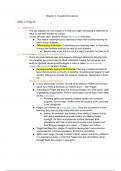
Class Notes EDUC 201 - Introduction to Education (EDUC201): Chapter 3 - Exceptional Learners
These notes on Chapter 3 of "Introduction to Teaching: Making a Difference in Student Learning" (Hall, Gene E., Quinn, Lina F., Gollnick, Donna M., 2019), focus on teaching and various learning strategies, with a particular emphasis on understanding and addressing the unique needs of individual students. Some of the key points covered in these notes include: 1. Objective of the Chapter- The primary goal is to help educators develop a repertoire of ways to see each student as unique. There is also an emphasis on the importance of differentiating instruction to facilitate learning for each student. 2. Child and Adolescent Development- The acknowledgment of predictable phases and stages in child and adolescent development. Teachers are encouraged to adapt their instruction based on their students' developmental stages and individual needs. 3. Piaget's Four Stages of Cognitive Development- An explanation of Jean Piaget's Theory of Cognitive Development, as well as examples of each stage. 4. Development of the Brain- An introduction to the concept of brain architecture and how the brain develops throughout childhood. There is also an emphasis on the plasticity of the brain and its responsiveness to environmental factors. 5. Exceptional Students- The definition of exceptional students is provided, including definitions for students with disabilities or labeled as "Gifted and Talented." There is also an explanation of Individualized Education Programs (IEPs) for students with identified disabilities. 6. Theory of Multiple Intelligences- An introduction to Howard Gardner's Theory of Multiple Intelligences (MI), highlighting the seven intelligences. Each intelligence is briefly explained, ranging from verbal and logical to interpersonal and intrapersonal. 7. IEPs and Inclusion- An explanation of IEPs and their components, as well as an explanation of inclusion, emphasizing the integration of students with disabilities into regular classrooms. 8. Signs of Struggling Students- Identification of students at risk, including those performing below grade level, disengaged, or facing various challenges. 9. Impact of Trauma- Recognition of the impact of trauma on child and adolescent development and learning. 10. Earning Warning Signs of Dropping Out- Indicators predicting potential risks of students dropping out of school, such as attendance (or the lack thereof), academic performance, and other early warning signs. 11. Importance of Vocabulary- An emphasis on the critical importance of vocabulary development, particularly in the first five years of a child's life. 12. Personalized Learning- A discussion of schools adopting personalized learning approaches, tailoring instruction to individual student needs using various types of technology.
Document information
- Uploaded on
- January 20, 2024
- Number of pages
- 8
- Written in
- 2020/2021
- Type
- Class notes
- Professor(s)
- Dr. prescott
- Contains
- All classes


