

Care of The Older Adult -TEST BANK
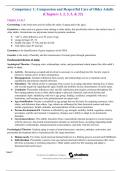
Care of The Older Adult -TEST BANK Gerontology is the broad term used to define the study of aging and/or the aged. Geriatrics is often used as a generic term relating to older adults, but specifically refers to the medical care of older adults. Geriatricians are physicians trained in geriatric medicine. ● “old” is often defined as over 65 years of age ● young old (ages 65–74 ● middle old (ages 75–84), and the old old ● frail elders (ages 85 and up) Genomics is the identification of gene sequences in the DNA Genetics is the study of heredity and the transmission of certain genes through generations Psychosocial Theories of Aging Sociological Theories- Changing roles, relationships, status, and generational cohort impact the older adult’s ability to adapt. ● Activity - Remaining occupied and involved is necessary to a satisfying late life. Society expects retirees to remain active in their communities. ● Disengagement -Gradual withdrawal from society and relationships serves to maintain social equilibrium and promote internal reflection. ● Subculture -The elderly prefer to segregate from society in an aging subculture sharing loss of status and societal negativity regarding the aged. Health and mobility are key determinants of social status. ● Continuity -Personality influences roles and life satisfaction and remains consistent throughout life. Past coping patterns recur as older adults adjust to physical, financial, and social decline and contemplate death. Identifying with one’s age group, finding a residence compatible with one’s limitations, and learning new roles postretirement are major tasks. ● Age stratification -Society is stratified by age groups that are the basis for acquiring resources, roles, status, and deference from others. Age cohorts are influenced by their historical context and share similar experiences, beliefs, attitudes, and expectations of life-course transitions. ● Person-Environment-Fit -Function is affected by ego strength, mobility, health, cognition, sensory perception, and the environment. Competency changes one’s ability to adapt to environmental demands. ● Gerotranscendence -The elderly transform from a materialistic/rational perspective toward oneness with the universe. Successful transformation includes an outward focus, accepting impending death, substantive relationships, intergenerational connectedness, and unity with the universe. Psychological Theories -Explain aging in terms of mental processes, emotions, attitudes, motivation, and personality development that is characterized by life stage transitions. ● Human needs -Five basic needs motivate human behavior in a lifelong process toward need fulfillment. ● Individualism -Personality consists of an ego and personal and collective unconsciousness that views life from a personal or external perspective. Older adults search for life meaning and adapt to functional and social losses. Med C Downloaded by Study Clock () lOMoARcPSD| ● Stages of personality -Personality develops in eight sequential stages with corresponding life development tasks. The eighth phase, integrity versus despair, is characterized by evaluating life accomplishments; struggles include letting go, accepting care, detachment, and physical and mental decline. ● Life-course/life span -Life stages are predictable and structured by roles, relationships, values, development, and goals. Persons adapt to changing roles and relationships. Age-group norms and characteristics are an important part of the life course. ● Selective optimization - Individuals cope with aging losses through activity/role selection, optimization, and compensation. Critical life points are morbidity, mortality, and quality of life. Selective optimization with compensation facilitates successful aging. Biological Theories of Aging Stochastic Theories - Based on random events that cause cellular damage that accumulates as the organism ages. ● Free radical theory - Membranes, nucleic acids, and proteins are damaged by free radicals, which causes cellular injury and aging. ● Exogenous Sources of Free Radicals ( Tobacco smoke, Pesticides, Organic solvents, radiation, ozone and selected medications) ● Orgel/error theory- Errors in DNA and RNA synthesis occur with aging. Cells accumulate errors in their DNA and RNA protein synthesis that cause the cells to die ● Wear and tear theory- Cells wear out and cannot function with aging. ● Connective tissue/cross-link theory- With aging, proteins impede metabolic processes and cause trouble with getting nutrients to cells and removing cellular waste products. Nonstochastic Theories - Based on genetically programmed events that cause cellular damage that accelerates aging of the organism. ● Programmed theory-Cells divide until they are no longer able to, and this triggers apoptosis or cell death. ● Gene/biological clock theory- Cells have a genetically programmed aging code. ● Neuroendocrine theory - Problems with the hypothalamus-pituitary-endocrine gland feedback system cause disease; increased insulin growth factor accelerates aging. ● Immunological theory- Aging is due to faulty immunological function, which is linked to general wellbeing. Nursing Theories of Aging ● Functional consequences (Miller) theory- Environmental and biopsychosocial consequences impact functioning. Nursing’s role is risk reduction to minimize age-associated disability in order to enhance safety and quality of living. Based on a person with a disability. RN role is to maximize their abilities that they have remaining so they can have a better quality of life instead of dwelling on their disabilities. ● Theory of thriving- Failure to thrive results from a discord between the individual and his or her environment or relationships. Nurses identify and modify factors that contribute to disharmony among these elements. Based on long term care pts and cascade of events that occur when a pt is in a long term care facility. Characteristics that happen: fatigue, generalized weakness, malnutrition because the pt doesn’t want to eat , cognitive dysfunction. The environment dictates how you age. If you are not in an environment that you can’t thrive in, you won’t thrive and you won’t age well. Chapter 5- Teaching and Communication with Older Adults and their families Normal and abnormal aging barriers might be: Med C Downloaded by Study Clock () lOMoARcPSD| ● Internal (e.g., cognition and physical deficits) ● External (e.g., speaking too softly, noisy room, elderspeak) ● Language (e.g., misunderstanding of terms, the use of a word in a different generational context, idiom, and slang) The Effect of Cognitive Issues on Communication ● reduce the individual’s frustration when communicating by minimizing the demands on memory and providing enjoyable communicative opportunities ● use of pictures, objects, or music from the older adult’s past, which allows individuals to practice communication without having to rely on memory. ● reduce their frustration during communication by minimizing the demands on memory and focusing on enjoyable communication opportunities that do not rely on memory. Speech and motor impairments caused by neurological changes in the body ● Apraxia is a speech impairment with an inability of the individual to send the correct messages to the mouth muscles for making motor planning ● Dysarthria refers to muscle weakness difficulties of the mouth affecting speech movements. ● Aphasia- Damage to the cortex. Can't read, write and say. EX: stroke, tumors, dementia, ALS o Broca’s Aphasia- comprehension remains intact, but spoken communications is not fluid. Speech is low, effortless, choppy and often lacks proper grammatical markers. o Global Aphasia- greater damage to left hemisphere thank found in broca’s aphasia. Effects on communication more devastated causing the person to have very limited spoken language and individuals may use only single words that are not always understood. o Wernicke’s aphasia- which is caused by damage to the Wernicke’s area of the brain. People with this aphasia have fluent speech with unintelligible content. Individuals will use real or nonsense words, but the string of words has no clear meaning Strategies for Communication with Persons with Dementia That Support Personhood ● Recognition -Acknowledge the person, know the person’s name, affirm uniqueness. “Come along Mrs. Jones, your dinner is being served.” ● Negotiation -Consult the person regarding preferences, desires, needs. “That was a nice bit of fresh air. I’m ready for my dinner now; would you like to join me?” ● Validation -Acknowledge the person’s emotions and feelings and respond. “Mrs. Johnson, it sounds like you would like to wait for your bath.” ● Facilitation and collaboration -Work together, involve the person. Enable the person to do what he or she otherwise would not be able to do by providing the missing parts of the action. “What is it you are looking for Mrs. Smith? Can I help? Tell me what it is and we can look for it together.” Normal and Abnormal Changes in Vision ● cornea becomes less sensitive and the pupils decrease to about one third of the size during young adulthood ● lenses become less flexible, slightly yellowed, and cloudy ● Visual acuity also decreases with age ● Presbyopia (aging eye) occurs and causes difficulty seeing at close range, such as in reading. o common for older adults to experience an increase in sensitivity to light and glare Care Partner Strategies for Vision Barriers Med C Downloaded by Study Clock () lOMoARcPSD| ● Contrasting warm and cool colors should be used when creating visuals such as calendars, instructions, and signs with a contrasting dark print for reading messages. ● need larger print papers, books, or tablet screen print and icons. ● may need auditory visual support, as seen in movies and books for the visually impaired, or talking computers. ● Correct lighting for the task is important. ● Reading lamps are useful and special magnifying devices can be used to see something that has fine detail or smaller print. Normal Aging Changes in Hearing ● inability to hear higher frequencies. ● Presbycusis- Permanent where higher frequency hair cells deteriorate and lose their function. They cannot be repaired nor do new hair cells grow back. o remains the most common sensory deficit in the older population Care Partner Interventions for Hearing Impairments ● hearing aids to amplify the speech frequencies when considering interventions ● personal amplification devices that can aid in hearing and are less expensive ● reduce background noise Physical Limitations- Physical abilities can decrease dramatically in a short period of time. The age when such physical limitations are noticed may be different for everyone. Nonverbal communication is more powerful than verbal messages. Partnering communication- Person-centered communication is an integral part of person-centered care and reflects a focus on the patients and their unique perceptions and experiences with health and illness. Partnering Communication Model - 5Ps method provides a unique example of person-centered care that builds trust and respect in any setting, but has been built for in-patient care settings originally. ● You did partnering already ● Ask about the restroom needs—potty ● Obtain a pain assessment ● Make positioning adjustments. ● Check the pump(s) to reduce potential noise distractions. patient-centered communication as a key characteristic of quality health care. Strategies for Effective Communication with P
Document information
- Uploaded on
- January 19, 2024
- Number of pages
- 86
- Written in
- 2023/2024
- Type
- Exam (elaborations)
- Contains
- Questions & answers


