

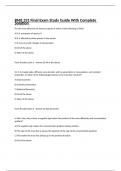
BME 331 Final Exam Study Guide With Complete Solution
For the mass diffusivity of chemical species A which of the following is TRUE? A) It is a property of species A B) it is affected by other species in the system C) It may vary with changes in temperature D) All of the above E) None of the above From Practice Exam 2 - Answer D) All of the above For 1-D, steady-state, diffusion mass transfer, with no generation or consumption, and constant properties, in which of the following geometries is the mass flux constant? A) Slab Geometry B) Cylindrical Geometry C) Spherical Geometry D) All of the above E) None of the above From Practice Exam 2 - Answer A) Slab Geometry In Fick's law, why is there a negative sign before the product of the mass diffusivity and concentration gradient? A) The negative sign makes the concentrations gradient always positive B) The sign of the mass flux is always the opposite of the sign of the concentration gradient C) This makes the mass flux always go in the positive direction D) All of the above E) None of the above From Practice Exam 2 - Answer B) The sign of the mass flux is always the opposite of the sign of the concentration gradient Second part to this question is that it goes from high to low concentration In 3-D mass transfer, which of the following is a vector quantity? A) The concentration gradient B) The mass flux C) The mass transfer rate D) All of the above E) None of the above From Practice Exam 2 - Answer All of the above Consider a hydrogel slab where there is 1-D, diffusion mass transfer at steady-state, constant properties and generation of species A. If one of the boundaries is impermeable to species A which of the following is TRUE?? A) The concentration of species A at a given position is changing with time B) The concentration gradient of species A does not change with position C) The mass flux of species A is not changing at one boundary D) All of the above E) None of the above Practice Exam 2 - Answer C) The mass flux of species A is not changing at one boundary The Laplacian term in the vector form of the mass transfer equation represents A) Mass transfer by diffusion B) Mass transfer by convection C) Accumulation of a chemical species in the system D) All of the above E) None of the above Practice Exam 2 - Answer A) Mass transfer by diffusion In our discussion of mass transfer with chemical reaction, the RA(referred to as generation or consumption) A) happens only in one part of the system B) is always negative C) Is on a per volume basis D) All of the above E) None of the above Practice Exam 2 - Answer C) Is on a per volume basis Which CANNOT be a boundary condition for mass transfer problems? A) Ca=0 B) Dca/Dx = constant C) Ca= solubility of gas in the solid D) All of the above can be boundary conditions Practice Exam 2 - Answer D) All of the above can be boundary conditions For oxygen gas diffusing into blood through the alveolar membrane in the lungs, which of the following is used to determine a boundary condition? A) Antoine's Equation (Liquid in equilibrium with vapor) B) Raoult's law (Liquid in equilibrium with a solution) C) Henry's law (N, O2, CO2) D) All of the above E) None of the above Practice Exam 2 - Answer C) Henry's Law A glass that is half-full of water is placed on a table in a room with no air circulation. The water evaporates and the water vapor diffuses out of the glass. What can you say about the air in contact with the water surface? A) The water vapor concentration of the air in contact with the water surface is equal to the concentration of liquid water B) The water vapor concentration of the air in contact with the water surface is in equilibrium with the liquid water at the surface C) The water vapor concentration of the air in contact with the water surface can be determined using Henry's Law D) All of the above E) None of the above Practice Exam 2 - Answer B) The water vapor concentration of the air in contact with the water surface is in equilibrium with the liquid water at the surface However, C would be correct if said Antoine's Equation instead of Henry's Law Consider a mass transfer system where species A is simultaneously diffusing and undergoing the following reaction: A-B. If the reaction is elementary, what is the expression for Ra? (Remember, It has to be negative because it is being used up) A) Ra= - constant B) Ra=-kaCa C)Ra=-KbCb D)Ra=-kbCaCb E)None of the above Practice Exam 2 - Answer B) Ra=-kaCa For series mass transfer through multiple resistances, which of the following is TRUE? A) The system is as at a Stady-State B) There can be mass transfer by diffusion C) There can be mass transfer by convection D) All of the above E) None of the above Practice Exam 2 - Answer D) All of the above For the mass diffusivity of chemical species A, which of the following is TRUE? A) It is not a property of species A) B) It is affected by other species in the system C) It does not vary with changes in temperature D) All of the above E) None of the above Exam 2 - Answer B) it is affected by other species in the system For 1-D, steady-state, diffusion mass transfer, with no generation or consumption, and constant properties, in which of the following geometries is the mass transfer rate constant? A) Slab geometry B) Cylindrical geometry C) Spherical geometry D) All of the above E) None of the above Exam 2 - Answer D) All of the above In 3-D Mass transfer, which of the following is a scalar quantity? A) The concentration B) The mass flux C) The mass transfer rate D) All of the above E) None of the above Exam 2 - Answer A) The concentration The term with Δ^2 in the vector form of the mass transfer PDE represents A) Mass transfer by convection B) Accumulation of a chemical species in the system C) Mass transfer by diffusion D) All of the above E) None of the above Exam 2 - Answer C) Mass transfer by diffusion In the Fick's Law equation for 1-D diffusion, why is there a negative sign before the product of the mass diffusivity and concentration gradient? A) The negative sign makes the concentration gradient always negative B) the sign of the mass flux is always the opposite of the sign of the mass diffusivity C) This makes the mass flux to always go form high concentration to low concentration D) All of the above E) None of the above Exam 2 - Answer C) This makes the mass flux to always go from high concentration to low concentration second part is mass flux is always the opposite of the sign of the concentration gradient, but it is not as correct. Ask for help on this one For the mass transfer coefficient, which of the following is TRUE? A) It is a property of the chemical species that is being transferred B) It is not affected b the flow characteristics of the fluid C) It represents the mass transfer due to convection D) All of the above E) None of the above
Document information
- Uploaded on
- January 19, 2024
- Number of pages
- 31
- Written in
- 2023/2024
- Type
- Exam (elaborations)
- Contains
- Questions & answers


