

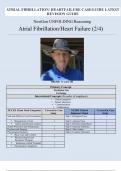
ATRIAL FIBRILLATION/ HEARTFAILURE CASEGUIDE LATEST
REVISION GUIDE
NextGen UNFOLDING Reasoning
Atrial Fibrillation/Heart Failure (2/4)
Bill Hill, 71 years old
Primary Concept
Perfusion Gas
Exchange
Interrelated Concepts (In order of emphasis)
• Clinical judgment
• Patient education
• Communication
• Collaboration
NCLEX Client Need Categories Covered in Case NCSBN Clinical Covered in Case
Study Judgment Model Study
Safe and Effective Care Environment Step 1: Recognize Cues ✓
• Management of Care ✓ Step 2: Analyze Cues ✓
• Safety and Infection Control Step 3: Prioritize Hypotheses ✓
Health Promotion and Maintenance ✓ Step 4: Generate Solutions ✓
Psychosocial Integrity ✓ Step 5: Take Action ✓
Physiological Integrity Step 6: Evaluate Outcomes ✓
• Basic Care and Comfort ✓
• Pharmacological and ✓
Parenteral Therapies
• Reduction of Risk Potential ✓
• Physiological Adaptation ✓
,ATRIAL FIBRILLATION/ HEARTFAILURE CASEGUIDE LATEST
REVISION GUIDE
Part I: Initial Nursing Assessment Present
Problem:
Bill Hill is a 71-year old male with a past medical history of benign prostatic hyperplasia (BPH), peripheral vascular
disease and myelodysplastic syndrome MDS) two months ago after a bone marrow biopsy. Six weeks ago, Bill was
admitted because he had a syncopal episode. He was diagnosed with paroxysmal atrial fibrillation and acute anemia with a
Hgb of 6.9 and received a transfusion of one unit of PRBCs.
Bill presents to the emergency department today with increasing weakness, fatigue, sinus congestion, fever, and chills
the past week. He was around grandchildren with colds two weeks ago. Bill woke up at 6 a.m. today feeling short of
breath, and coughing harshly with clear sputum. He had difficulty walking back to bed after getting up to the bathroom.
His wife, who is a retired nurse, noted that he was much paler, took his vital signs, which were BP: 96/62, HR: 140
irreg, RR: 24. Bill admits to losing 15 lb (6.8 kg) over the last 2-3 months.
Personal/Social History:
Mr. Hill is retired and lives at home with his wife in a rural area. His two adult children live out of state. He has been an
active, healthy male who enjoys gardening, hunting, and splits wood to heat his home in the winter. Since he has been
dealing with changes in his health he has not been able to participate in these activities as much. In the past, he has been
employed as a minister who has a strong Christian faith. He denies smoking, alcohol use, and illicit drug use.
What data from the histories are RELEVANT and must be interpreted as clinically significant by the nurse?
(NCSBN: Step 1 Recognize cues/NCLEX Reduction of Risk Potential)
RELEVANT Data from Present Problem: Clinical Significance:
• BPH, PVD, MDS, and Afib • Obstructions/decrease in urination, possible
• Acute Anemia retention from BPH that could lead to FVD, which
• Hemoglobin could then lead to BP issues, which could then
• Weakness, syncope, fatigue, lead to electrolyte imbalances.
SOB, fever/chills, congestion • Risk of inadequate perfusion from AFib
• Productive cough with clear sputum • Anemia could be the cause of
• Weight loss weakness/fatigue, syncope, or weight loss
• Infection caused from urinary retention
• BP 96/62 – HR 140 irregular – RR 24 or obstruction from BPH
• Hypotensive, tachycardic, and tachypnea could be
heart related (AFib/anemia)
RELEVANT Data from Social History: Clinical Significance:
• Retired • Emotional distress from not being able to
• Christian faith participate in activities that he enjoys, like
• Enjoys outdoor activities being outdoors
• Could effect decisions or already declining
health like poor nutrition due to being
depressed
Ymedications in the electronic health record:ou quickly review this patient’s past medical
history and home
What is the RELATIONSHIP of the past medical history and current medications? Why is your patient receiving these
medications? (Which medication treats which condition? Draw lines to connect)
Past Medical History: Home Medications:
, ATRIAL FIBRILLATION/ HEARTFAILURE CASEGUIDE LATEST
REVISION GUIDE
Benign prostatic hypertrophy (BPH) Peripheral vascular disease
Clopidogrel
(PVD) Myelodysplastic
75 mg PO dailysyndrome
Tamsulosin
(MDS)
0.4 mg
Paroxysmal
PO daily Atenol
atrial f
introduce yourself, to
Bill is transferred and collect
a cart theED
in the following clinical
and quickly data: to a room. You
brought
Patient Care Begins:
Current VS: P-Q-R-S-T Pain Assessment:
T: 99.6 F/37.6 C (oral) Provoking/Palliative:
P: 148 (irreg) Quality: Denies
R: 24 (reg) Region/Radiation:
BP: 104/60 Severity:
O2 sat: 88% room air Timing:
What VS data are RELEVANT and must be interpreted as clinically significant by the nurse?
(NCSBN: Step 1 Recognize cues/NCLEX Reduction of Risk Potential/Health Promotion and Maintenance)
RELEVANT Data: Clinical Significance:
• Temp 99.6 • Could be indicative of a possible infection
• HR: 148 • Patient is tachycardiac which could lead to dysrhythmias
irregular
• RR: 24 regular • Slightly tachypneic which could be an indicator of respiratory distress
• BP: 104/60 • BP taken at home was low, more stable now but still on the low end. If infection
is present this could be indicative of shock given the other vital signs, but
explains
• O2 Sat: 88% why the HR would be as high as it is.
on room air • Normal is 95-100%, should request an order to place patient on oxygen to
increase oxygen saturation to at least 95%. This contributes to the increased HR
and RR which is indicative of poor perfusion to the rest of the body, which adds to
the risk of arrythmias and PVD.
Current Assessment:
GENERAL SURVEY: Appears ill and is weak, barely able to stand. Currently in no acute distress.
Appetite has decreased recently.
NEUROLOGICAL: Alert & oriented to person, place, time, and situation (x4); muscle strength 5/5 in
both upper and lower extremities bilaterally.
HEENT: Head normocephalic with symmetry of all facial features. PERRLA, sclera white
bilaterally, conjunctiva pale bilaterally. Lips, tongue, and oral mucosa pale and
dry.
RESPIRATORY: Breath sounds clear but very diminished bilaterally with fine crackles in both
bases. Slightly labored respiratory effort on room air. Persistent cough of clear
sputum.
CARDIAC: Pale warm & dry, 1+ edema, heart sounds irregular and tachycardic, pulses faint,
equal with palpation at radial/pedal/post-tibial landmarks, brisk cap refill. No JVD
REVISION GUIDE
NextGen UNFOLDING Reasoning
Atrial Fibrillation/Heart Failure (2/4)
Bill Hill, 71 years old
Primary Concept
Perfusion Gas
Exchange
Interrelated Concepts (In order of emphasis)
• Clinical judgment
• Patient education
• Communication
• Collaboration
NCLEX Client Need Categories Covered in Case NCSBN Clinical Covered in Case
Study Judgment Model Study
Safe and Effective Care Environment Step 1: Recognize Cues ✓
• Management of Care ✓ Step 2: Analyze Cues ✓
• Safety and Infection Control Step 3: Prioritize Hypotheses ✓
Health Promotion and Maintenance ✓ Step 4: Generate Solutions ✓
Psychosocial Integrity ✓ Step 5: Take Action ✓
Physiological Integrity Step 6: Evaluate Outcomes ✓
• Basic Care and Comfort ✓
• Pharmacological and ✓
Parenteral Therapies
• Reduction of Risk Potential ✓
• Physiological Adaptation ✓
,ATRIAL FIBRILLATION/ HEARTFAILURE CASEGUIDE LATEST
REVISION GUIDE
Part I: Initial Nursing Assessment Present
Problem:
Bill Hill is a 71-year old male with a past medical history of benign prostatic hyperplasia (BPH), peripheral vascular
disease and myelodysplastic syndrome MDS) two months ago after a bone marrow biopsy. Six weeks ago, Bill was
admitted because he had a syncopal episode. He was diagnosed with paroxysmal atrial fibrillation and acute anemia with a
Hgb of 6.9 and received a transfusion of one unit of PRBCs.
Bill presents to the emergency department today with increasing weakness, fatigue, sinus congestion, fever, and chills
the past week. He was around grandchildren with colds two weeks ago. Bill woke up at 6 a.m. today feeling short of
breath, and coughing harshly with clear sputum. He had difficulty walking back to bed after getting up to the bathroom.
His wife, who is a retired nurse, noted that he was much paler, took his vital signs, which were BP: 96/62, HR: 140
irreg, RR: 24. Bill admits to losing 15 lb (6.8 kg) over the last 2-3 months.
Personal/Social History:
Mr. Hill is retired and lives at home with his wife in a rural area. His two adult children live out of state. He has been an
active, healthy male who enjoys gardening, hunting, and splits wood to heat his home in the winter. Since he has been
dealing with changes in his health he has not been able to participate in these activities as much. In the past, he has been
employed as a minister who has a strong Christian faith. He denies smoking, alcohol use, and illicit drug use.
What data from the histories are RELEVANT and must be interpreted as clinically significant by the nurse?
(NCSBN: Step 1 Recognize cues/NCLEX Reduction of Risk Potential)
RELEVANT Data from Present Problem: Clinical Significance:
• BPH, PVD, MDS, and Afib • Obstructions/decrease in urination, possible
• Acute Anemia retention from BPH that could lead to FVD, which
• Hemoglobin could then lead to BP issues, which could then
• Weakness, syncope, fatigue, lead to electrolyte imbalances.
SOB, fever/chills, congestion • Risk of inadequate perfusion from AFib
• Productive cough with clear sputum • Anemia could be the cause of
• Weight loss weakness/fatigue, syncope, or weight loss
• Infection caused from urinary retention
• BP 96/62 – HR 140 irregular – RR 24 or obstruction from BPH
• Hypotensive, tachycardic, and tachypnea could be
heart related (AFib/anemia)
RELEVANT Data from Social History: Clinical Significance:
• Retired • Emotional distress from not being able to
• Christian faith participate in activities that he enjoys, like
• Enjoys outdoor activities being outdoors
• Could effect decisions or already declining
health like poor nutrition due to being
depressed
Ymedications in the electronic health record:ou quickly review this patient’s past medical
history and home
What is the RELATIONSHIP of the past medical history and current medications? Why is your patient receiving these
medications? (Which medication treats which condition? Draw lines to connect)
Past Medical History: Home Medications:
, ATRIAL FIBRILLATION/ HEARTFAILURE CASEGUIDE LATEST
REVISION GUIDE
Benign prostatic hypertrophy (BPH) Peripheral vascular disease
Clopidogrel
(PVD) Myelodysplastic
75 mg PO dailysyndrome
Tamsulosin
(MDS)
0.4 mg
Paroxysmal
PO daily Atenol
atrial f
introduce yourself, to
Bill is transferred and collect
a cart theED
in the following clinical
and quickly data: to a room. You
brought
Patient Care Begins:
Current VS: P-Q-R-S-T Pain Assessment:
T: 99.6 F/37.6 C (oral) Provoking/Palliative:
P: 148 (irreg) Quality: Denies
R: 24 (reg) Region/Radiation:
BP: 104/60 Severity:
O2 sat: 88% room air Timing:
What VS data are RELEVANT and must be interpreted as clinically significant by the nurse?
(NCSBN: Step 1 Recognize cues/NCLEX Reduction of Risk Potential/Health Promotion and Maintenance)
RELEVANT Data: Clinical Significance:
• Temp 99.6 • Could be indicative of a possible infection
• HR: 148 • Patient is tachycardiac which could lead to dysrhythmias
irregular
• RR: 24 regular • Slightly tachypneic which could be an indicator of respiratory distress
• BP: 104/60 • BP taken at home was low, more stable now but still on the low end. If infection
is present this could be indicative of shock given the other vital signs, but
explains
• O2 Sat: 88% why the HR would be as high as it is.
on room air • Normal is 95-100%, should request an order to place patient on oxygen to
increase oxygen saturation to at least 95%. This contributes to the increased HR
and RR which is indicative of poor perfusion to the rest of the body, which adds to
the risk of arrythmias and PVD.
Current Assessment:
GENERAL SURVEY: Appears ill and is weak, barely able to stand. Currently in no acute distress.
Appetite has decreased recently.
NEUROLOGICAL: Alert & oriented to person, place, time, and situation (x4); muscle strength 5/5 in
both upper and lower extremities bilaterally.
HEENT: Head normocephalic with symmetry of all facial features. PERRLA, sclera white
bilaterally, conjunctiva pale bilaterally. Lips, tongue, and oral mucosa pale and
dry.
RESPIRATORY: Breath sounds clear but very diminished bilaterally with fine crackles in both
bases. Slightly labored respiratory effort on room air. Persistent cough of clear
sputum.
CARDIAC: Pale warm & dry, 1+ edema, heart sounds irregular and tachycardic, pulses faint,
equal with palpation at radial/pedal/post-tibial landmarks, brisk cap refill. No JVD


