

Psychodynamic approaches
Alternatives to the medical model
According to Bennet (2011), an alternative model must :
Make no dichotomy (division) between ‘normal’ and ‘disordered’ states
Consider social and psychological factors
Make the individual the focus of treatment
Consider non-pharmacological interventions as primary
Dimensional models
Reject the idea of ‘all-or-nothing’ approach to diagnosis
Strength – avoids ‘forcing’ someone into a category
Weakness – does not address processes causing or maintaining problems
States there is a time line of severe diagnosis – no diagnosis = there is a spectrum
Psychological formulation
Aims to identify processes leading to cause and maintenance of a disorder
1. What is troubling you?
2. What has left you vulnerable to your problems?
3. Why have you developed problems now?
4. What thoughts and behaviours are maintaining problems?
The therapist would then use this information to formulate an exploratory hypothesis and use this to
provide the correct treatment and diagnosis for the patient.
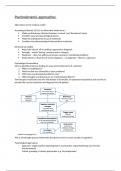
This is the thought process behind the therapist on how to come up with a hypothesis
Psychological approaches
- Approach: single position regarding theory and practise of psychotherapy (e.g. Freud’s
Psychoanalysis)
- School: grouping of similar approaches (e.g. Psychodynamic)
, o Totton (2003) – every therapist works from an idea of what people ‘really are’ like: a
vision of human nature
- Critical to remember – theories / approaches don’t develop in a vacuum – dramatically
influenced by context (time, place , character of originator)
Working in the mental health sector
- Settings – healthcare, social care, education, charities, private sector
- Roles – counselling psychologist, MH social worker, psychotherapist, clinical psychologist,
PWP, counsellor.
Freud’s Psychoanalysis
Freud (1856-1939)
- Became a physician after leaving school in 1882 – began studying ‘nervous diseases’
- Developed an interest in Breuer’s treatments of hysteria (e.g. Anna O)
- Was influenced by Fleiss’s views on sexual problems, became central to his work
- Wrote the ‘interpretation of dreams” from 1897-1899
- Published ‘three contributions to the theory of sex’ in 1905
- Analysts formed the international psychoanalytical association in 1910
- Left Austria in 1938 to escape Nazi persecution
- Died in 1939 in London (where the Freud museum now stands)
Anna O (Bertha Pappenheim)
- She was displaying physical symptoms of paralysis and deafness
- Under hypnosis, she spoke of past traumas and expressed strong emotions
- She was cured through catharsis (an emotional release – linked to a need to relieve
unconscious conflicts.
- Implications
o Behaviour influenced by unconscious mental processes
o Can remove physical symptoms with talk therapy
o Painful reminiscing is banished from consciousness
Psychic energy and instincts
- Brucke – argued all living things (incl humans) are energy systems
- Freud – psychic (mental) energy
- Personality is described as one big energy system. transformations and transference of
psychic energy from one part to another shape personality
- Instincts are the source of energy in behaviour, and make up the dynamics of personality
Instincts
Eros (life instinct)
- Self-preservation, species preservation, ego-love, object-love. The energy that rises because
of this instinct is called libido
Thanatos (death instinct)
- Self-destruction, aggression, the energy that arises from this instinct is destruction
Conscious and unconscious
- Consciousness – thoughts and feelings we are aware of
- Preconscious – can become conscious without need for intervention
Alternatives to the medical model
According to Bennet (2011), an alternative model must :
Make no dichotomy (division) between ‘normal’ and ‘disordered’ states
Consider social and psychological factors
Make the individual the focus of treatment
Consider non-pharmacological interventions as primary
Dimensional models
Reject the idea of ‘all-or-nothing’ approach to diagnosis
Strength – avoids ‘forcing’ someone into a category
Weakness – does not address processes causing or maintaining problems
States there is a time line of severe diagnosis – no diagnosis = there is a spectrum
Psychological formulation
Aims to identify processes leading to cause and maintenance of a disorder
1. What is troubling you?
2. What has left you vulnerable to your problems?
3. Why have you developed problems now?
4. What thoughts and behaviours are maintaining problems?
The therapist would then use this information to formulate an exploratory hypothesis and use this to
provide the correct treatment and diagnosis for the patient.
This is the thought process behind the therapist on how to come up with a hypothesis
Psychological approaches
- Approach: single position regarding theory and practise of psychotherapy (e.g. Freud’s
Psychoanalysis)
- School: grouping of similar approaches (e.g. Psychodynamic)
, o Totton (2003) – every therapist works from an idea of what people ‘really are’ like: a
vision of human nature
- Critical to remember – theories / approaches don’t develop in a vacuum – dramatically
influenced by context (time, place , character of originator)
Working in the mental health sector
- Settings – healthcare, social care, education, charities, private sector
- Roles – counselling psychologist, MH social worker, psychotherapist, clinical psychologist,
PWP, counsellor.
Freud’s Psychoanalysis
Freud (1856-1939)
- Became a physician after leaving school in 1882 – began studying ‘nervous diseases’
- Developed an interest in Breuer’s treatments of hysteria (e.g. Anna O)
- Was influenced by Fleiss’s views on sexual problems, became central to his work
- Wrote the ‘interpretation of dreams” from 1897-1899
- Published ‘three contributions to the theory of sex’ in 1905
- Analysts formed the international psychoanalytical association in 1910
- Left Austria in 1938 to escape Nazi persecution
- Died in 1939 in London (where the Freud museum now stands)
Anna O (Bertha Pappenheim)
- She was displaying physical symptoms of paralysis and deafness
- Under hypnosis, she spoke of past traumas and expressed strong emotions
- She was cured through catharsis (an emotional release – linked to a need to relieve
unconscious conflicts.
- Implications
o Behaviour influenced by unconscious mental processes
o Can remove physical symptoms with talk therapy
o Painful reminiscing is banished from consciousness
Psychic energy and instincts
- Brucke – argued all living things (incl humans) are energy systems
- Freud – psychic (mental) energy
- Personality is described as one big energy system. transformations and transference of
psychic energy from one part to another shape personality
- Instincts are the source of energy in behaviour, and make up the dynamics of personality
Instincts
Eros (life instinct)
- Self-preservation, species preservation, ego-love, object-love. The energy that rises because
of this instinct is called libido
Thanatos (death instinct)
- Self-destruction, aggression, the energy that arises from this instinct is destruction
Conscious and unconscious
- Consciousness – thoughts and feelings we are aware of
- Preconscious – can become conscious without need for intervention


