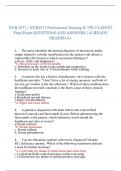
NUR 2571 / NUR2571 Professional Nursing II / PN 2 LATEST Final Exam QUESTIONS AND ANSWERS | ALREADY GRADED A+
NUR 2571 / NUR2571 Professional Nursing II / PN 2 LATEST Final Exam QUESTIONS AND ANSWERS | ALREADY GRADED A+ 1. The nurse identifies the nursing diagnosis of decreased cardiac output related to valvular insufficiencyfor the patient with infective endocarditis (IE) based on which assessment finding(s)? a.Fever, chills, and diaphoresis *b. Blood pressure of 85/48 mmHg c. Petechiae on the inside of the mouth and conjunctiva d. Increase in heart rate of 15 beats/minute while walking. 2. A patient who has a history of pulmonary valve stenosis tells the healthcare provider, “I don’t have a lot of energy anymore, and both of my feet get swollen in the late afternoon.” Which of these problemsdoes the healthcare provider conclude is the likely cause of these clinical findings? a.Acute pericarditis b.Peripheral arterial disease c.Deep vein thrombosis *d. Right side heart failure 3. A patient is diagnosed with heart failure and is prescribed digoxin (Lanoxin) and furosemide (Lasix).Before administering the furosemide to the patient, which laboratory result should the healthcare provider to review? a.Serum calcium *b. Serum potassium c. Serum sodium d. Serum phosphorous 4. You are educating a patient with newly diagnosed Vitamin B12 deficiency anemia. Which of thefollowing statements indicate a need for further teaching? *a. I will limit my intake of dried beans and citrus fruit. b.I will drink fluids with electrolytes while exercising. c.I will increase my intake of animal proteins and eggs. d.I will keep my follow up appointment with my provider. 5. You are providing patient education on their new medication, Amlodipine (Norvasc). Whichstatement by the patient indicates patient understanding? a.I will weigh myself daily at the same time every day. *b. I will need to avoid grapefruit juice and grapefruit while taking this medication. c. I will need to avoid green leafy vegetables while taking this medication. d. I will take this medication only when I remember. 6. A nurse is assessing a client diagnosed with Buerger’s disease. While assessing this client andextremities, the nurse correlates which clinical manifestations with this disease process? *a. ulcerations on digits and complaints of claudication b.Cold and pale, with bounding radial and pedal pulses c.Cyanotic, with hyporeflexive distal deep tendon reflexes d.Brownish, with hyperreflexive distal deep tendon reflexes 7. Which intervention suggested to the client with Raynaud’s disease is aimed at preventing worseningcomplications? a.“Take oral vasoconstrictive agents when you have symptoms.” *b. “Wear warm clothing when exposed to cool temperatures.” c. “Avoid placing lotion on affected extremities.” d. “Check the pulses in your arms and legs daily.” 8. The graduate nurse is assessing her newly admitted client’s abdomen and notes a bruit uponauscultation. Which assessment technique by this nurse should be questioned in this client? a.Observe for movement of the abdominal wall b.Measure the client’s abdominal girth c.Assessing the client for abdominal and back pain *d. Palpate and document if artery is found to have doubled in size 9. A client with atherosclerosis asks a nurse which factors are responsible for this condition. What is thenurse’s best response? a.“Injury to the arteries causes them to spasm, reducing blood flow to the extremities.” b.“Excess fats in your diet are stored in the lining of your arteries, causing them to constrict.” *c. “A combination of platelets and fats accumulate, narrowing the lumen of the artery, reducing bloodflow.” d. “Excess sodium from hypertension causes
Document information
- Uploaded on
- January 18, 2024
- Number of pages
- 16
- Written in
- 2023/2024
- Type
- Exam (elaborations)
- Contains
- Questions & answers