

HSC 326 - exam 1 (practical) and exam 2 (written & practical stuff), Complete Solution
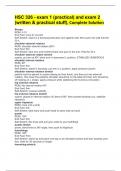
HSC 326 - exam 1 (practical) and exam 2 (written & practical stuff), Complete Solution Biceps ROM: 0-10 End Feel: none bc no joint Self Stretch: stand in a doorway/wall place arm against wall, then push into wall hold for 30 s. shoulder external rotators ROM: shoulder internal rotation (80º) End Feel: firm Self Stretch: take arm and it behind back and pull on the arm. Hold for 30 s. shoulder external rotator stretch supine, put arm at 90º, bend arm in downward L position, STABILIZE HUMEROUS shoulder internal rotators ROM: 90º End Feel: firm Self-Stretch: stand in doorway, put arm in L position, apply pressure (push) shoulder internal rotators stretch patient must be placed in supine (laying on their back), and then put into external rotation, this mean the patients shoulder should be on the table but their arm should be off making an L shape, apply pressure while stabilizing the humerus (shoulder) hip external rotators ROM: hip internal rotation 40º End Feel: firm Self-Stretch: reverse butterfly hip external rotators stretch supine, placed in internal rotation (X) bent at 90º, then pushed towards you, stabilize hip/pelvis upper trapezius ROM: none (not a joint) End Feel: firm Self Stretch: take hand and push head to same side as hand quads ROM: 150º End Feel: firm Self Stretch: flex knee and pull your ankle to your butt/thigh quads stretch prone, bend knee to 90º angle, then push to thigh/butt hamstrings ROM: 100º End Feel: Firm Self-Stretch: stand up and place one leg on an elevated surface and lean towards your foot. Hold for 30 seconds or longer. hamstring stretch: supine, (HCP gets on table) stabilize kneecap, lift leg straight up, place calf on your shoulder, push forward by leaning towards them. piriformis ROM: 100 End Feel: firm Self Stretch: figure 4 triceps ROM: 150-180 End Feel: firm Self Stretch: take arm straight up, bend it, and pull behind head. Hold for 30 seconds or longer hip adduction stretch lay on side away from you, stabilize pelvis, move top leg back until hip moves. Triceps Stretch go into elbow flexion, STABILIZE HUMERUS, then push elbow up. hip adduction ROM: hip abduction, 40º End Feel: firm Self Stretch: lay on the side of your on your side, allow the top leg to cross back and hang, this way gravity can assist and do all the work. stretch for 30 s gastrocnemius ROM: dorsiflexion, 20º end feel: firm self-stretch: set foot on table so heel is on it, then lean over and press on ball of foot. gastrocnemius stretch have patient sit up with legs straight and feet off the table, place your arm around/ against foot by holding heel and placing ball of foot against forearm and push back, stabilize knee cap shoulder flexion stretch prone, take one arm and bring it backwards in upwards motion while stabilizing the humerus and scapula (shoulder) shoulder flexion: ROM: 40º End Feel: firm Self Stretch: grab arm behind back and pull. Hold for 30 s shoulder extension ROM: 150-180 end feel: firm self stretch: walk fingers up wall, get until overstretched, hold for 30 s. shoulder extension stretch supine, make sure they are close enough to the table, STABILIZE HUMERUS, hold arm up until overstretch. hip extensors ROM: 100º End feel: firm self stretch: bring your knee towards your chest. Hold for 30 s hip extensor stretch same as hamstring but just bent leg- place patient in supine (laying on the back) take one leg and bend it into 45 degree angle and push back on it while stabilizing the opposite hip/pelvis what are the 4 types of muscle contractions isometric, concentric, eccentric, and isokinetic concentric contractions shortening of muscle eccentric contractions lengthening of muscle isometric contractions muscular contraction that increases tension but does not produce movement. (stays the same length example of isometric contraction plank, wall sit isokinetic contractions when a muscle contracts at a constant speed. doesn't happen in nature. (mechanical) when do isokinetic contractions occur? only occur when a muscle's max force of contraction exceeds the total load on the muscle. dynamic resistance exercise A type of contraction during which the muscle generates force by changing the length to move an object. can use concentric or eccentric contractions or both strength: the amount of force your muscles can produce to overcome resistance during a single maximum effort. strength training: systematic procedure of a muscle or muscle groups lifting, lowering, or controlling heavy loads (resistance) for a relatively low number of repetitions or over a short period of time what is power? strength and speed of movement and is defined as the work, produced by a muscle per unit of time. equation for power power = (force x distance) / time What is power training? Power can be enhanced by either increasing the work a muscle must perform during a specified period of time or reducing the amount of time required to produce a given force what is endurance? is the ability of a muscle to contract repeatedly against a load (resistance) generate and sustain tension resist fatigue over an extended period of time endurance training
Document information
- Uploaded on
- January 15, 2024
- Number of pages
- 9
- Written in
- 2023/2024
- Type
- Exam (elaborations)
- Contains
- Questions & answers


