
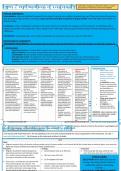
Conformity is changing your behaviour/ belief as a result of
group pressure. The pressure can be real or imagined
TYPES OF CONFORMITY
COMPLIANCE There IS a change in public behaviour SHORT TERM
Internalisation- when an individual is exposed to the views of a group, they validate/ examine their own. They may convince themselves
that the group is right, and they There ISNTLeads
are wrong. a change in private
to private behaviour
and public acceptance of group’s beliefs- they internalise these beliefs= an
attitude change
IDENTIFICATION SHORT TERM IN PRESENCE OF GROUP
Compliance- when an individualThere IS atochange
is exposed in public
the views/ actions behaviour
of a majority, the engage in social comparison. As identifying with a
majority is desirable, they change their views/
There actions in
IS a change to private
fit in withbehaviour
them. They go along with the majority without analysing why there is
a difference
INTERNALISATION
Identification- associating with aThere IS a change
role model in public
and adapting behaviour
your behaviour because youLONG
wantTERM-CONTINUES
to be like them. WITHOUT GROUP PRESENT
EXPANATIONS OF CONFORMITY
There IS a change in private behaviour
Informational social influence- where people conform because they lack information in a particular situation, so they look to others for
guidance
6 ETHICAL ISSUES
Normative Protection from harm-
social influence- Zimbardo
instances didn’tsomeone
where interfere when guardsinwere
conforms physically
order to fit in violent
and gain approval or avoid disapproval from other
Right to withdraw- was not given to participants even though it should’ve been allowed
group members- leads to conformity.
Confidentiality- filmed, identities released- participants cannot live a normal life anymore
Fully informed consent- the participants were arrested without consent, didn’t know they were selected for the study
Deception- the guards were told they were ‘chosen’- inflammation of sadistic personality (enjoyment of inflicting pain)
Debriefing- spoken to participants on ‘how they played their part’ – do they need counselling
DEINDIVIDUATION
LeBon (1896)- when
individuals lose their
identity, a collective
mindset is created, and
the group can become
‘mob like’
P- STRENGTH- Le Bon’s
theory on mob mentality-
Z’s thesis- individuals feel
less identifiable in a
group, so the normal
constraints that prevent
aggressive behaviour
may be lost.
Taking away someone’s
humanity- easier to
inflict paint
P, STRENGTH- Z’s
experiment provided
meaning to Abu Ghraib
OBEDIENCE- where someone acts in
response to a direct order, usually
from an authority figure
It all started with Adolf Eichmann. He was labelled as the man who masterminded the actual organisation of the holocaust. He said “I
was only following orders”. He is known as the holocaust architect of death.
ETHICAL ISSUES
DECEPTION- they were told that the
learner was being shocked when in
reality they weren’t even being
harmed.
, 65%- No male-female differences in obedience were found.
Although females did report feeling more stressed than men.
This implies that differences in gender is not a major factor in
obedience to authority.
This was because the teacher could experience the pain being inflicted on the
learner directly.
Without a prestigious setting the experiment does not feel as important or serious
and ppts can be more relaxed.
No physical authority figure present = less pressure. Teachers were under less
scrutiny and experienced less fear.
They used the judgement of their peers as a reason for causing further harm to the
victim.
HOFLING ET AL (1966)
Nurses working in a hospital
were phoned by an unknown
doctor & asked to administer
a drug to a patient. Doctor
said they would sign the
paperwork later. To obey the
request, nurses would have to
break hospital rules. Dose was
also twice the maximum on
the label.
21/22 NURSES
ADMINISTERED THE
DRUG. Conclusion – Levels
of obedience to authority
were high in this real-life
setting.
1956- Asch
123 male American participants, line test (ppts asked to point out shortest/longest line etc)
12 critical trials, 37% of the responses made by true ppts were incorrect, they conformed to the responses
given by the confederates- he found people only made mistakes 1% of the time.
He then carried out a number of variations of his original study to find out which variable has the most
significant effect on the level of conformity shown by participants.
Asch carried out a number of variations of his original study to find out which variable has the most significant effect on the level of
conformity shown by participants
This research has identified several situational variables, that is, qualities of an environment that influence levels of conformity in
individuals
AO1:
Group size: Unanimity: Task difficulty:
Conformity rates increase as the size of To what degree the group members are in Conformity increases when task difficulty
the majority influence increased agreement with each other increases, as the right answer becomes less
But there comes a point where further Conformity rates have been found to obvious (confidence in own judgement
increases into the size of the majority increase when majority influence is drops)
doesn’t lead to a further increase in unanimous This means that individuals will look to
conformity Asch found that when the participants were others for guidance as to what the correct
However, under the pressure of a given the support of another participant or response is, suggesting that ISI is a dominant
majority of three conformity increased to a confederate instructed to give the right force
30%. answers throughout, conformity dropped, Asch increased task difficulty by making the
Adding extra confederates (up to 15) had reducing the percentage of wrong answers comparison lines similar, so the correct
no further effect on the overall to 5.5%. Conformity dropped considerably answer was less obvious. He found
conformity rate down to 5% participants were more likely to conform to
He concluded that breaking the group’s the wrong answer
consensus was one of the main influences
in conformity.


